

























This article was first published on Deythere.
- What the Pilot Will Cover – Details and Scope
- Why This Matters – Institution Access, Capital Efficiency and U.S. Competitiveness
- Industry Reactions
- What Comes Next
- Conclusion
- Glossary
- Frequently Asked Questions About CFTC Crypto Collateral
- What are the eligible digital assets that may be used as margin for the new CFTC pilot?
- When will this pilot begin and who can participate in it?
- What are the conditions companies have to fulfill in order to use crypto as collateral?
- Does this suddenly mean that stablecoins are broadly accepted in U.S. derivatives markets?
- References
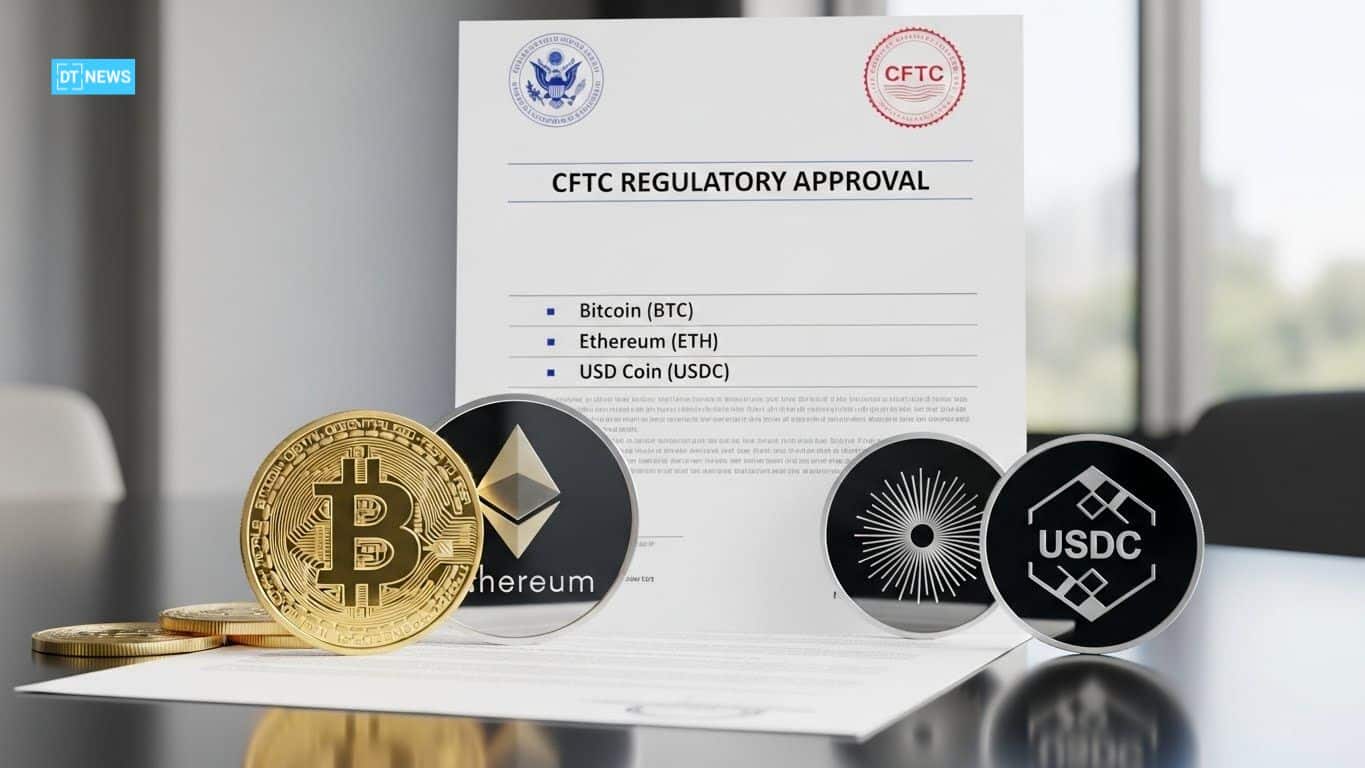
The CFTC has become one of the first US regulators to approve a pilot program aimed at enabling licensed firms to use cryptocurrencies, including Bitcoin (BTC), Ethereum (ETH) and USD Coin (USDC), as collateral for derivatives.
The new rules will allow futures commission merchants (FCMs) to accept tokenized crypto and certain stablecoins for margin, under strict reporting and custodial conditions.
The pilot project is intended to balance innovation with oversight, ultimately creating a pathway for institutional adoption that doesn’t sacrifice strong risk management, the regulators said.
What the Pilot Will Cover – Details and Scope
BTC, ETH and USDC are now available as crypto collateral for derivatives contracts under the pilot program. FCMs that are signed up must publish weekly reports about their digital-asset holdings per account class and notify the CFTC immediately of any issues they face.
The guidance further applies to tokenized traditional assets, such as U.S. Treasuries and money-market instruments, whose custody, valuation, and segregation have been specifically defined; therefore, they may qualify to be used as collateral.
The new rules also override previous regulations. A guidance issued in 2020 that restricted the collateral amount of virtual currency was being rescinded, as past constraints are now considered obsolete in the age of the GENIUS Act.
Why This Matters – Institution Access, Capital Efficiency and U.S. Competitiveness
This pilot program removes a major barrier for institutional investors. The CFTC is effectively building a crypto bridge to legacy financial markets as was done with traditional markets by permitting the use of crypto assets in a regulated derivatives market.
Now, those institutions that had crypto holdings on-chain can pledge these assets directly, no more needing to convert to fiat or treasuries before engaging in derivatives trading.
In a statement, Acting Chair Caroline D. Pham said the move is part of “America’s Golden Age of Innovation and Crypto,” and that safe, regulated U.S. markets must provide modern, efficient collateral solutions, especially in light of recent hiccups with non-U.S. S. crypto exchanges.
For the wider market, this might make capital more efficient: margin requirements may contract, settlement friction could collapse, and liquidity could flow more freely even outside regular market hours.
Stablecoins, such as USDC, enable near-instantaneous settlement, which could help alleviate liquidity squeeze risk in after-hours or volatile hours that may benefit traders and firms.
Industry Reactions
The industry is responding and quickly. Some top firms lauded the pilot, according to the CFTC announcement. Paul Grewal, the chief legal officer of Coinbase said the move was a confirmation that “stablecoins and digital assets can make payments faster, cheaper, and less risky”.
Other firms such as Circle, meanwhile, praised the regulatory certainty and said USDC and tokenized assets could now take on starring roles in advanced margin, custody and settlement functions.

What Comes Next
The pilot begins immediately. As a first step, only BTC, ETH and USDC can be used as collateral under certain conditions.
FCMs are required to satisfy certain segregation, custody and reporting requirements.
Protocols that applied successfully during the pilot will be eligible for faster consideration, and after six months, the CFTC can assess the results and add to what’s permissible potentially by allowing tokenized real-world assets or stablecoins besides USDC or cryptocurrencies beyond those three they’re considering now.
Conclusion
The introduction of the crypto collateral pilot at CFTC is a welcome development in modern U.S. financial regulation.
The agency has opened a door that was previously firmly closed to many institutional and legacy financial market participants via permissioning Bitcoin, Ethereum and USDC as collateral in regulated derivatives markets (as well as by providing clear guidance on tokenized assets).
With regulatory guardrails, reporting requirements and oversight in place, this pilot could help speed adoption, reduce friction and cost, as it integrates crypto more deeply into mainstream finance.
Glossary
Collateral – Assets pledged to secure a loan or derivative position, permitting borrowing and leverage.
Futures Commission Merchant (FCM) – A foreign exchange company providing customer orders and accounts handling services in the futures and derivatives markets, including margin allocation and risk management.
Tokenized Asset : A real world asset (either physical or digital) that is represented on a blockchain or DLT, and can be transferred or traded much like a crypto token.
Margin – The funds or securities covering potential losses from open positions.
Derivatives Market – A financial market in contracts where the value is derived from the basic asset (e.g., futures, options).
Frequently Asked Questions About CFTC Crypto Collateral
What are the eligible digital assets that may be used as margin for the new CFTC pilot?
The pilot’s first phase allows the use of Bitcoin (BTC), Ethereum (ETH) and stablecoin USD Coin (USDC). Tokenized assets from the real world may also benefit from this guidance.
When will this pilot begin and who can participate in it?
The pilot debuted on December 8, 2025. Futures Commission Merchants (FCMs) that satisfy the CFTC’s reporting, custody and segregation requirements are eligible to participate.
What are the conditions companies have to fulfill in order to use crypto as collateral?
Firms have to report weekly on their digital-asset holdings, properly segregate customer assets, and value collateral in compliance with CFTC guidance.
Does this suddenly mean that stablecoins are broadly accepted in U.S. derivatives markets?
For the time being, however, only USDC is specifically permitted in the pilot, partner assets are BTC and ETH. There could be development to other stablecoins or tokenized assets pending the evaluation.
References
Commodity Futures Trading Commission
TodayOnChain
Bloomberg
Bitcoinsensus