
























This article was first published on Deythere.
- How does the Cardano LayerZero integration work at a technical level?
- Why has Cardano historically faced interoperability friction?
- What does access to $80 billion in assets actually mean?
- Which asset categories could realistically expand on Cardano?
- How does this change the outlook for developers and users?
- What parallel infrastructure is being developed alongside this integration?
- How will success be measured over the next few quarters?
- Conclusion
- Glossary
- Frequently Asked Questions About Cardano LayerZero Integration
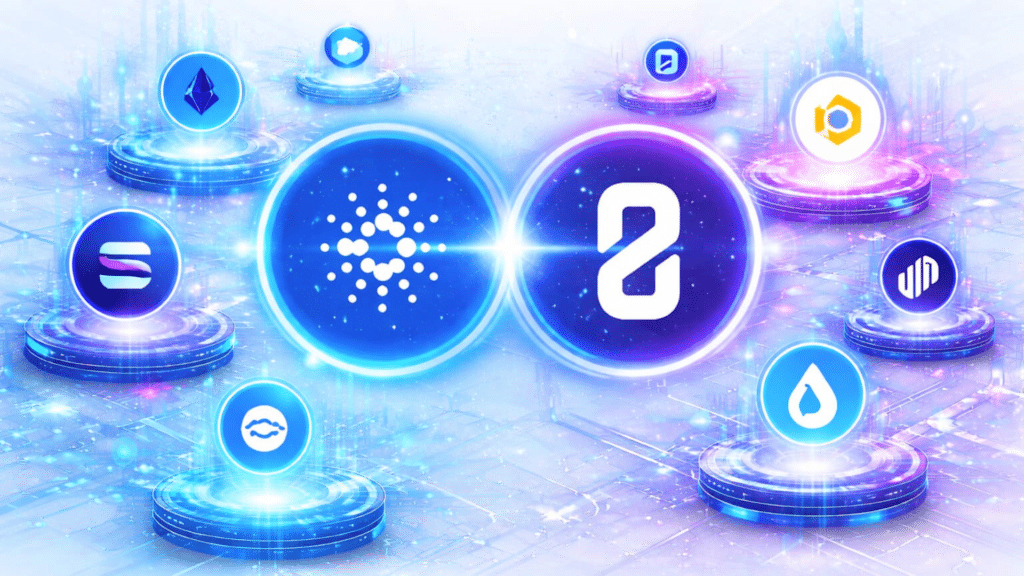
The Cardano LayerZero integration marks an important shift in how the network connects with the wider crypto ecosystem, opening a technical route to more than 400 tokens and over $80 billion in omnichain assets. Announced on Feb. 12, the integration is aimed at expanding Cardano’s DeFi capabilities without changing its extended UTXO architecture.
Instead of redesigning the network, the approach allows Cardano to interact with other blockchains through a shared messaging layer. This frames interoperability as core infrastructure for future growth, rather than a guarantee of immediate liquidity.
How does the Cardano LayerZero integration work at a technical level?
The Cardano LayerZero integration centers on deploying LayerZero Endpoint smart contracts on the Cardano network, with OFT-compatible token support planned as the next step. LayerZero functions as a chain-agnostic messaging system that already links more than 160 blockchains and has processed over $200 billion in cross-chain activity.

This setup enables Cardano-based applications to send and receive messages across different blockchain designs, including Ethereum, Solana, Base, Arbitrum, BNB Chain, Sui, and more than 140 additional networks. Importantly, this interoperability is achieved without requiring Cardano to move away from its extended UTXO framework.
Why has Cardano historically faced interoperability friction?
Cardano’s design is based on formal methods and a development approach that puts security first. Its extended UTXO structure, which shares roots with Bitcoin, focuses on clear and predictable outcomes. While this has improved network reliability, it has also made it harder to interact with account-based systems that dominate much of DeFi.
The Cardano LayerZero integration helps close this tooling gap by enabling cross-chain coordination through messaging endpoints instead of changing Cardano’s core architecture. This allows the network to engage with the multichain ecosystem while maintaining the principles it was built on.
What does access to $80 billion in assets actually mean?
The clearest asset-level impact of the Cardano LayerZero integration comes from the OFT standard. OFTs are designed to keep one shared token supply across multiple blockchains by using a burn-and-mint process, which lowers reliance on wrapped tokens and scattered liquidity pools.
More than 400 tokens already follow this standard, together accounting for over $80 billion in market value. While this does not mean liquidity moves to Cardano automatically, it does provide a practical route for these assets to expand onto the network if token issuers decide to deploy there.
Which asset categories could realistically expand on Cardano?
Supporters of the Cardano LayerZero integration highlight several types of assets that have historically been hard to use on Cardano at a larger scale. These include stablecoins, Bitcoin-linked liquidity, tokenized real-world assets, and core DeFi components such as lending assets, governance tokens, and liquid staking derivatives.
Many of these assets already operate across multiple blockchains through LayerZero’s infrastructure. The integration reduces the technical hurdles for issuers to expand onto Cardano, although whether they do so ultimately depends on market demand rather than technology alone.
How does this change the outlook for developers and users?
For builders, the Cardano LayerZero integration shifts development away from a single-chain mindset toward an omnichain distribution approach. Developers can build on Cardano while still accessing users and liquidity across LayerZero-connected networks, using the same application standards already in use across the wider ecosystem. For users, the change is more practical than technical.
Assets held on Cardano can move more easily into the broader crypto market, while assets from other networks can reach Cardano without complicated bridging steps. LayerZero’s Stargate product, the largest cross-chain bridge by volume, focuses on native asset transfers instead of wrapped-token structures.
What parallel infrastructure is being developed alongside this integration?
The Cardano LayerZero integration is part of a wider push to strengthen the network’s overall infrastructure. At the same time, Cardano is working on stablecoin development, deeper cross-chain connectivity, custody solutions, and tools designed for institutional use.
The goal is not only to make it easier for assets to come onto the network, but also to ensure there are reasons for them to stay and be actively used. This context is important, as interoperability by itself does not ensure lasting activity. Strong supporting infrastructure is still needed for trading, lending, and long-term capital use.
How will success be measured over the next few quarters?
The real measure of the Cardano LayerZero integration will be reflected in outcomes rather than connectivity alone. Stablecoin balances need to expand from the current level of roughly $37 million. Total value locked must show sustained growth from around $124.77 million, while daily DEX activity needs to rise beyond the current level of about $1.78 million.
If these indicators move together, interoperability will represent more than basic infrastructure. If they do not, Cardano will have improved its connectivity while reinforcing a familiar market reality: access creates opportunity, but demand still has to be earned.
Conclusion
The Cardano LayerZero integration represents the largest interoperability expansion in the network’s history, connecting Cardano to a messaging layer that already supports much of the multichain ecosystem. It preserves Cardano’s security-focused architecture while opening a clear technical path to hundreds of existing assets.
The integration strengthens Cardano’s ability to interact with other networks without changing its core design. Whether this development becomes a lasting turning point will ultimately depend on execution and real-world adoption.
Glossary
LayerZero: A system that links blockchains and lets them exchange data.
Omnichain Assets: Tokens available on multiple chains with one shared supply.
OFT: A token that shifts between chains by the burn-and-create method.
eUTXO: Cardano’s structured and secure way of processing transactions.
Cross-Chain Liquidity: Value that can flow across different blockchain networks.
Frequently Asked Questions About Cardano LayerZero Integration
How many tokens can access Cardano through this integration?
More than 400 tokens can potentially expand to Cardano through the LayerZero system.
What does the $80 billion figure mean?
The $80 billion refers to the total market value of tokens that use LayerZero’s OFT standard.
How does LayerZero connect different blockchains?
LayerZero uses a messaging system that allows blockchains to send and receive information between each other.
How can this integration help Cardano’s DeFi growth?
The integration can attract more assets and applications, which may increase trading, lending, and other DeFi activity.
Why did Cardano have problems with interoperability before?
Cardano uses a different system than many other blockchains, which made cross-chain connections more difficult.