

In a conventional IPO, companies sell shares to raise money and underwriters allocate the bulk of the shares to large institutional investors ahead of trading. Retail investors tend to be able to buy only once a stock is live on an exchange. This gap creates the “IPO pop,” where institutional buyers lock in a cheap price and then watch it surge, an initial gain retention that retail buyers miss out on.
Circle’s IPO, for instance, was priced at $31 but opened up on its first trading day at $69, closing at $83, with 168% first-day gains. That extra value went to insiders, not ordinary investors.
Wall Street’s I.P.O. procedure typically allocates early shares to large funds and brokerage clients rather than the public. The retail participants are left waiting, and often buying at much higher prices.
The On-chain IPO model seeks to remove that barrier by bringing the allocation onto blockchain platforms, allowing eligible users to subscribe at the offering price itself.
Blockchain-Based IPO Allocations
On-chain IPOs use crypto infrastructure to issue and settle stock at the time of IPO, while still complying with securities laws.
Backpack’s new service, built in partnership with blockchain company Superstate, aims to deliver tokenized equities on Solana to users’ wallets. Unlike stock “derivatives” on crypto, these tokens represent actual legal shares recorded in the official shareholder registry by an SEC registered transfer agent.
Real ownership: Each token is backed by a registered share. The Opening Bell platform from Superstate actually issues on-chain real legal shares, not simply synthetic exposure. In other words, a Backpack user’s token corresponds to one stock share in the company, and dividends and votes are managed through compliant infrastructure.
Faster settlement: On Solana, trades settle in minutes. Blockchain bookkeeping can serve faster than old clearinghouses and allow global investors to trade around the clock. The tokens are designed to be permissionless and stablecoin-like in composability, so they could flow seamlessly into DeFi apps or other exchanges once regulations permit.
Chain integration: Solana is the deployment platform, selected for high throughput and low fees. Superstate also works with Ethereum and Algorand, which is home to tokenized stock projects like WisdomTree’s Exodus fund.
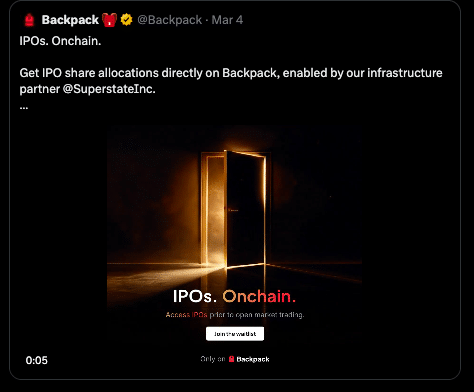
Backpack’s IPOs On-chain Service
Backpack’s IPOs On-chain product currently in waitlist/pre-launch enables users to reserve IPO shares before the public market opens. Key details:
Waitlist and eligibility: Interested users can register now. Access will be based on account activity and geographic eligibility. Early-stage plans target eligible non-US users under qualified investor and KYC rules. In actual sense, that means the U.S. and maybe other regulated regions might face limits. Backpack is licensed across Europe and collaborates with regulators.
Allocation Process: Underwriters would allocate a small portion of an IPO to Backpack as a ‘roadshow stop.’ When a deal is participating, Backpack’s platform gathers subscriptions on-chain. Backpack is issuing tokenized shares to qualifying wallets, at the official offer price, before trading on NYSE/Nasdaq opens. This isn’t a new Backpack IPO, this is real stock of the company going public.
Users Rights: These on-chain tokens hold the same rights as regular shares. The issuance is administered by Superstate’s SEC-registered agent, meaning any dividends, voting rights and future corporate actions would flow through standard channels before being recordable on-chain. The exact mechanics of rights delivery differ by deal and jurisdiction, however.
| Feature | Regular IPO | Backpack On-Chain IPO | Tokenized Stock Market |
| Price Point | Offering price for chosen institutions; retail buys at market. | Retail buys at offering price alongside institutions. | Market price after listing; no IPO-stage access. |
| Who Participates | Mainly institutional investors; some top clients. | Retail users (eligibility-gated) plus institutions if chosen. | Anyone holding tokens post-listing; generally after-market. |
| Settlement | Traditional clearing systems (T+1/T+2 days). | Instant, on-chain (via Solana/transfer agent). | On-chain/DeFi settlement, 24/7 trading (post-IPO). |
| Timing | Allocations before exchange open; retail only after open. | Shares delivered before trading starts. | Tokens available only after token issuance; secondary market. |
| Ownership Record | Centralized registry (Cede & Co); manual processes. | Blockchain registry + official shareholder records. | Blockchain ledger, but based on already-issued stock. |
| Regulation | Fully regulated (SEC, FINRA, etc.) | Compliance-first platform; SEC-registered agent. | Mixed: some platforms now SEC-compliant, others offshore. |
Rapid Growth of Tokenized Equities
Based on industry data, the value of tokenized US stocks and ETFs on blockchain is nearing $1billion, almost 30× more than a year ago. Three platforms (Ondo Global Markets, Kraken/Backed’s xStocks and Securitize’s Exodus) currently account for roughly 93% of that market. These assets allow investors to purchase traditional shares through crypto rails, in many cases around the clock, worldwide.
To that end, Binance worked with Ondo at the start of 2026 to provide tokenized IPO stocks listed on the Binance system from day one. In December 2025, Coinbase announced tokenized stock trading moving deeper into equities.
A big jolt came at the end of 2025. The U.S. SEC approved a DTCC pilot for tokenizing Russell 1000 stocks as well as Treasury ETFs. It also ruled that broker-dealers can custody crypto shares if controlled appropriately.
These changes reduce friction for institutional adoption. Nasdaq even offered to trade tokenized securities on its platform. All of this legitimizes blockchain stock settlement. Institutional rails are being built, but the focus is on retail inclusion
What This Means for Investors
On-chain IPOs could actually make access open for all. Currently, only insiders get first crack at IPO prices. By creating a window of opportunity for public investors to purchase shares in wallets prior to opening, retail participants could potentially hold on and benefit from gains previously difficult to access.
As noted by Backpack CEO Armani Ferrante, the platform wants to democratize what usually is a Wall Street-only affair known as the IPO roadshow for a “community tranche”.
Early retail adopters could buy stock at $31 rather than $69, leveling the playing field.
But experts warn that is neither guaranteed nor immediate for everyone. Participation is gated by regulators. Underwriters will only allocate to Backpack if its user base appears valuable.
According to Ferrante himself, “the more active and valuable our users, the more viable Backpack is as a venue for capital formation”.
In effect, issuers will treat Backpack as another investor if millions of engaged crypto users tune in.
This model, if it scales, could shrink the infamous IPO pop. Retail buyers may not have to watch large funds take early profits. It also puts pressure on traditional brokerages and underwriters to reevaluate distribution.
If nothing else, it points to a fact that crypto platforms (Backpack, Binance, Coinbase, etc.) are bridging TradFi and DeFi at speed with real asset tokenization.

Potential Challenges and Outlook
There are still a number of hurdles, however, despite all the hype.
First thing is eligibility. Backpack talks about “jurisdiction-specific KYC” and eligible investors. Retail in the U.S., for one, may be restricted at first by tough rules. Also liquidity, it is uncertain if Backpack tokens will be able to trade immediately at open or if transfers are restricted deal by deal. It will take time for the secondary markets to develop.
Furthermore, companies may be cautious. Issuers and underwriters have never invited open retail into allocations. Getting them to reserve stock for a crypto exchange’s community requires proving that it is large and involved.
But change will probably be gradual, deal by deal.
In some areas (e.g. Europe, Asia), tokenized share platforms are already live. The coming years may see a hybrid IPO process.
Conclusion
On-chain IPO access means bringing a real change in equity markets. Crypto platforms such as Backpack are looking to enable retail investors to purchase shares at the offering price with IPOs, potentially equalizing the divide between institutional insiders and average traders.
This will depend on tokenizing real but still SEC-compliant shares on blockchain networks (e.g. Solana), with licensed partners. If it works, the model could shrink the classic IPO pop and open new distribution channels.
However, experts say the roll-out will be cautious and controlled: early access could be restricted by geography, investor accreditation and user activity levels.
For now, on-chain IPOs are still an upcoming innovation that bridges DeFi and TradFi, one to watch closely.
Glossary
Initial Public Offering (IPO): The first sale of stock by a private company to the public on a stock exchange, providing capital to the firm.
On-Chain IPO: A blockchain-based IPO where shares are issued and settled on a blockchain network under regulatory oversight.
Tokenized Stock (Equity): A digital token that represents ownership of a real company share.
IPO Pop: The rise in a stock’s price on its first day of trading. It is the gap between the IPO price that was set by underwriters and the opening price in public trading, which often favors early investors.
Transfer Agent: A company that maintains a company’s stockholder data.
Frequently Asked Questions About On-chain IPO
What is an on-chain IPO?
An on-chain IPO means issuing and exchanging IPO shares on the blockchain but still following the rules of securities laws. Rather than trading solely through regular broker platforms, shares are sent as digital tokens in investors’ crypto wallets at the IPO price.
How does the new crypto IPO platform work?
Backpack’s “IPOs On-chain” service partners with Superstate to serve as a digital transfer agent. When a company goes public, underwriters might allocate some shares through Backpack, for instance. Then, eligible users on Backpack receive tokenized shares on the Solana blockchain before the stock starts trading. These tokens stand for real shares, allowing retail investors to effectively buy at the same offering price as institutions.
Am I guaranteed shares in an IPO at the offering price?
No. Access is not guaranteed. Underwriters dictate allocations and will engage with Backpack only if its user base is appealing.
Is this legal and regulated?
Yes, Backpack’s approach is compliance-first. They issue real shares through an SEC-registered transfer agent (Superstate). Unlike crypto exchanges or DeFi that create pseudo stocks, Backpack’s tokens are backed by legal ownership of stock. The platform complies with KYC/AML standards and geo-prohibitions.
How is this any different from trading tokenized stocks on other exchanges?
Most tokenized stock platforms (e.g. Binance, Coinbase, xStocks) are also allowing users to trade shares once they’re listed on the exchange. What sets Backpack’s service apart is that it takes the IPO allocation phase on-chain.