

This article was first published on Deythere.
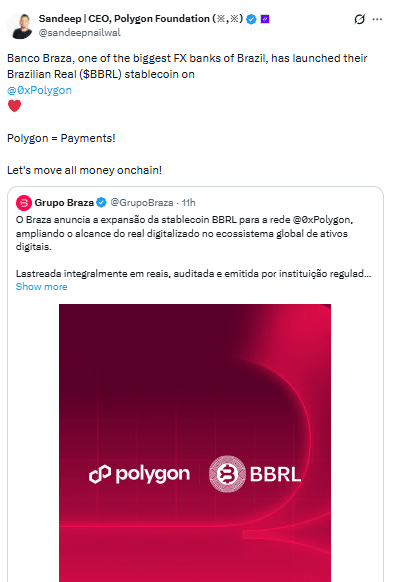
The BBRL stablecoin has entered a decisive new phase, and this time it is about scale, not experimentation. Banco Braza has officially expanded its Brazilian real-backed token onto the Polygon blockchain, signaling that regulated digital money in Brazil is moving beyond isolated systems into public blockchain infrastructure.
According to the source, Polygon Co-Founder and CEO Sandeep Nailwal shared the development on X, emphasizing that Polygon is increasingly being used for payments and on-chain value transfer. That remark underlines a broader trend. Blockchain networks are evolving from speculative platforms into payment rails for regulated institutions.
No Longer Confined to a Single Blockchain
The expansion marks a clear milestone. The BBRL stablecoin is no longer confined to a single blockchain setup. By launching on Polygon, it gains interoperability and broader usability across decentralized applications and payment systems.
This move strengthens Brazil’s position in the tokenization race. Rather than building a closed internal system, Banco Braza chose a public blockchain known for lower fees and faster confirmations. Polygon has gained strong traction in emerging markets, where payment efficiency and cost reduction remain critical. Industry research published through global financial studies shows that emerging economies are among the fastest adopters of digital payment infrastructure.
For Brazil, the shift represents infrastructure expansion, not a marketing upgrade.
What the BBRL Stablecoin Represents
The BBRL stablecoin mirrors the Brazilian real at a one-to-one ratio. Each token is fully backed by reals held off-chain, audited, and issued by an institution regulated by the Central Bank of Brazil. Regulatory clarity remains central to its credibility. Updates from Brazil’s monetary authority show the country’s steady progress in digital asset supervision.
Unlike volatile cryptocurrencies, the BBRL stablecoin is built for utility. Its design focuses on three distinct use cases.
- First, international transfers. The token supports cross-border settlements that can settle faster than traditional correspondent banking systems.
- Second, investment-related activity. Institutional and retail participants can use the token for structured financial flows and capital movement tied to real-denominated assets.
- Third, business payments. Companies operating in Brazil’s trade ecosystem can leverage blockchain settlement to improve cash flow efficiency and reduce intermediary costs.
This separation highlights the token’s functional purpose rather than speculative appeal.
FX Migration and Institutional-Grade Settlement
Braza Group’s crypto director, André Zachary, outlined a longer vision. The goal is to connect the Brazilian real with major blockchain networks and gradually move more foreign exchange activity on-chain.
That ambition points to something larger than a single token launch. It signals a shift toward institutional-grade settlement infrastructure. Foreign exchange markets handle trillions in daily volume worldwide. Even incremental migration of FX activity onto blockchain networks could reshape liquidity management and clearing systems.
The BBRL stablecoin becomes a bridge in that transition. Instead of routing transactions entirely through legacy banking rails, regulated digital tokens can facilitate real-time settlement with transparent audit trails.

Polygon’s Expanding Role in Emerging Markets
Polygon has increasingly positioned itself as payment infrastructure for emerging markets. Lower transaction fees and higher throughput make it attractive in regions where cost sensitivity remains high.
By expanding onto Polygon, the BBRL stablecoin gains access to a growing ecosystem of decentralized applications and payment tools. For Brazil, this aligns blockchain integration with practical economic needs rather than abstract innovation.
The network’s architecture allows faster processing compared to many traditional settlement channels. That improvement may seem incremental, yet for businesses managing recurring international transactions, small efficiencies compound quickly.
Conclusion
The BBRL stablecoin expansion is not about hype. It reflects a deliberate institutional decision to merge regulatory oversight with blockchain efficiency. Brazil is not abandoning traditional finance. Instead, it is extending it into digital territory with guardrails intact.
By moving beyond a single blockchain and embracing scalable infrastructure, the BBRL stablecoin signals a broader transformation. As more national currencies explore tokenization, regulated public blockchain settlement may become standard practice rather than a novelty.
For financial analysts, developers, and students of digital markets, the message is clear. The next phase of crypto growth may come from steady institutional integration, not speculative swings.
Glossary of Key Terms
Stablecoin: A digital asset designed to maintain stable value by backing it with fiat reserves.
Foreign Exchange (FX): The global marketplace where currencies are traded and exchanged.
On-Chain Settlement: Finalizing transactions directly on a blockchain ledger.
Emerging Markets: Developing economies experiencing rapid growth and modernization.
FAQs About BBRL Stablecoin
What is the BBRL stablecoin?
The BBRL stablecoin is a Brazilian real-backed digital token issued by a regulated financial institution.
Why is expanding beyond one blockchain important?
Multi-network availability increases interoperability, scalability, and broader ecosystem integration.
How does this affect foreign exchange in Brazil?
It supports gradual migration of FX settlement onto blockchain infrastructure.
Who benefits from this launch?
Institutional clients, businesses handling cross-border payments, and retail users in Brazil.