
This article was first published on Deythere.
- BlackRock’s Take: Tokenization Is the Next Big Leap for Market Infrastructure
- IMF’s Warning: Instant Settlement = Instant Risk
- Tokenized Market Reality at the End of 2025: Adoption Wins – Liquidity Worries
- What’s at Stake: Infrastructure Finance at a Crossroads
- Conclusion
- Glossary
- Frequently Asked Questions About Tokenized Financial Markets
- What are tokenized financial markets?
- Why is BlackRock supporting tokenization?
- What is the IMF warning about tokenized markets?
- Is the market for tokenized assets already large?
- Will the tokenization lead to more liquidity and transparency?
- References
Decentralized finance has taken off in recent years with the advent of tokenized markets where conventional financial assets are represented and traded on blockchain-based ledgers.
Already in late 2025, some of the world’s biggest financial firms are issuing tokenized funds, while regulators and global bodies sound fresh alarms.
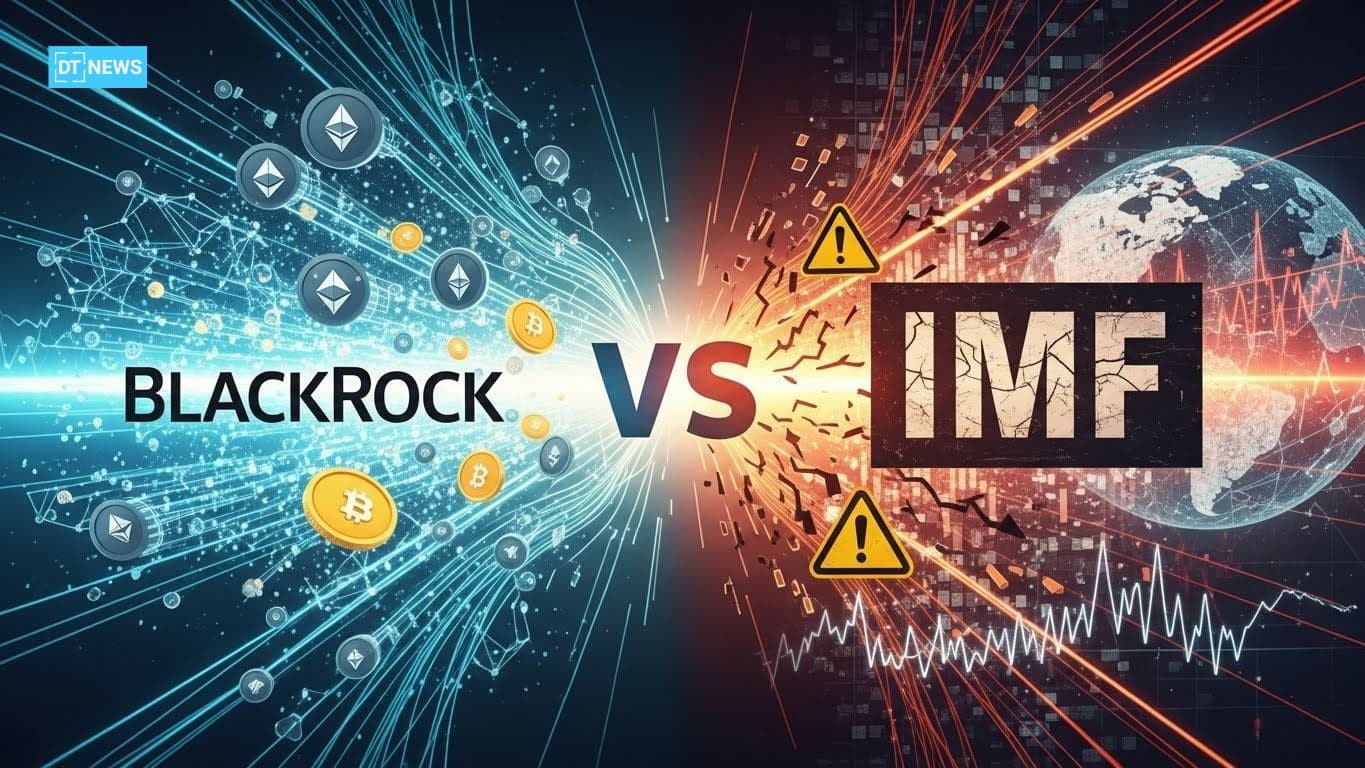
The contrast could not be starker: to BlackRock, tokenization stands for a transformation of the global financial infrastructure; whereas to The International Monetary Fund (IMF), it is a highway leading straight into an age of instability, precarious liquidity and risk-a-domino-chains-reaction.
BlackRock’s Take: Tokenization Is the Next Big Leap for Market Infrastructure
BlackRock’s leadership has vocally stated: Tokenization will be the most significant infusion into financial systems since the internet was conceived.
In a statement to the public in late 2025, the firm said that representing assets on programmable, on-chain ledgers could make settling trades more efficient and less costly while opening access to others.
The reason BlackRock is so keen on the formula rests on actual momentum. The total market size of the tokenized real-world asset (RWA) market, including bonds, corporate credit, and treasuries on record, surged to $33.84bn as of October 2025.
BlackRock’s own tokenized U.S. Treasury fund has emerged as a leader of on-chain institutional issuance.
Beyond sheer size, tokenization holds the attraction of structural benefits compared to legacy systems with near-immediate settlement, less counterparty intermediation, fractional ownership and computerized data-entry.
A report from one of Wall Street’s biggest firms issued to clients in 2025 made the case that tokenization could boost liquidity, reduce fees and make it easier for retail investors to gain access to traditionally illiquid assets such as private credit or real estate.
For BlackRock and firms like it, tokenized financial markets represent an overhaul of how assets are issued, traded and held in a digital-first world.

IMF’s Warning: Instant Settlement = Instant Risk
The IMF issued a warning: the move of Western countries and their central banks toward an instant settlement world where markets can clear in one to t minutes is fraught with risks.
The IMF, in turn, is sounding a loud warning. In November 2025, the institution released a working paper captioned Optimal Policy for Financial Market Tokenization that explored potential systemic risks of tokenized markets.
According to the IMF, tokenization introduces a liquidity paradox: when markets settle without delay relative to trade and with no netting, this removes the in-built mechanism for markets to smooth imbalances that are due simply to differences in timing of trade, or to absorb at short notice any shocks.
In a recent public video, the IMF cautioned that tokenized markets could “be more volatile than traditional venues” and highlighted concern about flash-crash-style events where interlinked smart contracts would behave like “falling dominoes.”
The fund also noted the danger of liquidity fragmentation if many tokenized platforms come into existence without interoperability, something that could serve to erode rather than support the advantages represented by tokenization.
Regulators have taken notice. The worldwide securities-regulatory umbrella body, IOSCO has recently put out a caution to the effect that tokenization ‘brings additional risks,’ particularly related to custody, settlement finality, and participant-default procedures should one or multiple service providers fail.
Tokenized Market Reality at the End of 2025: Adoption Wins – Liquidity Worries
New figures for 2025 reveal the tokenized finance markets are growing, though suffering from some structural frictions. As mentioned earlier, RWAs in tokenized form exceeded $33-34B last October.
Meanwhile, research from independent academia in August 2025 discovered that many tokenized real-world assets (TREAs) still maintain sluggish trading volume, secondary-market activity and liquidity despite their on-chain status.
The paper called “Tokenize Everything, But Can You Sell It?, explains that while in theory tokenization enables fractional ownership and 24:7 trading, many of the tokenized credit, real estate or bond instruments will have actual tradability constrained by regulatory gating, custody requirements, valuation opacity and missing broad decentralized trading venues.
The contrast between the headline market-cap sizes and real-world liquidity sets off some immediate questions: Are tokenized blockchains for finance really living up to their promise of immensely improved depth, or are they only a layer of record-keeping?
What’s at Stake: Infrastructure Finance at a Crossroads
The stakes for the world of finance could not be higher. If tokenized financial markets succeed on a grand scale, they might make for a faster, cheaper, and more inclusive system for issuing assets and trading them, including private credit, bonds, shares of real estate investments, and other previously illiquid instruments, as well as for settling transactions in near-instant time from country to country.
Tokenization, in other words, has the potential to mould the plumbing of global capital markets.
On the other hand, if adoption advances without strong regulatory standards, interoperability and protections for liquidity, speed and automation that have made tokenized markets so enticing may also act as vectors of dangerously rapid contagion.

Automated margin calls, interdependent smart-contract dependencies and cross-platform liquidity fracturing run the risk of cascading markets into flash crashes or systemic failures too quickly for traditional risk management to respond.
Besides, as the IMF working paper contends, relying only on public-private cost-sharing or market competition is not enough to ensure that there is a socially optimal outcome.
For now, only a mix of interoperability mandates, good regulation and public-private collaboration can create a sustainable environment for tokenized financial markets.
In other words, tokenized financial markets now stand at a fork in the road, with one path offering a world-leading modern global financial system, and another leading to fragmentation, poor liquidity and systemic risk.
Conclusion
Tokenized financial markets exist, are growing and have the backing of major institutions such as BlackRock. Momentum behind adoption is driven by clear improvements like quicker settlement, less friction, expanded access and the ability to programmably issue what users want.
At the same time, the dire warnings from the IMF and global regulators highlight serious structural risks: automated, composable trades; instant settlement that evaporates liquidity buffers; not to mention potential for unpredictable flash crashes or cascading failures across interlinked contracts and platforms.
If stakeholders, private firms, public regulators, and global institutions could somehow converge on sensible interoperable standards and disclosure rules, along with robust settlement safeguards, then maybe tokenized financial markets will find their promise fulfilled. If not, the very innovations in question could instead magnify ancient frailties at a machine-speed scale.
Glossary
Tokenized financial markets – Markets in which financial instruments like bonds, real estate or credit are represented digitally on blockchains/ledger systems.
Real-world assets (RWAs) – Traditional assets digitized into a token, like bonds, real estate or corporate debt.
Atomic settlement – Instant trade finalization without offsetting or delay, frequently through smart contracts.
Flash crash – A rapid and severe drop in the price of an asset that occurs over a short period, typically caused by automated trading systems or lack of liquidity.
Composability – The capacity for smart contracts or on-chain modules to interoperate and construct layered financial logic.
Liquidity fragmentation – Liquidity is spread over several platforms that are not interoperable: tradability and market depth decrease.
Frequently Asked Questions About Tokenized Financial Markets
What are tokenized financial markets?
They are markets where traditional assets like bonds, corporate credit or real estate are issued, traded or held as digital tokens on a blockchain- or ledger-based platform instead of over conventional securities-exchange and banking infrastructure.
Why is BlackRock supporting tokenization?
BlackRock sees tokenization as a cheap and low-friction means of settlement, faster and more efficient asset transfers, fractional ownership opportunity and greater market availability for liquidity when markets become illiquid.
What is the IMF warning about tokenized markets?
According to the IMF, programmable immediately-cleared markets may accentuate volatility, cause flash crashes, and propagate systemic stress via automated chains of contracts and thinner liquidity cushions.
Is the market for tokenized assets already large?
As of late 2025, the tokenized real-world assets (RWA) market had reportedly grown to about $33.8 billion including tokens that represent bonds private credit and treasury instruments.
Will the tokenization lead to more liquidity and transparency?
Not necessarily. Even though tokenization holds the promise of enhanced transparency and fractional ownership, research has found that many of the new tokenized assets indeed experience thin trading volumes, low secondary market activity, and fragmented liquidity.
References
IMF
Cointelegraph
Finance Magnates
The Coin Republic
CoinDesk
IMF
Cryptoslate