
The BlackRock Bitcoin prediction points to an important turning point for digital assets, as the world’s largest asset manager describes a future in which Bitcoin and blockchain-based finance grow in a way similar to major technological breakthroughs of the past. This view does not treat Bitcoin as a short-term or speculative idea.
- What does BlackRock’s outlook actually mean for Bitcoin’s future?
- Why is tokenization central to BlackRock’s view?
- How is institutional behavior reinforcing this forecast?
- What has Larry Fink said about Bitcoin’s role?
- How does this compare to earlier technology shifts?
- What should investors realistically take from this message?
- Conclusion
- Glossary
- Frequently Asked Questions About BlackRock Bitcoin Prediction
Instead, it presents Bitcoin as a long-term structural shift that is gradually forming across global financial markets. According to BlackRock executives, rising institutional participation, improving financial infrastructure, and the expansion of tokenization are the main factors supporting this outlook.
What does BlackRock’s outlook actually mean for Bitcoin’s future?
In simple terms, the BlackRock Bitcoin prediction shows strong belief in Bitcoin’s long-term adoption, not in short-term price changes. Company leaders indicate that Bitcoin’s growth path is similar to the early days of the internet, when adoption increased slowly at first and later became widespread.

They stress that this comparison is based on facts, not hype. The view comes from the fast pace at which financial institutions are adopting blockchain technology. As the most established digital asset, Bitcoin remains central to this broader transition in the financial system.
Why is tokenization central to BlackRock’s view?
BlackRock’s leadership sees tokenization as the main force pushing the digital asset market forward. At its core, tokenization means taking familiar assets such as bonds, shares, or property and placing them onto blockchain networks so they can be traded and managed more efficiently.
Within this framework, the BlackRock Bitcoin prediction places Bitcoin in a dual role. It stands to gain from this shift, while also acting as a foundational layer within it. As tokenized markets continue to take shape, analysts expect demand to rise for settlement systems that are secure and decentralized.
Several market observers argue that Bitcoin’s long-standing network and proven resilience give it a clear structural advantage as this transition unfolds.
How is institutional behavior reinforcing this forecast?
Institutional involvement in Bitcoin is now clearly visible. BlackRock’s iShares Bitcoin ETF has seen strong inflows, showing a shift in how large investors are choosing to enter the crypto market. Market strategists say this movement supports the BlackRock Bitcoin prediction.
As one digital asset analyst explains, institutions usually prefer regulated and familiar investment routes, and the growing demand for Bitcoin ETFs shows that Bitcoin is increasingly being treated as part of standard portfolio strategies.
The steady inflows also indicate that more cautious investors, who once stayed away from crypto, are becoming more comfortable with exposure through regulated products.
What has Larry Fink said about Bitcoin’s role?
CEO Larry Fink has on several occasions recognized Bitcoin’s growing role as a store of value. His comments support the wider BlackRock Bitcoin prediction, presenting Bitcoin as a hedge that fits within diversified investment portfolios rather than a standalone or speculative position.
Fink has also referred to increasing global monetary fragmentation as a reason why institutions are reconsidering alternative assets. From that perspective, Bitcoin’s decentralized structure is seen as strategically important, rather than experimental or unproven.
How does this compare to earlier technology shifts?
BlackRock executives compare the current digital asset market to the early days of the internet. At that time, adoption was slow, uneven, and often misunderstood, with many underestimating its long-term impact. The BlackRock Bitcoin prediction is based on this historical perspective.

Market analysts point out that major technologies rarely appear transformative at the beginning. Instead, they tend to grow steadily through improvements in infrastructure, regulatory clarity, and wider use by businesses, patterns that are now becoming visible across crypto markets.
What should investors realistically take from this message?
The key message is not about urgency, but about awareness. The BlackRock Bitcoin prediction points to Bitcoin moving away from the fringes and becoming a foundational part of the financial system. This view has also echoed across social platforms, where market participants are closely tracking BlackRock’s stance.
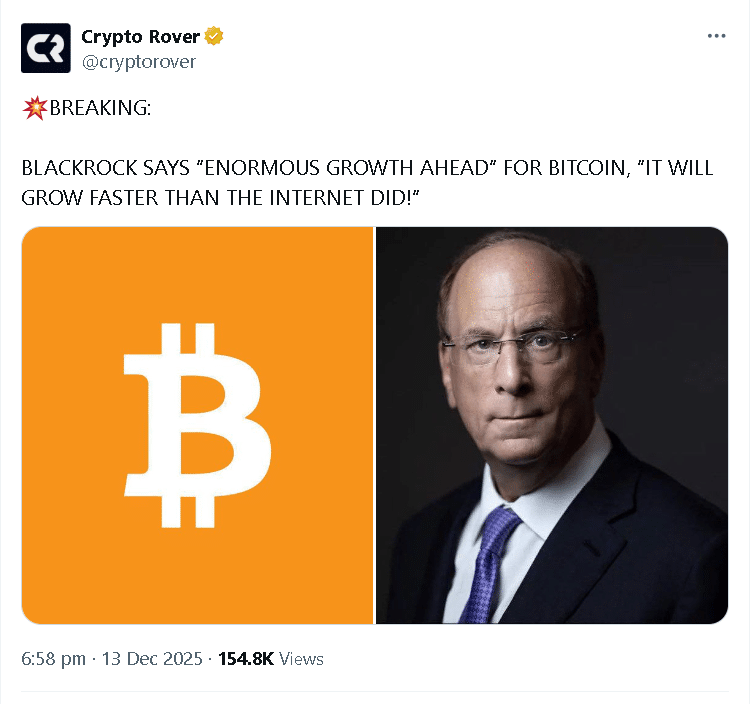
The sentiment gained wider attention after Crypto Rover highlighted BlackRock’s comments in an X post, noting expectations of enormous growth ahead for Bitcoin. As one portfolio manager explains, the focus is not on short-term gains, but on understanding the direction global capital markets are taking.
With regulated investment products expanding and blockchain adoption deepening, Bitcoin’s relevance is increasingly tied to broader, system-wide financial change.
Conclusion
BlackRock Bitcoin prediction highlights shift toward maturing asset class, rather than one driven by speculative excess. The assessment reflects growing belief that Bitcoin’s future will be influenced by institutional participation, stronger infrastructure, and deeper real-world integration.
As tokenization continues to develop and traditional financial systems adjust, Bitcoin’s role is likely to appear less controversial and more mainstream. For market participants, message is straightforward. This transition is already in motion. And its impact reaches well beyond the crypto market alone.
Glossary
Blockchain: A secure digital system that records transactions across many computers.
Tokenization: The process of converting real-world assets into digital tokens on a blockchain.
Bitcoin ETF: A regulated investment product that gives exposure to Bitcoin without direct ownership.
Store of Value: An asset that is expected to keep its value over time.
Decentralization: A system where control is shared across a network instead of one central authority.
Frequently Asked Questions About BlackRock Bitcoin Prediction
Why does BlackRock compare Bitcoin to the early internet?
BlackRock compares Bitcoin to the internet as adoption is slow at first but grows over time.
Does BlackRock see Bitcoin as a short-term investment?
No, BlackRock sees Bitcoin as a long-term change, not a short-term trade.
How are institutions supporting this outlook?
Institutions are supporting this outlook by investing through regulated products like Bitcoin ETFs.
What does BlackRock’s Bitcoin ETF show?
The Bitcoin ETF shows that large investors are becoming more comfortable with Bitcoin.
What has Larry Fink said about Bitcoin?
Larry Fink has said Bitcoin can act as a store of value in diversified portfolios.