

This article was first published on Deythere.
- Market Reaction and ETF Filing Fatigue
- 11 New ETFs Filed By Bitwise
- Why the Market No Longer Reacts to Filings
- Distribution, Not Documentation, Matters Most
- Conclusion
- Glossary
- Frequently Asked Questions About Bitwise Altcoin ETFs
- Why didn’t Bitwise Altcoin ETF filings affect crypto prices?
- What is a “strategy” ETF?
- When might these ETFs launch?
- Are these ETFs all spot products?
- Which matters most to ETF performance: filings or listings?
- References
Bitwise Asset Management just recently filed applications with the U.S. Securities and Exchange Commission for 11 new cryptocurrency “strategy” exchange-traded funds. Each proposed fund targets a specific token like Aave (AAVE), Uniswap (UNI), Zcash (ZEC), NEAR Protocol (NEAR), Sui (SUI), Hyperliquid (HYPE), Bittensor (TAO) and Tron (TRX).
The funds offer around 60 percent direct token exposure, with the balance representing an indirect stake through exchange-traded products and derivatives. Assuming approval, these ETFs will become effective by March 16, 2026.
However, this set of Bitwise altcoin ETF filings, unlike other comparable files submitted earlier, did not immediately create noticeable price moves throughout crypto markets. Instead, this news barely registered in terms of crypto asset prices and investor flows.
Market Reaction and ETF Filing Fatigue
Bitwise’s 11 new filings came in through a more mature and crowded crypto ETF ecosystem. No longer needing the 19b-4 regulatory approval with the SEC (a months-long process), given the generic listing standards brought in by the SEC in September 2025, commodity-based trust shares are also now liberated.
Spot and strategy crypto ETFs are now able to list under 60-75 days, if they meet certain criteria.
This has completely changed the way the market approaches ETF news. In the past, even news of an ETF filing would cause noticeable price action. But by the end of 2025, markets became accustomed to routine filings and traders priced in approvals long before public announcements.
ETF flows in 2025 confirm this much, as XRP products attracted over $1B in net inflows, Bitcoin ETFs saw more than $22B in the month, Ethereum into the low-$12B range and Solana products close to $800M, volumes which show a deep and sustained institutional interest.
Yet, this activity did not sharply respond to Bitwise’s filings.
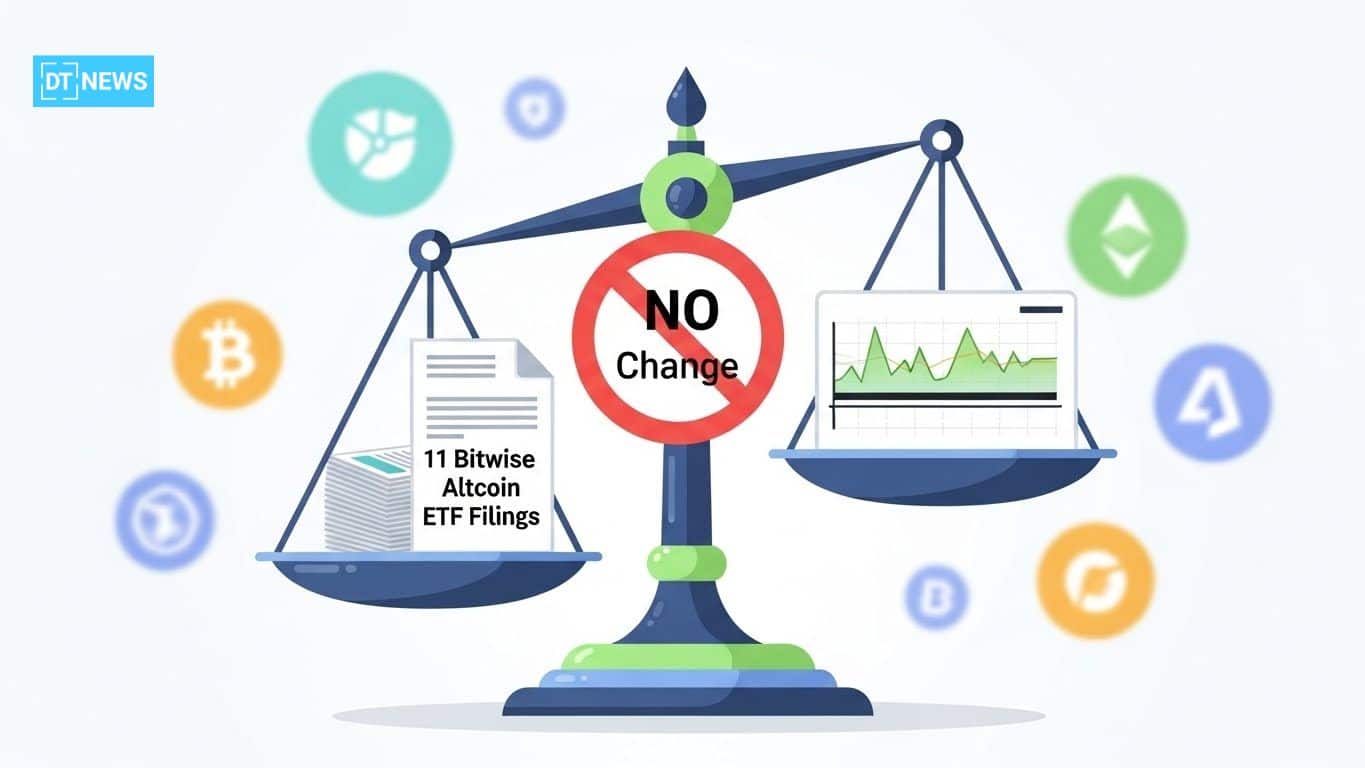
11 New ETFs Filed By Bitwise
Bitwise’s offerings span a wide range of altcoin exposure, each concentrated on a specific token’s performance and market rating. The ETFs are associated with funds linked to Aave, Uniswap, Zcash (ZEC), NEAR (NEAR), SUI, Starknet (STRK), Bittensor (TAO), Hyperliquid (HYPE),Ethena (ENA), Canton Network( CC ), and Tron(TRX).
Under the support documents, the funds would invest approximately 60 percent of assets directly in that cryptocurrency, with the remaining 40 percent going into ETPs or derivatives that are linked to the same token.
This hybrid structure maintains direct market exposure and complies with the SEC Rules.
The target effective date of March 16, 2026 is dependent on the SEC not objecting during its review period. These filings follow the foundation set by existing spot ETFs, including Bitcoin, Ethereum, Solana and XRP products now trading in U.S. markets that have garnered dozens of billions in assets together.
Why the Market No Longer Reacts to Filings
Several reasons explain why the filings for Bitwise altcoin ETFs failed to lead to price spikes or widespread inflows
For one, generic listing criteria has normalized the influx of new ETFs, lessening shock and immediate effect. These allow exchanges to list eligible products without the custom, old-style approval process, reducing time-to-market for issuers and ensuring an industry standard of future access.
Data also suggests that institutional interest is now largely focused on a few liquid low-fee products. For example, Bitcoin and Ethereum exchange-traded funds (comprising several funds each) also collectively account for the $153 billion in U.S. crypto ETP assets, with Bitcoin alone representing some $125 billion across around 60 ETPs.
Smaller or specialized altcoin ETFs can have a hard time competing for capital unless they have similar distribution partnerships.
Actual demand seems to react most strongly at listing or early asset accumulation points and not upon filing announcements. The Solana ETF experience demonstrates this. Bitwise listed its first U.S. spot Solana ETF which began trading on NYSE Arca on October 28, 2025 and raised approximately $420 million in its first week, such action is a visible event that moved capital and automatically, sentiment in the market.
Distribution, Not Documentation, Matters Most
While Bitwise’s filings confirm continued regulatory acceptance for crypto ETFs, the true proving ground for these proposed products is distribution and platform adoption.
Institutional investors and retail channels (like Vanguard, Charles Schwab, Fidelity, and the major wirehouses) largely decide where and how capital lands.
Notably, Vanguard’s move last year, in late 2025, to allow trading of third-party crypto ETFs on its platform, is an effective change in distribution access that could open up new sources of buyers for Bitcoin-, Ethereum-, XRP- and Solana-related ETFs.

But the firm does not have any plans to develop its own crypto ETFs and, instead, will focus on distributing third-party products rather than creating proprietary ones.
How much capital really flows into these new altcoin ETFs will depend on how issuer filings, exchange listings, fee structure, liquidity and distribution network support play out.
At this point, regulatory filings, even in large numbers, are just the beginning of that journey.
Conclusion
Bitwise’s 11 altcoin ETF applications on the 30th of December, 2025 is essentially an increase in the range of regulated crypto investments, which are being considered for launch in March, 2026.
However, the Bitwise altcoin ETF filings 2025 event didn’t ignite noticeable price action or any capital flow.
This is indicative of a market that has matured, where generic ETF routes to approval, existing spot vehicles for key assets and distribution dynamics now dominate investor mentality more than mere headline filing activity.
These altcoin ETFs will likely be successful if they are listed properly and there is platform support, a healthy fee environment, and liquidity, not just for filing.
Glossary
Exchange traded fund (ETF): A regulated investment vehicle that trades on a public exchange, offering exposure to assets without owning them directly.
Generic Listing Standards: Regulations by the SEC that would enable certain financial instruments like crypto ETF to be listed rapidly when they meet established criteria.
Exchange-Traded Product (ETP): A financial product that trades on an exchange and is linked to an asset or index.
Direct Token Exposure: A fund’s investment in cryptocurrency tokens themselves, rather than through derivatives or synthetic positions.
Flows: Capital going into or out of a product, measured in net inflows or outflows.
Frequently Asked Questions About Bitwise Altcoin ETFs
Why didn’t Bitwise Altcoin ETF filings affect crypto prices?
Given that the market today and the advancement of filings through the SEC’s generic listing standards, this limits a surprise re-action to new registrations.
What is a “strategy” ETF?
From Bitwise’s perspective, a strategy ETF maintains direct exposure to a token and, further, with positions in ETPs and derivatives, is constructed for regulated asset growth.
When might these ETFs launch?
The documents cite a potential effective date of March 16, 2026, assuming all regulatory hurdles are cleared.
Are these ETFs all spot products?
No. They use a hybrid structure that integrates direct token holdings with related ETPs and derivatives, not pure spot token ownership.
Which matters most to ETF performance: filings or listings?
Listings and opening asset-gathering activity usually stir prices and flows vastly more than the mere announcement of filing.