

























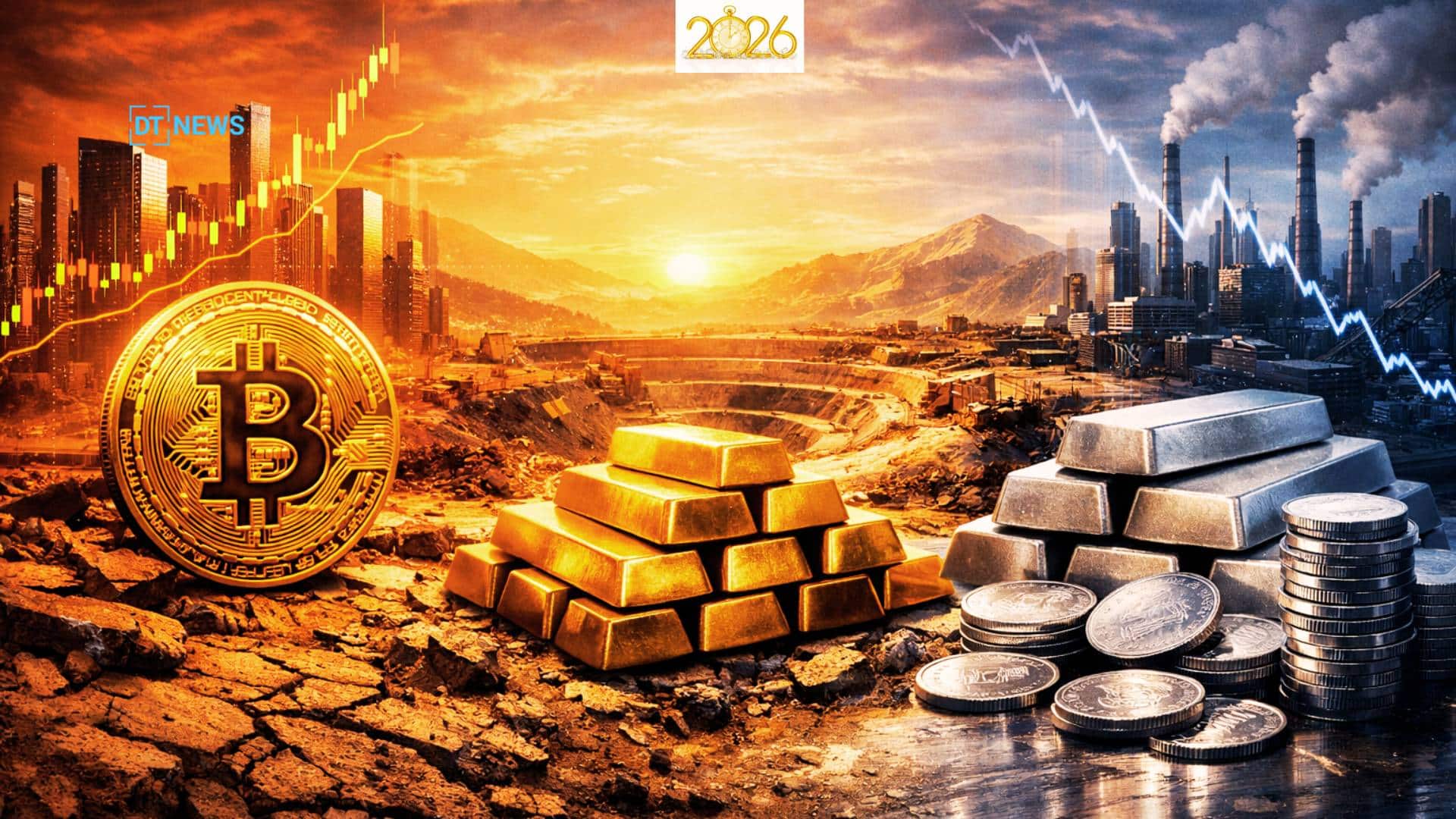

Repricing scarcity is influencing how investors are looking at Bitcoin, gold and silver in 2026, as shifts in market structure, investment access and financial narratives change how limited supply is understood. This market analysis shows that scarcity is no longer measured only by how rare an asset is, but by how well that limitation functions within modern financial systems.
- How has the meaning of scarcity changed in modern markets?
- How has Bitcoin’s scarcity narrative changed in 2026?
- Why is gold’s scarcity driven more by trust than mining output?
- What complicates silver’s scarcity profile?
- How do exchange-traded products affect scarcity perceptions?
- Why do derivatives blur the line between scarcity and abundance?
- Conclusion
- Glossary
- Frequently Asked Questions About Repricing Scarcity
Bitcoin, alongside gold and silver, is now assessed through liquidity conditions, institutional participation and evolving market frameworks rather than simple rarity. The shift does not highlight any single asset as the clear choice. Instead, it reflects a wider reassessment of how value is determined when scarcity intersects with derivatives, exchange-traded products and global portfolio strategies.
How has the meaning of scarcity changed in modern markets?
Scarcity in modern markets is no longer defined only by how limited an asset’s supply is. Investors now focus on credibility, liquidity and portability when assessing value. In earlier market cycles, scarcity was closely linked to physical production limits, which made gold and silver natural examples. Bitcoin introduced a different model, with scarcity enforced through transparent, rule-based issuance.

In 2026, repricing scarcity reflects how reliably scarcity is maintained, how easily investors can enter or exit positions, and how efficiently value moves across financial systems. This perspective is not about predicting returns. It explains how market views on scarcity have evolved and continue to adjust.
How has Bitcoin’s scarcity narrative changed in 2026?
Bitcoin’s scarcity remains unchanged, but the way it is reflected in markets has shifted toward financial channels. Its issuance schedule is public, predictable and capped at 21 million units, with supply growth slowing through programmed halvings. What has evolved is investor access. In 2026, a larger share of exposure comes through spot ETFs and regulated derivatives instead of direct on-chain ownership.
As a result, repricing scarcity in Bitcoin increasingly reflects liquidity management, hedging activity and derivatives positioning. Market participants note that Bitcoin is now often treated as a financial instrument within traditional portfolios, even though its underlying scarcity rules remain unchanged.
Why is gold’s scarcity driven more by trust than mining output?
Gold’s scarcity in 2026 is closely linked to its role as neutral global collateral. While extraction remains costly and reserves are limited, investors place less emphasis on annual mining output and more on gold’s institutional credibility. Central banks and long-term asset managers continue to view gold as an asset that is independent of sovereign debt and monetary policy.
Gold is traded through physical holdings, futures and ETFs, with each responding differently during periods of market stress. During times of geopolitical or policy uncertainty, repricing scarcity in gold markets reflects confidence in settlement reliability and legal recognition rather than concerns about supply disruption.
What complicates silver’s scarcity profile?
Silver’s scarcity is shaped by its dual role as both an investment metal and an industrial input. Unlike gold, silver is closely tied to manufacturing activity. Electronics, solar panels and advanced technologies make up a significant share of demand. As a result, industrial consumption can tighten supply even when investor interest remains limited.
Silver markets are also smaller and more sensitive to changes in futures positioning and inventory levels. Analysts note that repricing scarcity in silver often shows up through sharp price movements, reflecting the tension between physical demand and financial flows.
How do exchange-traded products affect scarcity perceptions?
They expand access and speed up price adjustments without altering the underlying supply. ETPs have changed how Bitcoin, gold and silver function within investment portfolios. Bitcoin ETPs bring a digitally native asset into traditional brokerage systems. For precious metals, ETFs convert physical scarcity into instruments that behave more like equities.
This structure allows scarcity to be traded, hedged and rebalanced more quickly. Short-term traders and arbitrage strategies now play a larger role, contributing to repricing scarcity as a market-driven process rather than a fixed condition.
Why do derivatives blur the line between scarcity and abundance?
They allow exposure without direct ownership, influencing prices without changing the underlying supply. Futures and options markets enable investors to gain exposure to Bitcoin and precious metals without holding them directly. Trading volumes in these markets often exceed the flow of physical or protocol-level supply.

These dynamics do not remove scarcity, but they influence how it is reflected in prices. In 2026, investors increasingly recognize that repricing scarcity must consider leverage, liquidity and market structure along with supply limits.
Conclusion
Repricing scarcity shows that scarcity is no longer a single, fixed concept. But a contextual one shaped by access, trust and financial structure. Markets are not choosing between Bitcoin, gold and silver as competing forms of scarcity. Instead, they are assigning roles.
Bitcoin is valued for its rule-based certainty and portability. Gold is trusted for its neutrality and reliability in settlement. Silver reflects its dependence on industrial demand and sensitivity to supply changes. In 2026, scarcity is no longer only about how limited an asset is.
Glossary
Repricing Scarcity: Setting an asset’s value based on access, trust, and market factors.
Derivatives: Deals to trade an asset without owning it.
ETPs: Tools that follow an asset’s value for easy trading.
ETFs: Funds that let you invest in assets indirectly.
Credibility: Trust that an asset’s scarcity and rules are reliable.
Frequently Asked Questions About Repricing Scarcity
How has scarcity changed in modern markets?
Scarcity now depends on credibility, liquidity, and portability. And not just on how rare an asset is.
How is Bitcoin’s scarcity different in 2026?
Bitcoin’s supply is still capped at 21 million, but investors mostly access it through ETFs and derivatives.
Why is gold’s scarcity based on trust?
Gold is valued for its neutrality, legal recognition, and reliability, not just mining output.
What makes silver’s scarcity unique?
Silver is used both as an investment and in industries, so demand can tighten supply even if investors are less active.
How do market structures influence scarcity?
Liquidity, futures, and derivatives affect how scarcity shows up in prices for Bitcoin, gold, and silver.
Sources