



This article was first published on Deythere.
- All-Time Highs in Gold and Bitcoin’s Ride Along
- Supply and Mining: Cap vs NoCap
- Market Size and Demand Rotation
- Volatility, Accessibility, and Use Cases
- What This Means for Bitcoin’s Rally
- Conclusion
- Glossary
- Frequently Asked Questions About Bitcoin vs Gold Differences
- How does Bitcoin’s supply compare with gold’s?
- What is the relation between Bitcoin and digital gold?
- Is gold’s rally bullish or bearish for Bitcoin?
- What are the dangers for Bitcoin?
- Is Bitcoin a store of value, like gold?
- References
Bitcoin and gold seem to be diverging differently, with Gold hitting all-time highs around$5,500-$5,600/oz while Bitcoin has been seeing tough times, even dropping to a low of 84,000 at the end of January 2026.
Analysts have commented that Bitcoin is behaving as a high-beta risk asset, rather than a safe-haven. However, there are some differences between Bitcoin and gold that may clear the way for BTC’s next leg higher.
Recent data has shown that over the past year, gold has shot up +100% or so while Bitcoin fell 13.3%. The contrast leads to one question: can Bitcoin catch up? In the end, the difference in Bitcoin vs gold says that if a fraction of demand for gold flows into crypto, it could lead to Bitcoin gains.
All-Time Highs in Gold and Bitcoin’s Ride Along
Gold’s surge is proof of a strong safe-haven demand. Gold’s price currently sits around $5,600 per ounce, largely due to central bank purchases and inflation worries.
Bitcoin on the other hand has been trading largely sideways. Over the 12 months through January 2026, the price of Bitcoin was basically flat or slightly down, while the dollar index fell 12%.
Strategists are saying that the dollar’s collapse is something that should drive safe assets higher, yet Bitcoin has lagged.
The U.S. Dollar Index (DXY) slid to 96.40, which tends to lift commodities and crypto. Many investors have been perplexed by Bitcoin’s refusal to take off.
SynFutures COO Wenny Cai says that, “Bitcoin’s recent stagnation reflects a market that’s trading macro first, narrative second,” which means Bitcoin’s been behaving less like a dollar hedge and more like a risky tech stock.
Yet to some investors, this creates an opening. According to Ben Caselin (VALR crypto exchange) traditional types of “old money” often flow into gold first in times of crisis, but one big acceleration by gold followed by profit taking is all it takes for a big Bitcoin surge.
In other words, quick moves by gold could also indicate capital rotating into Bitcoin. Prediction markets give a 65% probability that Bitcoin’s next major move might be up to $100k, not down to $69K.

Supply and Mining: Cap vs NoCap
One of the notable differences is supply mechanics. The total supply of Bitcoin is fixed at just 21 million BTC. By the end of 2025, approximately 93% of all BTC had been mined; inflation was running around 0.8% per year. Bitbo data cites that after the next Halving in March 2028, inflation could decline to about 0.41%. This built-in scarcity supply makes Bitcoin a predictable, low-inflation currency.
On the other hand, there’s no limit for gold. Gold miners can increase production as prices go up. For decades now, annual gold production has consistently risen (from 2,300 tonnes in 1995 to a record high of 3,672 tonnes in 2025).
In fact, as Bitcoin expert Pierre Rochard explains, “The problem with gold as a long-term treasury asset is that it lacks a difficulty adjustment and halving”. And he says higher prices for gold only prompts more mining projects, which dilutes the supply.
By comparison, Bitcoin’s mining schedule is hard-coded; more miners bringing in rigs cannot increase the issuance rate. This means that rising Bitcoin prices don’t inflate more supply, whereas rising gold prices tend to do so.
With declining Bitcoin issuance rates, BTC could increasingly behave as an even stronger hedge against inflation over time. Bitcoin’s capped supply means that even a modest increase in demand will lead to substantially higher prices, experts point out.
Market Size and Demand Rotation
Bitcoin has a market cap of just 4.3% of gold’s $41.7T, so even relatively small inflows have an outsized effect.
There is already a decent, established demand for gold (jewelry, central bank reserves, etc.), while Bitcoin still has a smaller market, which is also growing.
This difference in size is what gives Bitcoin its higher “beta.” Chief Risk Officer Jeff Walton says Bitcoin simply needs a “marginal allocation” of the gold-like demand to create outsized gains. For instance, if just a portion of investors’ capital flows from gold to BTC (a small fraction of its market), the resulting price effect for BTC can be massive.
Analysis projects a 116% price appreciation in BTC (to 192K) if only 5% of gold demand switches over into Bitcoin.
Some analysts see gold’s rally as “a leading indicator” for Bitcoin. In past times, big capital that came to gold, had moved out into other things when the gold cycle tops.
Now, with the continued fears of inflation, investors might shift from gold (which has already run) into higher growth assets such as Bitcoin.
Veteran analyst Eric He of LBank calls this “coiling for the next explosive leg higher,” saying Bitcoin is “poised to reclaim digital-gold status as adoption and clarity accelerate”
Volatility, Accessibility, and Use Cases
Bitcoin and gold also have contrasting levels of volatility and accessibility. Gold is predominantly a stable and low-volatility asset; Bitcoin is high volatility.
Gold’s 2025 gain (+52.8%) arrived with reasonably low volatility by crypto standards. Bitcoin’s ride is bumpier. Such high volatility means that Bitcoin can overshoot on rallies, but also risks deep drawdowns.
On use cases, gold is mainly a store of value and an industrial commodity. Bitcoin is often compared to digital gold, but it also functions as a network for moving money across borders and a speculative investment.
Bitcoin trades 24/7 across the globe with borderless wallets, gold requires storage and is less liquid, although there are gold ETFs.
These differences influence who has bought into each: tech-savvy and institutional investors have poured into BTC as a new asset class, while conservative buyers stick with gold and fiat hedges.
The regulatory environment also diverges. As of 2026, many countries have accepted Bitcoin with ETFs and ETPs, while others (e.g., China) have even banned cryptos. Gold is a far less restricted substance, legally. The presence of high-profile Bitcoin ETFs and stablecoin adoption are evidence that institutions are embracing crypto.
Some entrepreneurs, fund managers and investors see Bitcoin gaining acceptance as a legitimate investment over time, even usurping gold in some portfolios.
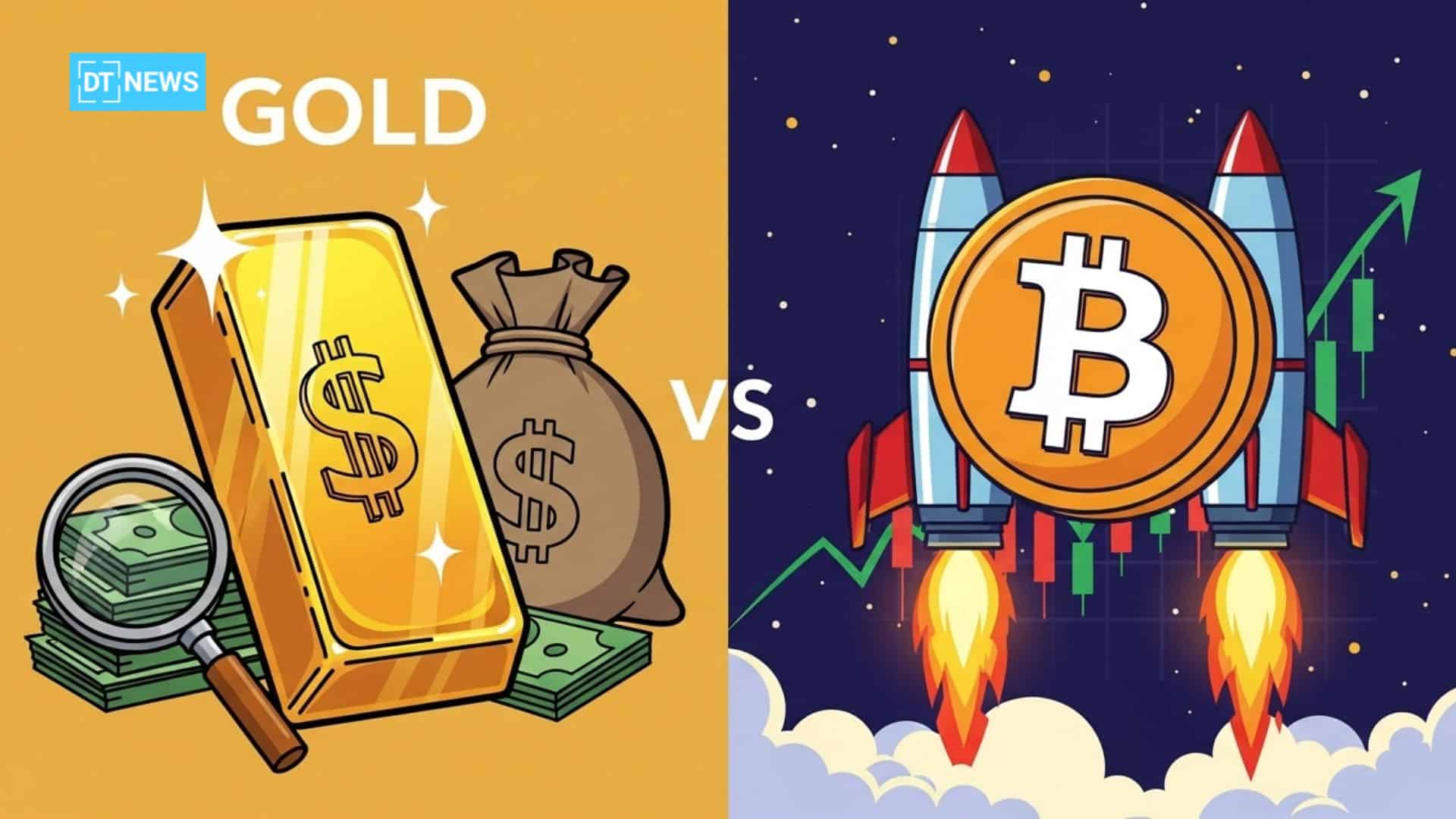
What This Means for Bitcoin’s Rally
The main differences that might favor Bitcoin would be its fixed supply in circulation, low future interest rate and very low market cap. With gold having recently exploded higher, analysts see a possible reallocation opportunity.
The point is made neatly by Ben Caselin who says when there’s a surge in gold, and investors begin to take profits, the proceeds often find their way into Bitcoin next. Hence, as the gold trade gets long in the tooth, Bitcoin could draw a fresh inflows.
Prediction markets and experts are already staking on this reality that the market is giving a 65% chance that Bitcoin’s next move is to $100K. Even a fractional repurposing of gold demand could make BTC higher.
Bitcoin vs Gold Comparison Table January 2026
| Category | Bitcoin (BTC) | Gold |
| Market Capitalization | $1.67 trillion | $40+ trillion (total above-ground supply) |
| Current Price | $84,000 per BTC | $5,500 – $5,600 per ounce |
| Supply Limit | Fixed at 21 million coins | No fixed cap; supply grows with mining output |
| Supply Inflation Rate | 0.81% annually (could drop to 0.41% post-2028 halving) | 1.5%-2% yearly depending on global mining |
| Regulatory Treatment | Varies by region; increasing ETF acceptance (e.g., U.S. and EU) | Universally accepted as commodity; minimal restrictions |
| Primary Use Case | Digital store of value, speculative asset, transaction medium | Physical store of value, jewelry, central bank reserves |
| Accessibility | 24/7 global trading via exchanges and ETFs | Traded via brokers, ETFs, futures, and physical dealers |
| Custody & Storage | Digital wallets, custodians, hardware wallets | Physical vaults, custodians (e.g., LBMA), ETFs |
| Correlation to Equities | Moderate to high (risk-on asset) | Low to negative (safe-haven asset) |
| ETF Adoption | Yes; U.S. spot Bitcoin ETFs launched in 2024 (e.g., BlackRock) | Yes; Established for decades (e.g., SPDR Gold Trust – GLD) |
Conclusion
Looking at the Bitcoin vs gold differences that could make BTC see a big rally, it is evident that Bitcoin’s design (limited supply, digital in nature, and smaller market size), gives it a huge potential.
Gold’s performance of 2025 could really set the tone for a Bitcoin rally and propel the prices higher if even a small portion of capital transitions from gold to crypto, where targets as high as $192K are considered in this scenario.
Although near-term price action of Bitcoin has been dull, these differences, along with rising institutional adoption, are telling the market that Bitcoin might see a breakout. More and more experts believe Bitcoin is coiling up for its next big move once conditions are ripe.
Glossary
Store of Value: A way to save and retrieve value in the future without much loss.
Halving: An event in the Bitcoin protocol that occurs once every four years which results in new BTC issuance being cut in half.
Market Cap: product value of an asset (price × supply).
Safe-haven asset: an investment that maintains or increases in value when markets go through a tumultuous period.
Frequently Asked Questions About Bitcoin vs Gold Differences
How does Bitcoin’s supply compare with gold’s?
Bitcoin has a maximum supply of 21million coins, halving every four years. There is no cap on gold, when prices go up, miners make more. This means Bitcoin is inflating slower and slower (to a predicted 0.41% after 2028), and the supply of gold can be increased with demand.
What is the relation between Bitcoin and digital gold?
Both are used as value stores. But Bitcoin is digital, scarce and borderless; gold is the physical asset that’s been traded for centuries. Lately, the price of Bitcoin hasn’t behaved like gold’s in that respect, prompting some to say that Bitcoin is more of a tech asset at this point.
Is gold’s rally bullish or bearish for Bitcoin?
Experts say it helps in the long run. A spike in gold price is a sign of inflation-hedging demand that eventually often migrates elsewhere. As Ben Caselin mentions, taking some of the profits from gold’s could trigger a Bitcoin rally. In essence, gold’s rally is being seen as an indicator that Bitcoin could soon follow.
What are the dangers for Bitcoin?
Short term Bitcoin’s volatility could bring it lower if risk appetite declines. Regulatory actions (banning or taxing) could also stamp it down. With that being said, if macro drivers (low interest rates, inflation, dollar weakness) persist there is a chance that the fundamentals for Bitcoin could overshadow this risk.
Is Bitcoin a store of value, like gold?
Typically, gold is the ultimate safe-haven. Bitcoin is younger and more volatile. At the moment, Bitcoin appears to have traded more like a risk asset but some investors see it as “digital gold” for the future.