

This article was first published on Deythere.
- The Debate: Takeaways from CZ vs. Schiff
- Utility, Scarcity and Verifiability: Why CZ Says Bitcoin Beats Fiat Money
- Where Gold Supporters Stand: Peter Schiff Defends the Old Ways
- Conclusion
- Glossary
- Frequently Asked Questions About Peter Schiff and CZ’s Bitcoin vs Gold Debate
- What was CZ vs Peter Schiff debate about?
- Does tokenized gold address gold’s problems according to Schiff?
- But what is CZ saying about the value of Bitcoin?
- Why does this Bitcoin vs Gold debate matter now?
- References
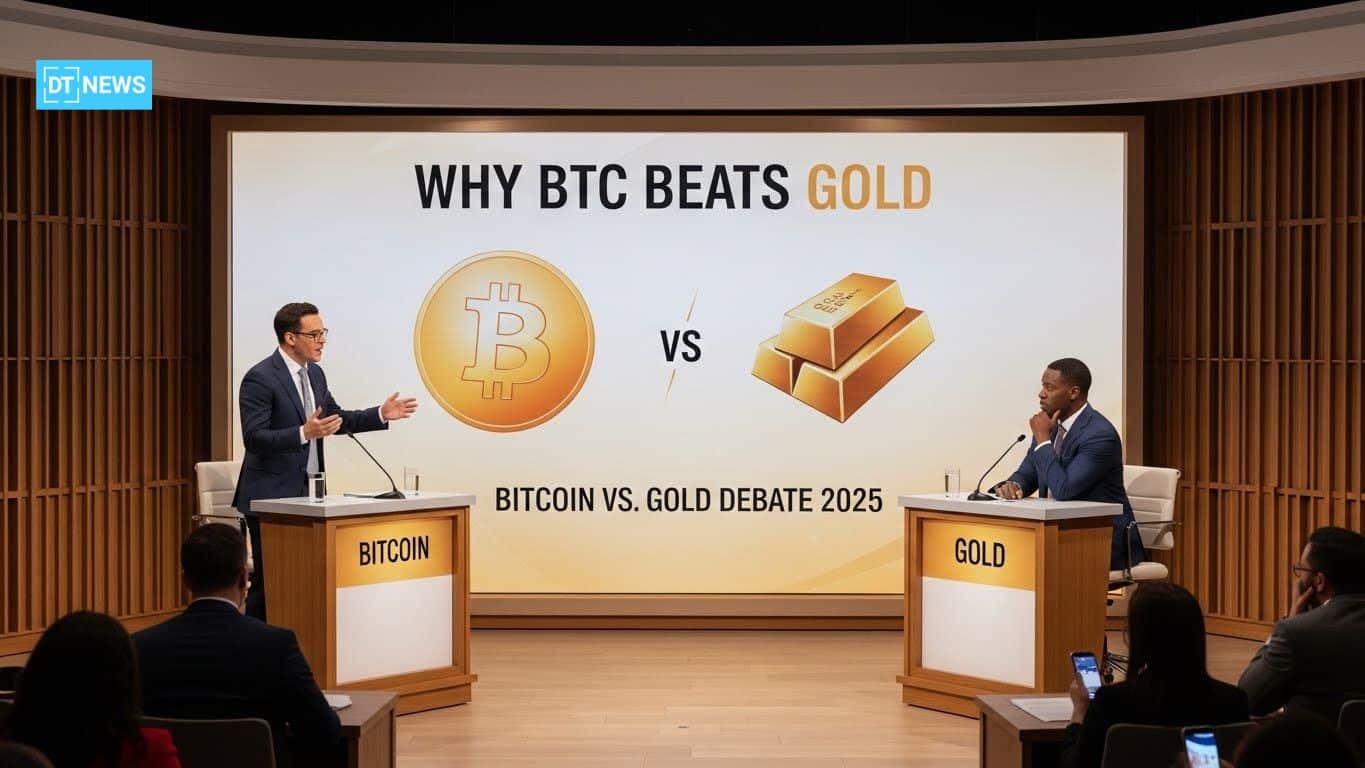
The Bitcoin vs Gold battle surfaced again at the Binance Blockchain Week 2025 in Dubai. The debate was a highly anticipated showdown between CZ and Peter Schiff.
Before a full audience, CZ questioned age-old assumptions on gold’s value by claiming that Bitcoin, with its transparent blockchain, unwavering supply, and increasing real-world utility, has already replaced gold as the future of money.
However, Schiff, an unflinching gold standard supporter, retaliated by pointing out Bitcoin does not have intrinsic value and is useless in real life. The showdown quickly became one of the most-followed money debates of 2025.
The Debate: Takeaways from CZ vs. Schiff
The debate was framed around a simple, on-stage test that ended up being quite powerful. CZ handed Schiff a gold bar stamped “999.9 fine gold, 1000 grams” and asked him to confirm whether it was authentic.
Schiff admitted, “I don’t know.” The crowd responded with laughter. From there, CZ took the opportunity to point out what he views as a fundamental flaw with physical gold: verifiability. In contrast, each individual that has a Bitcoin wallet can audit the BTC ledger immediately.
CZ expressed his sentiment simply:
“With Bitcoin, we know exactly how much there is, and we know exactly where they are.”
This level of transparency and certainty, he contended, has no equivalent in gold, for which total reserves (both mined and unmined) remain unknown.
From Schiff’s perspective, he rested on tradition and real value. He called Bitcoin “backed by nothing,” and said it does not have any real-world purpose other than for speculation.

He said gold’s value depends on centuries of trust, its physical properties and use as an industrial and ornamental item.
Schiff also defended tokenized gold, a value equivalent stored in a vault and represented on a blockchain, saying the technology combines gold’s historical qualities with modern liquidity and transferability. “Tokenized gold improves what already works,” he added.
But CZ was unrelenting: He described tokenized gold as a “trust-me-bros token” and shared that, just like anything else in the space, even tokenized gold is anchored on centralized vaults and promises by third parties. Bitcoin, on the other hand, has no intermediaries.
Utility, Scarcity and Verifiability: Why CZ Says Bitcoin Beats Fiat Money
CZ consistently presented Bitcoin as a new form of money made for the internet age, where value is digital, borderless and verifiable without intermediaries.
Many of the traditional virtues ascribed to gold such as scarcity, durability, store of value, are better replicated by Bitcoin’s fixed supply and open ledger, he argued.
Additionally, CZ mentioned that the Bitcoin (BTC) network already supports real-life use cases: peer-to-peer payments, cross-border remittances with crypt-linked debit cards, and remittance corridors in areas where there is a need for money to be sent and received quickly or cheaply, as traditional banking could be quite slow or expensive. Gold plays a limited role in such modern value flows, he added.
This utilitarian approach, CZ argued, illustrates why Bitcoin not gold, is “money for the 21st century.”
Participants and viewers characterized the Bitcoin vs gold debate as a collision of physical age-old trust and digital-native credibility.
Where Gold Supporters Stand: Peter Schiff Defends the Old Ways
Schiff’s defense of gold was an assertion that value has to be based on something real, intrinsic, historically proven. Bitcoin’s value was nothing but a matter of belief. He argued that the world has to believe in the digital scarcity or it loses its value.
That, he said, is a feeble basis for value compared with gold’s millenniums-deep legacy.
He emphasized that gold has useful attributes other than being a hard money, including an industrial use case or its value as jewellery and some role in traditional finance beyond mere speculation.
He believes that gold in tokenized form adds accessibility and transferability and does not do away with the core value proposition of gold.
Additionally, Schiff claimed that many of the people praising Bitcoin’s utility fail to account for the fact that merchants and consumers frequently convert BTC into fiat currency when they need to buy something in real life, making it seem as though Bitcoin is still a speculative asset rather than a practical medium of exchange for daily business.
His closing argument is that as long as existing cryptocurrencies are “digital only” and have no physical substance, no intrinsic industrial use, they cannot match the depth of gold’s market in serving as a store of value.
Conclusion
The 2025 Bitcoin vs gold debate at Binance Blockchain Week put in stark contrast two contrasting visions for the future of money.
CZ cast Bitcoin as the evolution of money, digital, transparent, decentralized and suitable for the modern age.
Schiff believes that gold remains the bedrock when it comes to value and that any sort of physical commodity backed by thousands of years of global confidence cannot be shook so easily.
In a world increasingly shaped by digital commerce, cross-border transactions and programmable finance, Bitcoin’s claims of verifiability, fixed supply, utility are persuasive. As CZ put it in the debate, “Value is not defined by physical form.”
This fight pings at a general question: what kind of money do we want for the future – metal locked in vaults, or bits secured to a global ledger?
Glossary
Verifiability – The capacity to cryptographically or otherwise be able to verify an asset’s authenticity and supply (as with Bitcoin on-chain).
Tokenized Gold – A digital token that represents ownership of physical gold stored in vaults. It is backed by the value of gold and can be transferred by blockchain.
Store of Value – An asset that holds its value over time and does not significantly depreciate (typical characteristic of safehaven assets).
Digital Asset – A type of asset whose transactions and value both exist in electronic form on a blockchain or distributed ledger.
Frequently Asked Questions About Peter Schiff and CZ’s Bitcoin vs Gold Debate
What was CZ vs Peter Schiff debate about?
They discussed which of Bitcoin vs gold (and tokenized gold) is a better store of value and future money. CZ pushed Bitcoin’s verifiability, scarcity and utility. Schiff pressed back with gold’s tangibility, millennia of history and intrinsic value.
Does tokenized gold address gold’s problems according to Schiff?
Schiff said tokenized gold combines gold’s value with blockchain’s ability to move and divide it, maintaining the inherent worth of a gold bar while making it easier to trade.
But what is CZ saying about the value of Bitcoin?
For CZ, Bitcoin’s fixed supply coupled with a transparent, visible ledger that can be audited “anytime and anywhere,” widespread adoption in every country and its utility that includes payments, remittance and global transfers make it a better, more modern money versus Menger’s shiny rock.
Why does this Bitcoin vs Gold debate matter now?
Because macroeconomic instability, growth of digital finance and increased interest in crypto have renewed investor interest in what constitutes “money.”
References
Cointelegraph
The Block
Cryptopolitan
Coinlive
Cryptonews
GNcrypto