
























Investors are behaving much differently toward Bitcoin vs Gold in the face of equal macro pressure. Bitcoin remains in huge institutional demand via its ETFs while Gold seems to be left to wallow in a bear market.
Gold was recently recorded to be trading at about $4,388 per ounce, a decline of 22% from its January high of $5,594.82. The sell-off worsened after the conflict in the Middle East, when prices dropped by about 17% during that period.
On the other hand; U.S. spot Bitcoin ETFs took in approximately $2.42 billion in net inflows over four weeks ending March 20.
Gold Plunges Into Bear Market as Liquidity Comes First
Gold’s drop now qualifies as a bear market in formal terms, with the metal losing more than 20% from recent peaks.
The decline has been pushed by a macro environment that has turned unfavorable for nonyielding assets. The Federal Reserve’s decision to keep rates at an elevated level has raised the opportunity cost of holding gold, and a stronger dollar has compounded that pressure.
The magnitude of this is confirmed by fund flows. Global gold funds recorded $5.19 billion in weekly outflows, the largest since 2018, and money market funds took up $32.57 billion for the week.
SPDR Gold Shares logged approximately $7.07 billion in outflows at the ETF level in March, surpassing prior record inflows set in 2013.
Despite the strong force with which gold entered 2026, its status as a safe-heaven asset is being overshadowed by demand for liquidity and rate expectations over the near term.
Bitcoin ETFs Complete Strongest Inflow Run in 2026
As gold got hit with heavy selling, institutional capital continued flowing into Bitcoin. U.S. spot Bitcoin ETFs have registered inflows for four consecutive weeks, amounting to over $2 billion with $2.42 billion coming in during the past four-week period, according to data.
Equity ETFs received in just one day, $167 million, again continuing the overall inflow. March brought in $1.5 billion to Bitcoin investment products worldwide, continuing the trend of steady demand.
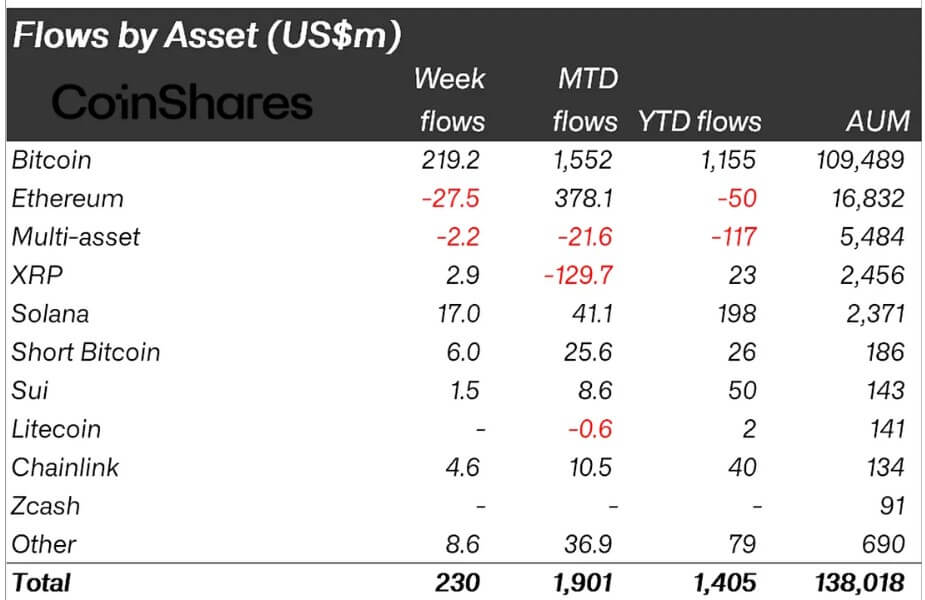
All of this is happening even as there’s uncertainty including war risks and changing rate expectations, indicating that institutions are treating ETFs as a reliable channel for exposure.
Correlation Break Signals Strong Divergence
One thing that really stood out this year was how differently both assets performed.
According to data from CryptoQuant, the Bitcoin-to-gold correlation fell to -0.88, its lowest reading since November 2022. That means the two assets are moving in opposite directions with unusual intensity.
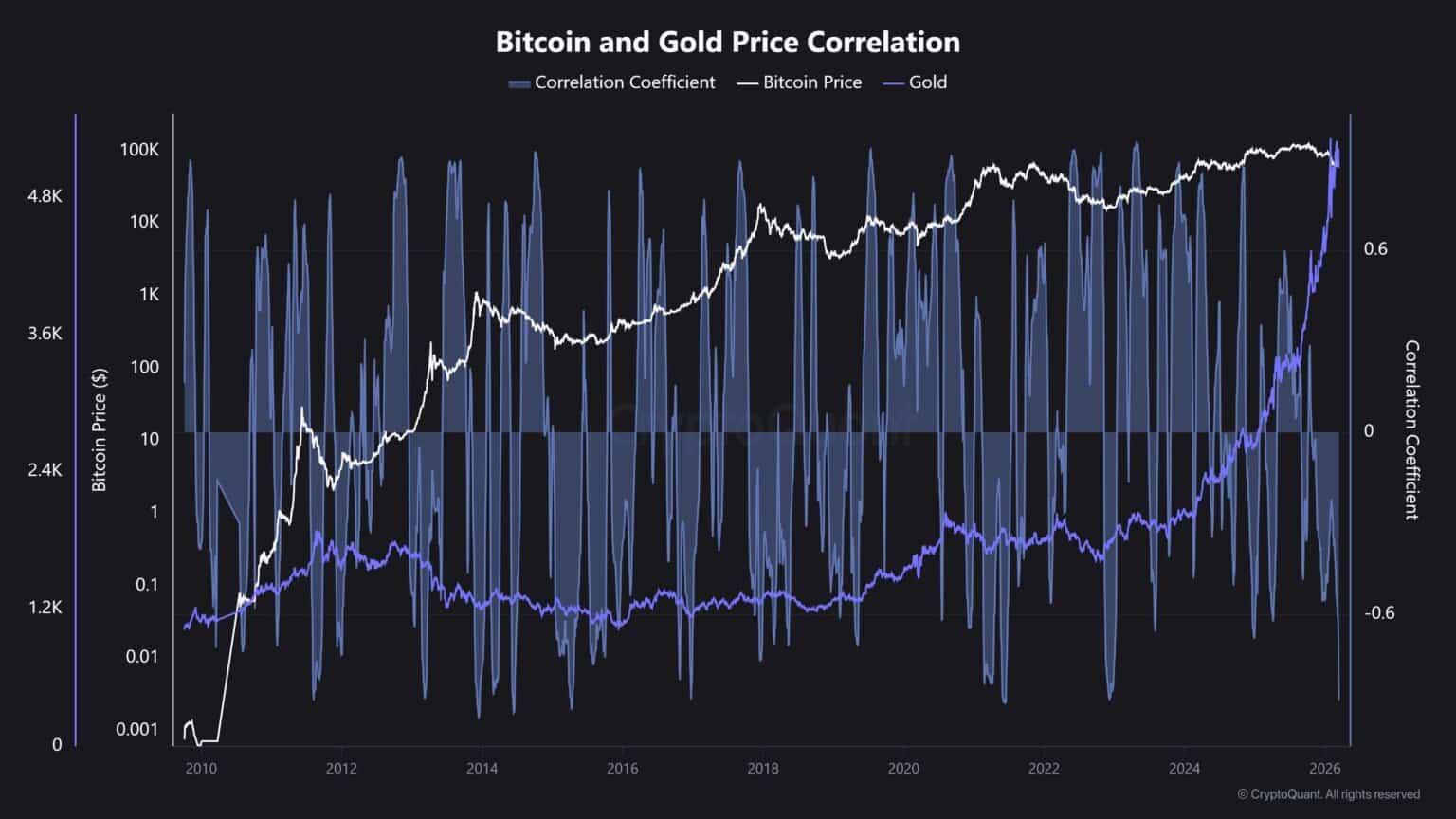
Both assets have been lumped together as hedges against inflation and currency risk. But the latest data indicates that investors have stopped viewing them as interchangeable.
Bitcoin and other major crypto assets have been outperforming U.S. equities and gold since early March, suggesting an early-stage capital rotation, according to Bitwise Asset Management.
However, the firm warned that gold has usually preceded Bitcoin by four to seven months, so this could prove temporary.
Macro Forces that Cause Bitcoin vs Gold Separation
The difference comes down to how each asset performs under macro conditions. High rates pressure gold directly, because they raise the cost of holding a non-yielding asset. Bitcoin, meanwhile, is more sensitive to liquidity conditions and institutional risk appetite.
This difference is confirmed by ETF data. In the last 30 days, Bitcoin ETFs saw net positive inflows while gold ETFs are experiencing record outflows, suggesting a clear capital reallocation.
Simultaneously, expectations for oil prices are climbing. Analysts at the likes of Bank of America and Standard Chartered have lifted Brent targets to $77.50 and $85.50, with scenarios for upside to even hit $130 should anything disrupt supply.
Higher oil prices would help keep inflation too high and force central banks to stay on restrictive policies; a phenomenon that continues to pressure gold where Bitcoin remains linked more directly with liquidity and ETF obsession.
Conclusion
Historically regarded as a haven asset, gold seems to be in bear market territory, battered as liquidity renews its importance: achieving high rates and a strong dollar are now the market’s dominants. Bitcoin, though it could still fluctuate in price, is attracting institutional buy-ins via ETFs.
There has been a strong decoupling between the Bitcoin vs Gold as a combination of forces are making investors favor ETF demand, declining correlation and macro pressures.
Macro conditions in the months ahead will decide if this rotation would last or if it is just a short term short-term change.
For the moment, capital is moving differently unlike any past cycle.
Glossary
ETF (Exchange-Traded Fund): A fund that tracks an asset and trades on exchanges as if it were a stock.
Bear Market: A drop of 20% or more from recent peaks.
Correlation: A measure of how two assets move together.
Liquidity: the ease with which you can buy or sell assets.
Inflows: Money coming into an investment product.
Frequently Asked Questions About Bitcoin vs Gold
Why is gold falling in 2026?
High interest rates, a rising dollar and demand for liquidity have made it less alluring.
What is Bitcoin still attracting investors?
Despite short-term market fluctuations, institutional demand via ETFs remains positive.
How much has gold dropped?
Gold is 22% lower since peaking in January of 2026.
How much money is going into Bitcoin ETFs?
Four weeks of $2.42 billion, with continued daily inflows.
Do Bitcoin vs gold still correlate?
To clarify, correlation fell to -0.88 indicating high divergence.