

Bitcoin price vs realized price is attracting close scrutiny as the market moves toward levels that historically indicated cycle lows. Bitcoin currently trades at $68,420.08, roughly 21% above its realized price of $54,286, indicating that most holders remain in profit and that on-chain data do not yet signal a classic long-term accumulation zone. For the spot to reach the realized price from here, Bitcoin would need to fall to approximately $54,000, representing another 20% decline from current levels, sufficient to put the network collectively underwater.
- What Does Bitcoin Price vs Realized Price Reveal About Market Health?
- How Quickly Has the Gap Between Spot and Realized Price Compressed?
- Are On-Chain Signals Supporting a Buying Opportunity Or Is It Too Early?
- What Would It Take for Bitcoin to Reach a Classic Bottom?
- Conclusion
- Glossary
- Frequently Asked Questions About Bitcoin Price vs Realized Price
This rapid narrowing of the gap from a 120% premium in late 2024 to 21% today is one of the fastest adjustments outside outright crashes. Traders are weighing whether this signals a near-term buying opportunity or if further downside is necessary before the market reaches a historically reliable entry point.
What Does Bitcoin Price vs Realized Price Reveal About Market Health?
Bitcoin price vs realized price compares the current market price with the average cost at which all coins last moved on the network. Bitcoin is currently trading around $68,420.08, showing a 1.16% increase in the last 24 hours and a 2.38% rise over the past month. When the spot price stays above the realized price, it shows that most holders are in profit. When the spot price drops below it, the network moves into a loss on average, which has historically pointed to accumulation phases.
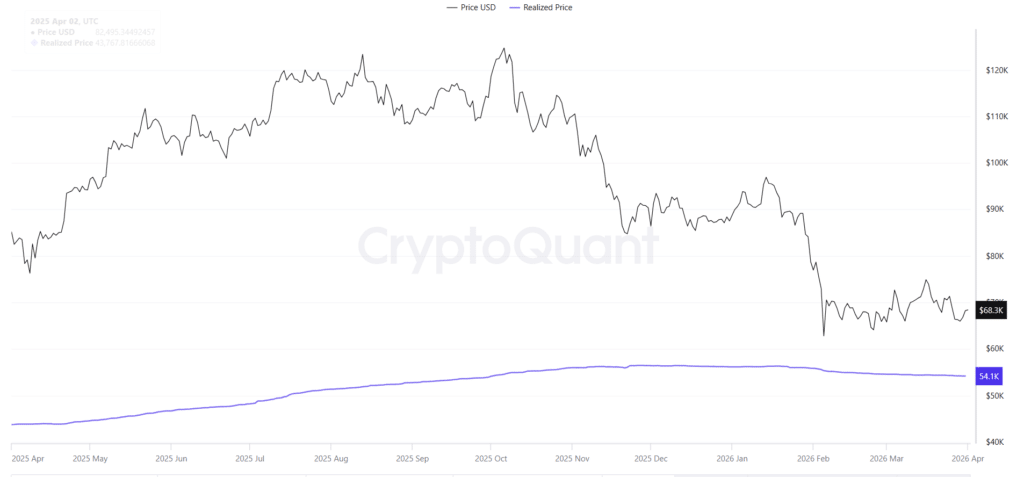
In the 2022 bear market, the signal that marked the actual bottom was spot trading below realized price. Bitcoin traded under its aggregate cost basis from June through October 2022, and the deepest point when spot was roughly 15% below realized coincided almost exactly with the cycle low near $15,500.
A similar breach occurred during the early 2020 COVID crash, when spot plunged below realized price and the entire network was collectively underwater. Buying when the network is collectively at a loss has historically been one of the most reliable entry signals in Bitcoin’s history. By contrast, the current 21% premium to realized price means the average holder is still in profit, a meaningful buffer that separates today’s conditions from past bottoms.
How Quickly Has the Gap Between Spot and Realized Price Compressed?
The gap between Bitcoin’s spot and realized price has shrunk rapidly, from roughly 120% in late 2024 to just 21% now. This 15-month compression is unusually fast for conditions outside outright market crashes.
CryptoQuant analyst Oinonen noted that Bitcoin has entered what some describe as an accumulation zone. However, the 2022 accumulation zone was defined by spot trading at or below realized price. The current price levels show a range where spot remains well above the realized price metric that is supposed to define that zone.
Are On-Chain Signals Supporting a Buying Opportunity Or Is It Too Early?
Current indicators show no clear capitulation event and no broad institutional surge in demand. The Coinbase Premium Index has returned to negative territory, signaling weakening institutional demand on the venue most associated with U.S. buyer flows, another sign that the market has not completed a full reset.
Given that the market has not yet experienced the level of selling pressure typically associated with historical bottoms, any rally from current levels would occur before the traditional capitulation signal materialises. At the same time, the $65,000–$70,000 range has remained resilient during weeks of heightened geopolitical tension, and ETF inflows exceeding $1 billion in March reflect a committed base of buyers.
The ultimate test, spot falling below realized price amid broad capitulation, has not yet occurred, meaning any rally now would be pre-empting the classic bottom signal.
What Would It Take for Bitcoin to Reach a Classic Bottom?
For Bitcoin price vs realized price to indicate a traditional accumulation zone the spot price would need to reach or fall below the realized price of approximately $54,000. The market would only resemble the on-chain conditions seen before past cycle lows once spot moves close to or below that level. Which leaves the network collectively underwater.

Until this happens the 21% premium to realized price continues to act as a meaningful buffer for holders. This suggests that although the market is closer to historically favorable conditions than it has been in the past three years, the classic bottom signals have not yet appeared.
Conclusion
Bitcoin price vs realized price underscores that the market is still in a transition phase. The quick narrowing of the gap points toward a possible move closer to a buy zone but on-chain data make it clear that the network has not yet gone through the kind of pressure that usually defines a market bottom.
Disclaimer: This article is for informational purposes only and should not be considered financial or investment advice. Readers should conduct their own research before making investment decisions.
Glossary
Realized Price: The average level where Bitcoin last changed hands
Spot Price: The live market price of Bitcoin right now
Accumulation Zone: A phase where buying slowly builds after a dip
On-Chain Data: Blockchain signals that show how the market is behaving
Premium (21%): The extra percentage Bitcoin trades above its average cost
Frequently Asked Questions About Bitcoin Price vs Realized Price
What is Bitcoin price vs realized price?
It compares Bitcoin’s current market price with the average price holders paid.
Is Bitcoin in an accumulation zone now?
No Bitcoin is not in a true accumulation zone yet because price is still above realized price.
What happens when Bitcoin falls below realized price?
It means most holders are in loss. Which has often marked strong buying zones in the past.
Can Bitcoin still go higher from here?
Yes Bitcoin can still rise, but it may not be a strong long-term bottom yet.
What signal confirms a real Bitcoin bottom?
A real bottom usually happens when price drops below realized price with strong selling pressure.