

























Bitcoin price surge set the direction at the start of Monday’s U.S. trading session, with Bitcoin rising more than 6% and moving close to the $70,000 mark. The move came as stock markets opened lower, while energy prices climbed sharply, creating a cautious tone across traditional assets.
- Why the Bitcoin price surge diverged from a risk-off U.S. market open?
- Why did Bitcoin rise as equities struggled early?
- Did liquidations drive the Bitcoin price surge?
- How did U.S. trading hours change price dynamics?
- Why did the CME premium matter in this move?
- How do ETFs fit into this structure?
- Why didn’t inflation-linked risk cap Bitcoin’s upside?
- Conclusion
- Glossary
- Frequently Asked Questions About Bitcoin Price Surge
The broader session was shaped by elevated geopolitical tensions, firmer oil prices, and early weakness in equities. Against that backdrop, Bitcoin’s advance stood out as it appeared to be driven by market structure and trading flows rather than short-term investor sentiment.
Why the Bitcoin price surge diverged from a risk-off U.S. market open?
The Bitcoin price surge reflected a clear divergence from the broader macro setup at the U.S. market open. Oil prices jumped on escalation risk, equities opened sharply lower, and the dollar held firm, with the S&P 500 falling at the bell before stabilizing closer to flat levels later in the session.
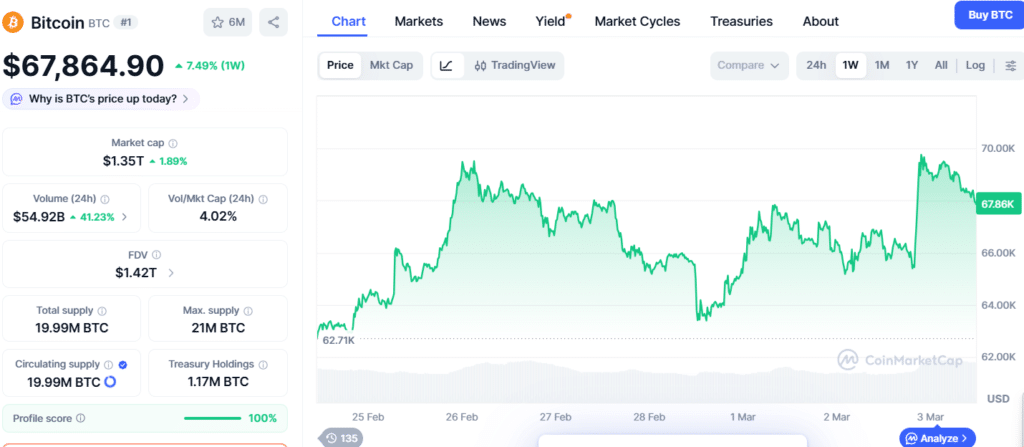
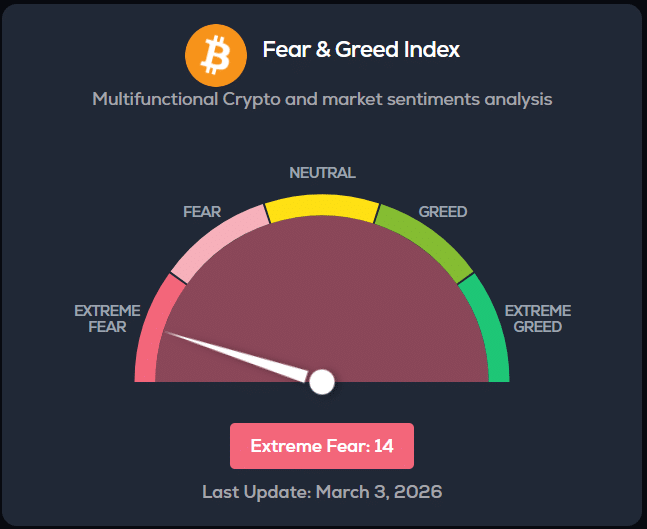
Despite this backdrop, Bitcoin briefly pushed higher during U.S. hours and is currently trading around $67,964.39, up about 1.88% over the past 24 hours. The move unfolded alongside rising trading activity and cautious positioning, while market sentiment remains subdued, with the Fear & Greed Index at 14, which is still in the “Extreme Fear” zone, underscoring that the advance was driven by market structure rather than a broad risk-on shift.
Why did Bitcoin rise as equities struggled early?
Bitcoin price surge continued even as stock markets faced early pressure, indicating that the move was not driven by improving growth expectations. U.S. crude climbed about 7.6% to roughly $72, while Brent advanced nearly 8.6% to around $79, highlighting rising energy-related concerns.
European markets moved lower overall, although defense and energy stocks outperformed, and natural gas prices jumped close to 50%. Against this backdrop, Bitcoin’s price action moved in the opposite direction, pointing to market structure and trading flows rather than broad macro optimism as the main driver.
Did liquidations drive the Bitcoin price surge?
Liquidations were not the main force behind the Bitcoin price surge. Total liquidations were close to $423 million, split almost evenly between about $221 million in long positions and roughly $203 million in short positions.
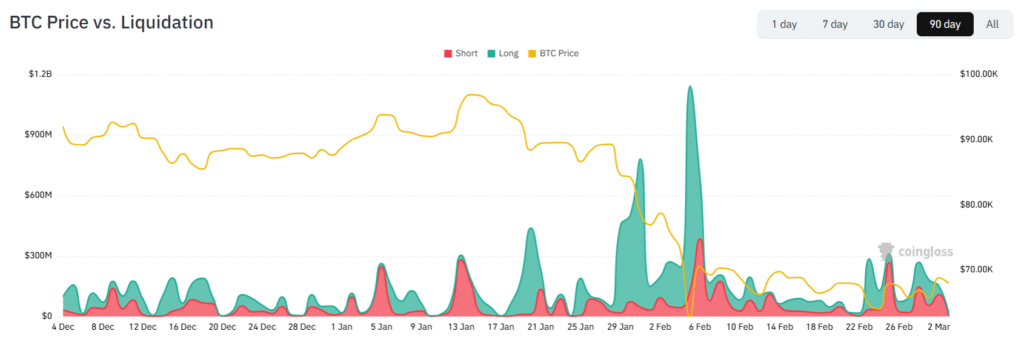
Coinglass shows Bitcoin liquidations totaling $137.54 million over the past 24 hours, with around $46.33 million from long positions and about $91.22 million from shorts, reflecting ongoing but balanced position clearing. This pattern points to two-sided activity rather than a one-directional squeeze, as sessions driven by forced buying usually show a much clearer imbalance, which is not evident here.
How did U.S. trading hours change price dynamics?
Bitcoin price surge moved in step with the return of liquidity during U.S. trading hours. As regulated markets reopened, larger amounts of capital re-entered the market, helping correct price gaps that had developed during quieter weekend trading.
This transition typically draws spot-based buying and hedging activity back into play. As a result, prices can adjust more smoothly and quickly without depending on heavy leverage or forced positioning.
Why did the CME premium matter in this move?
A widening CME premium provided one of the clearest signals behind the Bitcoin price surge. After trading resumed, the CME premium moved higher and peaked near 1.3%, following earlier normalization around 0.34%.
A positive premium usually indicates that institutions are willing to pay more for regulated exposure or are using futures to manage risk. When demand for futures moves faster than arbitrage activity can respond, spot prices can rise as basis trades adjust, allowing Bitcoin to climb without a wave of forced liquidations.
How do ETFs fit into this structure?
The ETF-era market structure has changed how demand flows into Bitcoin. In the previous week, U.S. spot Bitcoin ETFs saw about $1.1 billion in net inflows over three straight days, following several weeks of net outflows.
This shift in flow provides important context for recent price moves. When ETF-related spot demand and futures hedging line up during U.S. trading hours, Bitcoin can move sharply even when broader macro conditions remain mixed.
Why didn’t inflation-linked risk cap Bitcoin’s upside?
The macro shock centered on inflation risk rather than outright growth collapse. Rising energy prices can delay rate cuts and tighten financial conditions, pressuring equities early in the session.

Bitcoin, however, can attract hedge-related flows in this environment when U.S. liquidity is active. That distinction helps explain why Bitcoin did not mirror equity weakness at the open.
Conclusion
Bitcoin price surge at the U.S. open shifted attention away from forced buying and toward flow-driven price adjustments. The move highlighted how institutional and spot-related activity can influence price when liquidity returns during U.S. trading hours.
The outlook now depends on clear signals, including whether oil prices hold their risk premium, whether ETF inflows continue, and how the dollar and interest rates respond. If the CME premium stays elevated and spot demand remains active during U.S. hours, Bitcoin could stay resilient even as broader risk appetite remains constrained.
Disclaimer: This article is for informational purposes only and does not constitute financial, investment, or trading advice. Cryptocurrency markets are volatile, and readers should conduct their own research or consult a qualified professional before making any investment decisions.
Glossary
Long Liquidation: Forced sale of a losing leveraged long position.
Short Liquidation: Forced buyback of a losing leveraged short position.
U.S. Market Open: Start of U.S. trading hours with higher liquidity.
CME Premium: Futures price trading above the spot price.
Hedging Flow: Trades made to reduce risk exposure.
Frequently Asked Questions About Bitcoin Price Surge
How much did Bitcoin rise during the session?
Bitcoin rose more than 6% and moved close to the $70,000 level.
What were total liquidations during the move?
Total liquidations were about $423 million, split almost evenly between long and short positions.
What does a CME premium above 1% mean?
A CME premium above 1% means futures were trading higher than the spot price, showing strong institutional demand.
Why are U.S. trading hours important for Bitcoin?
U.S. trading hours bring more liquidity and institutional participation, which can move prices faster.
Did ETF flows play a role in the rally?
Yes, recent ETF inflows showed renewed demand, which supported Bitcoin’s price strength.