














Bitcoin price resilience continues to shape market trends, staying strong even as oil prices climb and geopolitical tensions remain high. Bitcoin held near $70,000 while WTI crude briefly reached $100 a barrel, a situation that in the past would have caused significant drops in cryptocurrency values.
- How Does Bitcoin Price Resilience Explain the Current Market Stability?
- Why Has Bitcoin Price Resilience Held Amid Oil Volatility?
- How Are On-Chain Indicators Shaping Market Outlook?
- Could Bitcoin Move Toward $80,000 in the Current Environment?
- What Does This Mean for Traders and Investors?
- Conclusion
- Glossary
- Frequently Asked Questions About Bitcoin Price Resilience
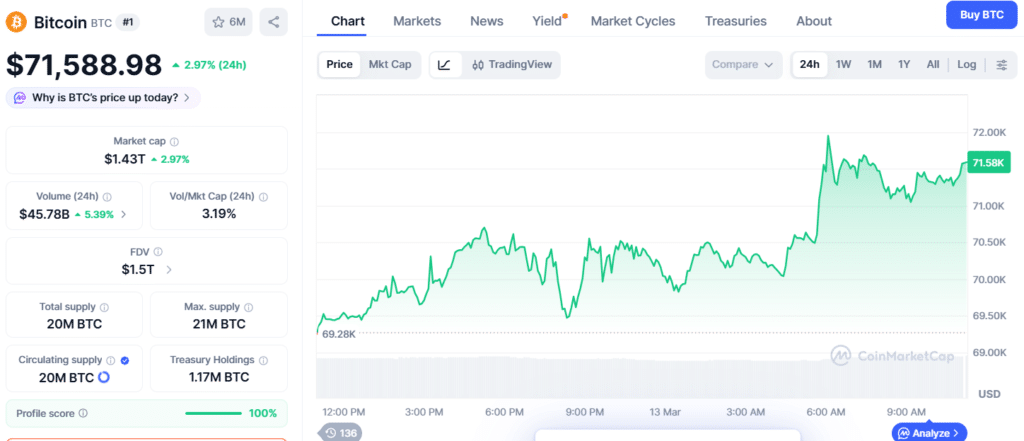
Recent market data shows that Bitcoin increased by 2.97% over the last 24 hours, currently trading around $71,598.81. This behavior marks a notable shift compared with previous weeks, highlighting that the market is now much better equipped to absorb major external shocks and maintain stability despite volatile conditions.
How Does Bitcoin Price Resilience Explain the Current Market Stability?
Bitcoin price resilience is visible in its capacity to maintain value despite oil surges and inflation concerns. WTI crude rose 4.79% to $92.04, and Brent crude jumped 5.24% to $97.22 amid Strait of Hormuz disruptions and Iran warning of $200-a-barrel oil. In previous cycles, such shocks would have dragged BTC down. Yet, Bitcoin remains within its established range, demonstrating a notable departure from the typical macro correlation.
Experts attribute this resilience to a cleaner market structure. CoinShares reported BTC leverage ratios fell from 33% in October 2025 to 25% by early March. “Market structure entering the crisis was already significantly cleaner, following an estimated $30 billion of whale distribution,” the firm said. This allowed the market to absorb new demand efficiently, even as speculative froth declined.
Why Has Bitcoin Price Resilience Held Amid Oil Volatility?
Institutional flows and ETF activity have strengthened Bitcoin price resilience. Spot BTC ETFs recorded over $1 billion in inflows during the first five days of March, reversing five consecutive weeks of outflows totaling around $4 billion. Data from Glassnode shows that flows into 12 US spot Bitcoin ETFs have returned to positive territory, helping support the market.
Santiment points out that Bitcoin’s 365-day MVRV now aligns with levels seen after the 2022 FTX collapse, which was followed by a 67% rally, although it emphasizes that overall market conviction remains fragile. In addition, Strategy has accumulated 66,231 BTC, providing further stability. Together, these factors help explain why Bitcoin is maintaining value this time, despite macroeconomic pressures that would have driven prices lower in previous cycles.
How Are On-Chain Indicators Shaping Market Outlook?
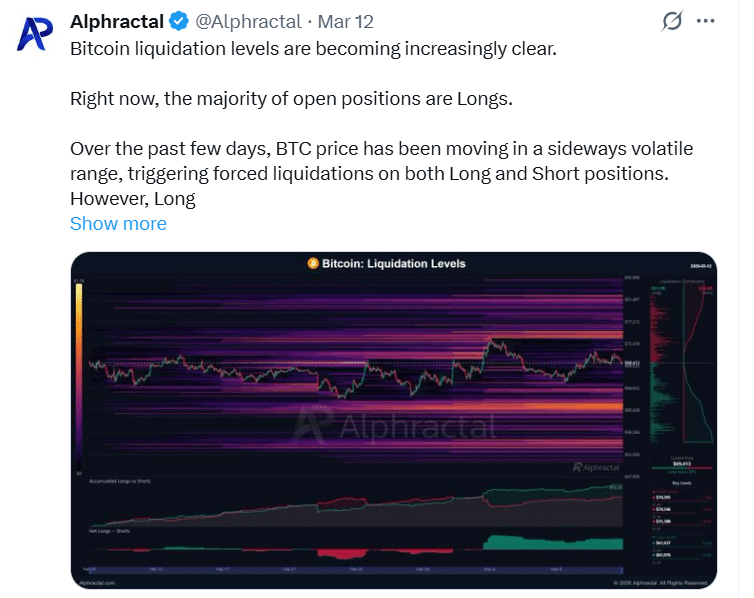
On-chain data provides a clear view of the market’s current dynamics and highlights Bitcoin price resilience. Alphractal shows liquidation levels are now more defined, with most positions on the long side. The maximum pain for longs is around $61,000, while shorts are concentrated near $75,000, creating clear pressure points. Glassnode data shows an accumulation cluster forming between $62,800 and $72,600, although its intensity remains below previous expansions.
The Realized Value to Transactions (RVT) Ratio, which compares Realized Cap with daily on-chain transaction volume, has been rising. A higher RVT indicates that coins are circulating less on-chain and more capital is being held, suggesting accumulation rather than speculative overheating. Additionally, Bitcoin’s current MVRV ratio stands at 0.92, slightly below fair value, pointing to moderate undervaluation relative to long-term holders. Together, these metrics reinforce Bitcoin price resilience while showing that overall market conviction remains cautious.
Could Bitcoin Move Toward $80,000 in the Current Environment?
Futures market data indicates there is room for potential upside in Bitcoin. Glassnode reports negative perpetual funding, which reflects increased short positioning, while CME data shows $660 million in call open interest compared with $240 million in puts for March. Around $2 billion of negative gamma is concentrated near the $75,000 strike, with $1.8 billion of that set to expire on March 27, highlighting key price pressure points.
Traders such as Andreja Cobeljic from Amina Bank point out that negative funding rates, combined with whale accumulation around $60,000, create favorable conditions for a relief rally. However, the market has not yet developed strong directional conviction, and ongoing inflation concerns remain, meaning any breakout toward higher levels would be cautious rather than certain.
What Does This Mean for Traders and Investors?
Bitcoin price resilience indicates that the market is better prepared to handle shocks, though caution is still warranted. Accumulation is picking up, leverage levels are lower, and ETF flows have stabilized, providing support to BTC.

At the same time, the intensity of accumulation remains below previous strong expansions, and inflation concerns continue to influence market sentiment. Traders should keep in mind that while Bitcoin is holding above $70,000, near-term price movements could still be affected by volatility and ongoing geopolitical developments.
Conclusion
Bitcoin price resilience remains the defining feature of the current market cycle. Stabilizing ETF flows, cleaner leverage ratios, on-chain accumulation, and strategic whale activity all work together to create a market that is capable of absorbing shocks and handling external pressures more effectively than in previous cycles.
While momentum toward $80,000 is plausible under current conditions, traders and investors should balance optimism with caution. Fragile conviction, lingering inflation concerns, and ongoing macroeconomic uncertainties continue to play a significant role in shaping Bitcoin’s overall trajectory and near-term movements.
Disclaimer: This article is for informational purposes only and does not constitute financial or investment advice. Readers should consult with a professional before making any investment decisions.
Glossary
WTI Crude: US benchmark for crude oil prices.
Brent Crude: Global crude oil price reference from the North Sea.
Spot BTC ETF: ETF that holds actual Bitcoin, not futures.
MVRV Ratio: Shows if BTC is over- or undervalued.
RVT Ratio: Tracks BTC circulation vs. stored value on-chain.
Frequently Asked Questions About Bitcoin Price Resilience
Why is BTC holding near $70K now?
BTC is holding near $70K as the market structure is cleaner and institutional support and ETF flows are helping stability.
Can Bitcoin move toward $80,000 soon?
Bitcoin could move toward $80,000 if buying pressure continues but market conviction is still fragile.
What should traders keep in mind?
Traders should watch for volatility, macroeconomic changes, and ongoing geopolitical risks while BTC holds near $70K.
What does accumulation mean in Bitcoin?
Accumulation means that investors are buying and holding Bitcoin instead of selling it. Which supports its price.
How does oil price affect Bitcoin?
Oil price can affect Bitcoin as higher oil costs can trigger inflation fears. Which used to push BTC down but Bitcoin is showing resilience now.