
This article was first published on Deythere.
- What does the Bitcoin price rally reveal about the broader market situation?
- Why are derivatives markets signaling caution?
- How is the mining sector influencing market pressure?
- Why is the $76,000 level considered a psychological barrier?
- Can Bitcoin move toward the $78,700 level?
- Conclusion
- Glossary
- Frequently Asked Questions About Bitcoin Price Rally
Bitcoin price rally is gaining momentum again as the cryptocurrency market tries to rebuild confidence after a turbulent start to the year. The recent upward movement has renewed discussions among traders and analysts about whether the asset can regain stronger footing in the coming weeks.
Even though market sentiment has improved slightly, many investors remain cautious while they assess whether the current upward trend can turn into a steady recovery. Market signals from blockchain activity, derivatives trading, and changes within the mining industry show that prices are rising, but participants are still moving carefully.
The overall mood suggests that investors want stronger confirmation before taking larger positions during the ongoing Bitcoin price rally. Bitcoin reached its highest level in four weeks on Wednesday and is now trying to move closer to the $78,700 monthly closing level recorded in January. The recent movement follows a rebound of about 22% from the $60,000 local low that formed on Feb. 6.
What does the Bitcoin price rally reveal about the broader market situation?
The Bitcoin price rally shows that the market is trying to recover after a sharp drop earlier this year. Bitcoin faced a steep 32% fall during the first week of February. After that decline, the market moved sideways for several weeks before the latest recovery began.
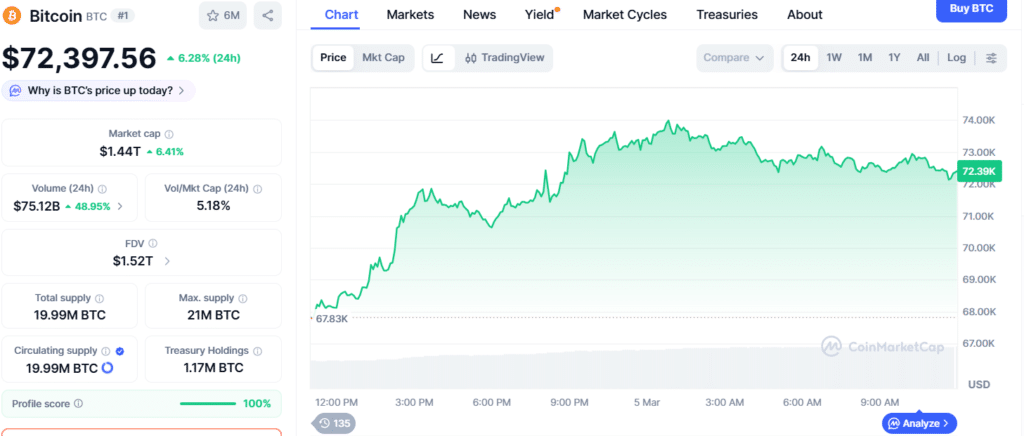
Even though the Bitcoin price rally pushed prices above $73,000 during the rebound, Bitcoin is now trading around $72,398.43, reflecting a 5.7% rise in the past 24 hours. Despite this improvement, blockchain data indicates that many investors are still holding their coins at a loss. Data from Glassnode shows that about 43% of Bitcoin’s circulating supply is held below the price at which those coins last moved.
This share was closer to 30% when Bitcoin traded near $90,000 in late January. The increase suggests that many investors who entered the market during earlier highs are still below their purchase levels. Because of this, traders remain cautious. Some investors may choose to sell their holdings if prices recover closer to where they originally bought, which could create selling pressure in the market.
Why are derivatives markets signaling caution?
Derivatives markets reveal that many professional traders are still protecting their positions even as the Bitcoin price rally continues. In the options market on Deribit, put options, which give traders protection if prices fall, are trading at about a 10% premium compared with similar call options. In a balanced market, the 30-day options skew usually stays between -6% and 6%.
This neutral range was last seen in mid-January when Bitcoin was trading close to $95,000. The higher demand for put options shows that traders are still focusing on downside protection even while prices attempt to move higher. Interest in strongly bullish futures positions has also remained limited.
Another indicator supports this cautious view. The annualized futures premium, often called the basis rate, is still below the neutral 5% level. When this metric stays under that threshold, it usually signals that institutional traders are not aggressively opening leveraged long positions during the ongoing Bitcoin price rally.
How is the mining sector influencing market pressure?
Changes in the mining sector are also influencing the outlook for the Bitcoin price rally. The rapid growth of artificial intelligence infrastructure has increased global demand for energy, which has raised operating costs for Bitcoin mining companies. At the same time, weaker demand for the Bitcoin blockchain registry has added more pressure on the industry.
Because of these factors, miner profitability has moved closer to record low levels. The Bitcoin Hashprice index, which tracks the expected daily value of one terahash per second of hashing power, dropped to $30 on Tuesday. The Hashprice (Spot) is currently around $31.73 USD, showing only a slight improvement from earlier levels.
Around three months ago, the same index was near $39, highlighting how much mining returns have declined during this period. With profit margins becoming tighter, several publicly listed mining firms have started shifting part of their focus toward artificial intelligence computing and other high-performance computing services.
As part of this shift, some companies have also sold portions of their Bitcoin reserves. This trend is being watched closely by investors because miners have historically accumulated Bitcoin during stronger market conditions. If more mining companies start selling their holdings regularly, the additional supply could place pressure on the ongoing recovery in the market.
Why is the $76,000 level considered a psychological barrier?
The $76,000 level has become an important point for traders because it reflects the average purchase cost of Bitcoin held by Strategy. Since launching its Bitcoin treasury strategy in August 2020, the company has accumulated 720,737 BTC. When Bitcoin briefly moved this average purchase level below, the company’s holdings came under closer attention from market participants.
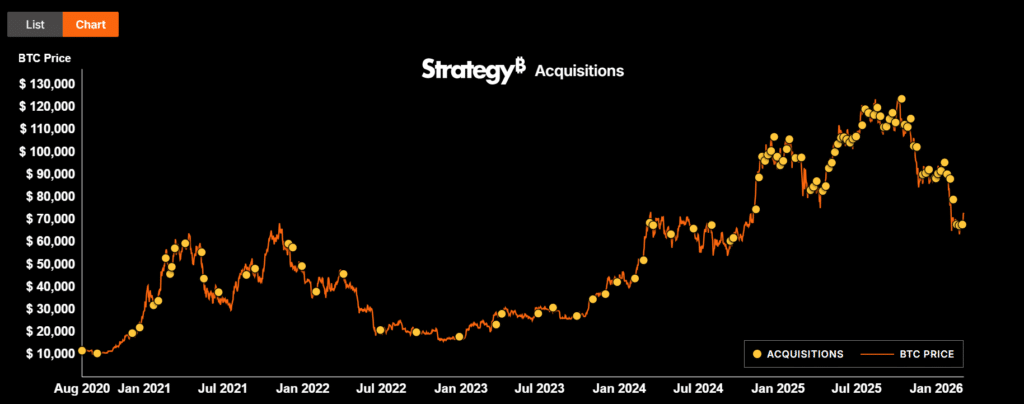
The situation also highlighted the risks faced by publicly traded companies that maintain large Bitcoin reserves. Other listed firms with similar approaches, including Metaplanet (3350 JP) and Twenty One Capital (XXI US), have also faced comparable valuation pressure in the current market environment.
Despite this, Strategy does not face immediate liquidity concerns or difficulties in covering interest payments linked to yield-bearing assets such as STRC. Even so, the $76,000 cost basis remains an important level for traders and investors.
If Bitcoin trades above this threshold, the company would have the ability to issue additional shares without diluting existing shareholders. Because of this factor, many market participants view $76,000 as both a psychological and strategic barrier during the Bitcoin price rally.
Can Bitcoin move toward the $78,700 level?
The next major milestone for investors is the $78,700 monthly closing level recorded earlier this year. The recent Bitcoin price rally has moved the asset closer to that range, although analysts believe the move may take time rather than happening quickly. Several underlying factors are still influencing market sentiment.

A large number of investors are still holding Bitcoin at a loss, while derivatives market data shows traders continuing to take defensive positions. Pressure on mining companies is also adding uncertainty to the broader market outlook. At the same time, the recovery from the $60,000 level shows that buying interest has not completely faded. If market confidence improves and key resistance levels are cleared, stronger participation from institutional investors could follow.
Conclusion
Bitcoin price rally reflects a market that is recovering but still facing several structural challenges. The rebound from $60,000 low recorded in February has improved sentiment among traders. But several indicators show that caution remains in place. Options data shows put contracts trading at a premium compared with calls while futures basis remains below the neutral 5% threshold. Suggesting that professional traders are still hedging against downside risks.
Rising energy costs are also putting pressure on mining companies, adding another layer of uncertainty for the broader market. A decisive move above the $76,000 cost-basis level linked to major corporate holdings could strengthen momentum and bring the $78,700 level back into focus. Until then, the recovery may remain gradual as the market continues to face resistance.
Glossary
On-chain Data: Blockchain metrics showing transaction and holder activity.
Derivatives Market: Market where futures and options trade on asset prices.
Put Option: Contract used to profit from or hedge against price drops.
Call Option: Contract giving the right to buy an asset at a fixed price.
Bitcoin Hashprice: Estimated daily miner revenue per unit of computing power.
Frequently Asked Questions About Bitcoin Price Rally
Why are many Bitcoin holders still in loss?
Many holders bought Bitcoin when the price was much higher earlier this year.
How many Bitcoin holders are currently in loss?
About 43% of Bitcoin’s circulating supply is currently held by investors who bought at higher prices.
Why are Bitcoin miners selling some of their coins?
Some miners are selling Bitcoin as higher energy costs have reduced their profits.
How do miner sales affect the Bitcoin price rally?
Miner selling can add more Bitcoin supply to the market and may slow down price rally.
What could happen if Bitcoin moves above $76,000?
If Bitcoin moves above $76,000 the rally could become stronger. And prices may move closer to $78,700.