

Bitcoin price outlook is starting to take an upward bias once more, and the change is coming from a surprising source which is the global oil market.
- The Biggest Oil Supply Shock in Decades
- Why Oil Prices Directly Influence Bitcoin’s Direction
- EIA Forecast: Oil May Drop Below $80
- The Two Scenarios That Will Define Where Bitcoin Goes Next
- Conclusion
- Glossary
- Frequently Asked Questions About Bitcoin Price Outlook
- What was the impact of the Iran conflict on Bitcoin?
Bitcoin seemed to have stabilized above the $70,000 mark after weeks of volatility from the Iran conflict, even as geopolitical uncertainty lingers. That resilience comes as a result of a sharp downturn this week in oil prices, due to reports of diplomatic signals between the United States and Iran.
Reports of a temporary pause in hostilities and indirect negotiations helped push crude prices lower, while Bitcoin climbed modestly together with equities.
Brent crude even hit more than $120 a barrel at the height of the crisis, as Bitcoin dropped to around $69,600 on mounting risk aversion. Now, oil has begun to retrace back toward the $90-$100 domain, and Bitcoin reclaimed above $70K as well.
The Biggest Oil Supply Shock in Decades
In order to understand the current Bitcoin price outlook, one must have an idea about the scale of the disruption.
The Iran conflict caused what analysts called the largest oil supply shock in modern times, disruptions that impacted roughly 20% of world oil supply passing through the Strait of Hormuz.
At one point; tanker traffic through the strait declined by about 70%, with some days recording near-zero movement. More than 150 vessels had to anchor at their destinations as a result of the security threats; Brent crude shot up to $126 per barrel, at a four-year high.
The supply disruption was hardly marginal. It took millions of barrels per day out of global circulation, with estimates as high as 10 million barrels a day lost in output across major Gulf producers.
This set off a classic chain reaction because energy prices rose, inflation expectations soared and central banks were obliged to make more hawkish changes.

Why Oil Prices Directly Influence Bitcoin’s Direction
The relationship between oil to the Bitcoin price outlook goes through inflation and interest rates.
When oil prices soar; they pass directly through to headline inflation. Filling up gas tanks makes consumers pay more; and energy costs have second-round effects that cut across food prices and core inflation, based on research and historical data.
At the height of that oil spike, Bitcoin dropped below $70,000, global equities weakened, and expectations of rate cuts were pushed even farther out. These moves were not based on crypto fundamentals. It was a macro repricing.
Oil hit above $100 and markets started to price a prolonged period of tight monetary policy. That caused liquidity to tighten, which then put pressure on risk assets; Bitcoin included. Now the opposite is starting to unfold.
EIA Forecast: Oil May Drop Below $80
According to the U.S. Energy Information Administration (EIA); Brent crude oil price is projected to stay above $95 in the near term before dropping below $80 by third-quarter 2026, with further decline toward $70 by year-end if disruptions ease.
This forecast is supported by expectations on the supply side of recovery. Global oil stockpiles are set to rise by 1.9 million barrels a day. U.S. output is forecast to hit 13.6 million bpd in 2026 and climb more in 2027.
Investment banks are getting in line with this. Analysts at JPMorgan expect Brent to be averaging $100 in Q2 2026, then falling to around $80 in the fourth quarter.
This is important because markets are pricing the future, not today. Even a belief in only some of this downward set-up for oil is enough to change financial conditions.
The Two Scenarios That Will Define Where Bitcoin Goes Next
At press time, the reports that President Trump wants to end the US-Iran war quickly reintroduced uncertainty. At the same time, reports showed that Bhutan’s Royal Government sold over 500 BTC ($36.75 million), adding tangible selling pressure to the current BTC price.
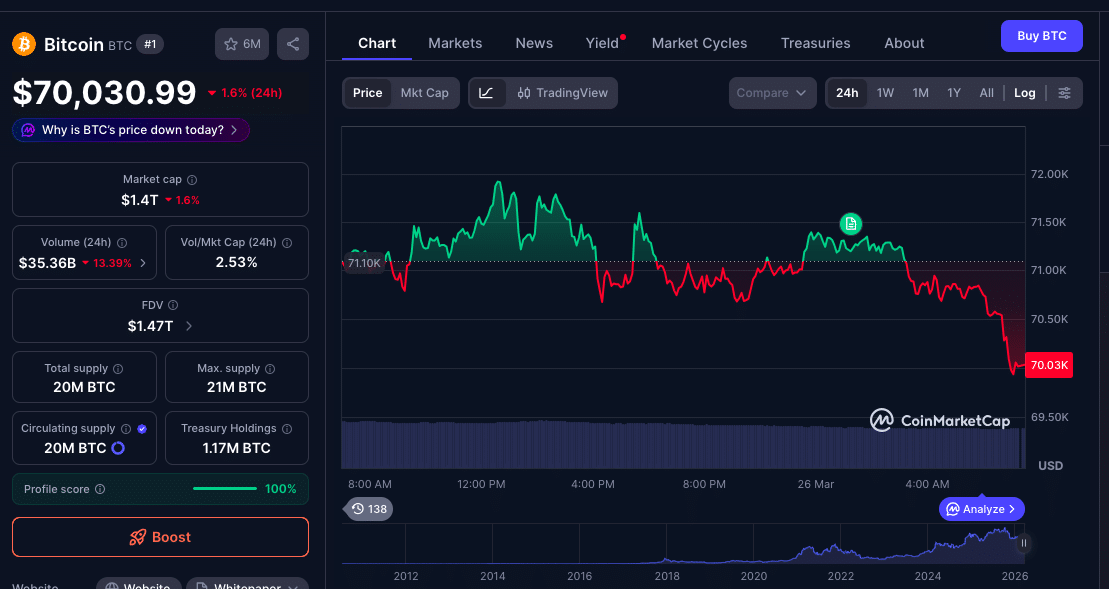
If diplomacy continues to de-escalate tensions, crude prices are likely to drift lower toward the EIA’s projected range. In this scenario, inflationary pressures would decline, central banks would have more flexibility and liquidity conditions would ease. Such an environment would be favorable for Bitcoin; which may have a greater chance of retesting and breaching recent highs.
On the other hand, if negotiations break down, the whole chain is reversed. Oil might jump back above $100, shipping risks would once again be present, and inflation expectations would be rebounding. Markets would rapidly price in a more hawkish policy trajectory, tightening liquidity and reigniting pressure on Bitcoin.
Recent moves in the market show just how quickly this can occur. One moment it was the possibility of rate cuts, then oil spiked early in the conflict and then came expectations for policy to tighten.
Conclusion
Current Bitcoin price outlook is being defined to a huge degree by oil markets, rather than anything taking place inside crypto itself.
The easing of the supply shock is starting to reduce inflation pressure and create better liquidity conditions. That gives Bitcoin a straighter road to the upside.
However, these conditions are not stable. The same geopolitical forces that drove the oil spike are still unresolved and markets were responding to signals not certainties.
Should oil head towards the sub-$80 trajectory indicated by the EIA, it is likely Bitcoin will be able to find the momentum needed for a breakout. Otherwise, volatility returns just as fast.
Glossary
Strait of Hormuz: A major shipping channel that accounts for about 20 percent of global oil supply.
Inflation: The rate at which the price of goods and services rise.
Liquidity: The measure of capital in financial markets.
Brent Crude: International standard for oil prices.
Frequently Asked Questions About Bitcoin Price Outlook
What’s influencing the Bitcoin price outlook at the moment?
Bitcoin price outlook is currently mostly influenced by oil prices; inflation expectations and central bank policy; not crypto-specific developments.
What was the impact of the Iran conflict on Bitcoin?
The conflict drove oil above $120; widened inflation alarms and sent Bitcoin tumbling below $70,000 before it stabilized.
Why does Bitcoin get dragged down with oil so much?
Oil first feeds into inflation that feeds into interest rates. High rates decrease liquidity and hurt Bitcoin.
What does the EIA say will happen to oil in 2026?
If supply disruptions are resolved; the EIA sees oil dropping below $80 in Q3 2026 and trending toward $70 by the end of that year.