


























This article was first published on Deythere.
Bitcoin price crash headlines dominated global search trends after nearly $100 billion vanished from crypto markets in one violent weekend. Traders who expected calm waters instead faced a policy storm that moved faster than liquidity could absorb. The drop below $65,000 was not just technical noise. It was a stress signal.
According to the source, the selloff followed sudden legal and trade policy shifts in Washington. Within hours, leverage unwound, confidence cracked, and Bitcoin support levels faced their toughest test in months.
From Courtroom to Chaos: How Policy Whiplash Triggered a Bitcoin Price Crash
The chain reaction began on Feb. 20 when the Supreme Court struck down tariffs imposed under the International Emergency Economic Powers Act. IEEPA allows emergency economic action during national threats. Its reversal removed a major tariff framework overnight.
Confusion deepened when US Customs said it would halt collections at 12:01 a.m. EST on Feb. 24, more than three days after the ruling, while offering no refund guidance. Markets dislike gray zones. That delay left importers guessing about cash flow and liabilities.
The White House moved quickly. President Donald Trump invoked Section 122 of the Trade Act of 1974 and imposed a 10 percent temporary import surcharge for 150 days, later raising it to 15 percent. In a public post, he wrote that the increase was due to the “urgency of the situation,” as seen here. Officials also signaled continuity through Section 301 and Section 232 authorities.
Policy continuity existed. Policy clarity did not.
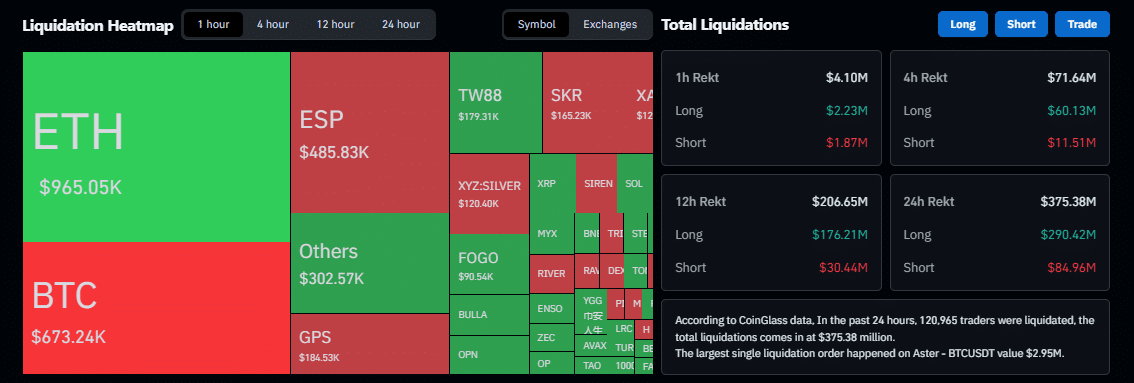
Crypto markets processed a court ruling, a delayed halt, a new framework, and a rate hike within one cycle. Over $500 million in liquidations followed, including a $61 million wipeout on a BTC-USDT pair, confirmed by this derivatives data source. The Bitcoin price crash accelerated as forced selling fed on itself.
The Macro Fuse Was Already Lit Before the Bitcoin Price Crash
The Bitcoin price crash did not hit a calm system. The Economic Policy Uncertainty Index printed 706.97 on Feb. 19. The Trade Policy Uncertainty Index stood at 3,027.14433 late last year. Those figures showed a market already on edge.
An academic fiscal estimate suggested reversing IEEPA tariffs could create up to $175 billion in refunds, while tariff receipts had been running near $500 million per day. Sudden shifts of that scale affect Treasury projections and importer balance sheets.
When fiscal assumptions wobble, investors demand higher risk premiums. Leveraged assets reprice quickly. Crypto often feels the pressure first because it trades nonstop and remains liquid. That transmission explains why the Bitcoin price crash unfolded so fast.
Inflation Was Not the Villain, Uncertainty Was
Some expected tariffs to spark fresh inflation fears. Yet analysts at a major US bank estimated tariff passthrough had already lifted core PCE by about 0.7 percent, with only 0.1 percent more expected this year. That analysis, published here, showed inflation was not the primary driver.
Cross-asset signals confirmed this view. Reports noted the dollar weakened and gold rose while Bitcoin fell. Investors treated crypto as a risk asset rather than a haven. The Bitcoin price crash reflected uncertainty and margin stress, not runaway inflation.
Live pricing data from this market tracker showed Bitcoin dipping under $65,000 before stabilizing above $66,000. Bitcoin support near $65,000 weakened, while options hedging clustered around $60,000. That concentration makes $60,000 a critical Bitcoin support zone if selling resumes.

Conclusion
The Bitcoin price crash revealed how fast confidence fades when clarity disappears. Nearly $100 billion evaporated because policy sequencing outpaced market digestion. Bitcoin support now carries the weight of macro uncertainty.
Three paths lie ahead. A grinding base case keeps the temporary surcharge in place while noise continues. A relief rally emerges if refund clarity improves and boundaries solidify. A broader trade conflict deepens risk-off positioning and pressures Bitcoin support again.
The Bitcoin price crash will fade from headlines, but the lesson remains clear. Markets crave certainty. Until policy volatility eases, Bitcoin support around $60,000 stands as the line between stabilization and renewed stress.
This article is for informational purposes only and does not constitute financial advice. Readers should conduct their own research before making investment decisions.
Glossary of Key Terms
IEEPA: A US law allowing emergency economic measures during national threats.
Bitcoin Support: A price level where buying demand may slow further decline.
Risk Premium: Extra return investors require for holding volatile assets.
Policy Uncertainty Index: A measure tracking instability in economic and trade policies.
FAQs About Bitcoin Price Crash
Why did the Bitcoin price crash after the tariff ruling?
Rapid legal changes and tariff replacements created uncertainty, triggering heavy liquidations.
What is the key Bitcoin support level now?
Analysts watch $65,000 and especially $60,000 as critical Bitcoin support zones.
Did inflation cause the Bitcoin price crash?
Data shows uncertainty and fiscal stress drove the move, not new inflation shocks.
What happens next for Bitcoin?
Future direction depends on policy clarity and whether Bitcoin support levels attract strong demand.