

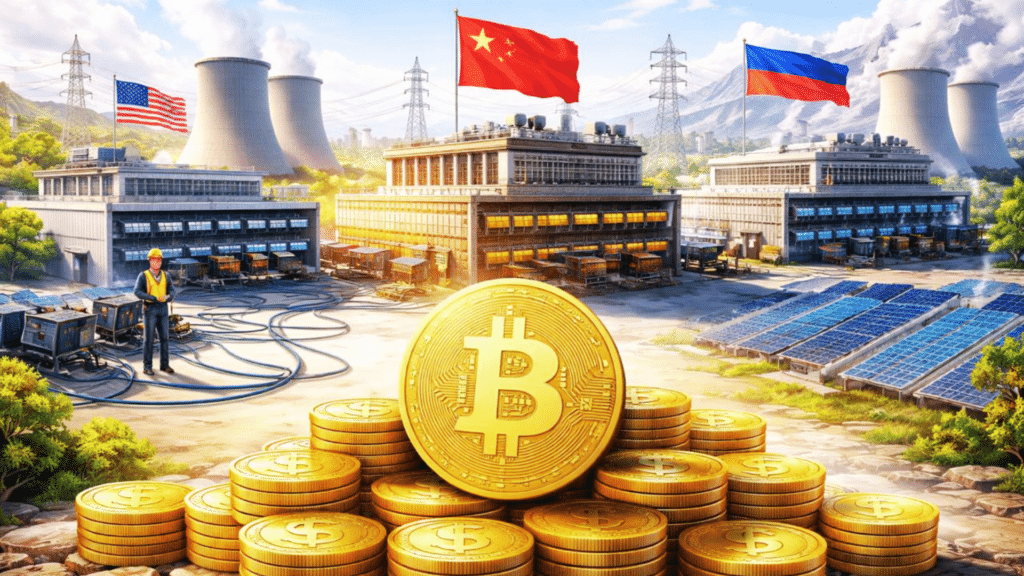
Bitcoin mining power is increasingly concentrated in the United States, China, and Russia, highlighting significant questions about the Bitcoin network’s decentralization and resilience. About 68% of global mining power is controlled by these three nations, reflecting the combined impact of energy costs, industrial infrastructure, and regulatory environments.
- Why is Bitcoin Mining Power Concentrated in These Countries?
- How Does This Impact the Bitcoin Network?
- What Are the U.S. Legislative Moves Affecting Mining?
- How Are Mining Companies Adapting?
- What Does the Concentration Mean for the Future?
- Conclusion
- Glossary
- Frequently Asked Questions About Bitcoin Mining Power
Analysts caution that while this concentration raises strategic and operational risks, the network has repeatedly demonstrated its ability to absorb shocks and adapt. Understanding how mining power is distributed globally is essential for assessing both the vulnerabilities and the growth potential of the Bitcoin ecosystem.
Why is Bitcoin Mining Power Concentrated in These Countries?
The dominance of Bitcoin mining power in the U.S., China, and Russia comes down to a mix of practical advantages. Mining consumes large amounts of electricity, and these countries offer power that is either cheaper or easier to access than in many other parts of the world. They also have the physical capacity needed for such operations, including large facilities, cooling setups, and dependable internet networks, which are not easy to build everywhere.
Even in places where rules are tight or unclear, mining activity does not simply disappear if it remains profitable. As Dennis Porter, CEO of Satoshi Action Fund, said, “Mining often finds ways to survive where profits are strong.” China’s continued activity through relocated or less visible operations reflects this pattern, while the U.S. maintains its position with better funding access and a wider range of energy options across states.
How Does This Impact the Bitcoin Network?
A high concentration of Bitcoin mining power presents operational risks, but it does not mean the network is broken. If mining activity clusters too heavily in a few regions, political or energy disruptions could create short-term volatility. Past shocks, such as the 2021 crackdown in China, showed that Bitcoin can continue functioning even as hashpower relocates, though migrations temporarily increase centralization risk.
At the same time, mining is gradually spreading to new regions with cheaper renewables and supportive policies, including parts of Central Asia, North America, and the Middle East. This mobility suggests that concentration is dynamic rather than permanent.
What Are the U.S. Legislative Moves Affecting Mining?
On March 30, Republican Senators Cynthia Lummis and Bill Cassidy proposed the Mined in America Act to support domestic mining. The bill introduces a voluntary certification system for mining pools and sites, allowing certified operations to access existing federal energy subsidies and rural development programs.
It also targets reliance on foreign mining hardware, particularly Chinese-made machines, while incorporating Trump’s strategic Bitcoin reserve executive order into law. Porter described the initiative as a way to strengthen domestic infrastructure and hardware supply chains, noting that 97% of the mining machines supporting the U.S.’s 38% computing power currently come from Chinese manufacturers.
While these measures aim to reinforce U.S. competitiveness, they represent one approach among many, as global mining remains mobile and responsive to profit incentives.
How Are Mining Companies Adapting?
Major U.S. mining firms, including Marathon, Core Scientific, and Riot, are diversifying into AI computing power services amid BTC price pressures, even as Bitcoin mining power dynamics continue to evolve globally. Repurposing mining infrastructure helps companies maintain profitability while aligning with government incentives.
Chinese manufacturers such as Bitmain, Canaan Creative, and Bit Microelectronics have also started U.S.-based production. These factories reduce import dependencies, though questions remain about whether locally produced equipment still falls under “foreign adversary-related” regulations, reflecting the complex global supply chain and its link to Bitcoin mining power distribution.
What Does the Concentration Mean for the Future?
Bitcoin mining power will continue shaping the global digital asset landscape. While the U.S., China, and Russia dominate today, mining is mobile and may gradually expand to new regions, balancing concentration over time.

Decentralization depends on multiple layers; despite concentrated hashpower, Bitcoin’s node base and user ecosystem remain broadly distributed. Energy availability, infrastructure investments, and evolving policies will influence the long-term distribution of mining power.
Conclusion
Bitcoin mining power remains concentrated in the U.S., China, and Russia, but the network has repeatedly demonstrated resilience to shocks and relocation. Legislative initiatives like the Mined in America Act aim to strengthen U.S. leadership and reduce foreign dependencies, yet broader global diversification and distributed infrastructure will be essential for a balanced and resilient Bitcoin network.
At the same time, mining activity continues to shift across regions as companies respond to energy costs and policy changes. Observers note that mining mobility, regional incentives, and evolving policies will collectively shape the future of global Bitcoin mining power.
Glossary
Bitcoin Mining Power: The combined computing force that keeps Bitcoin active
Hash Rate: The speed at which mining calculations are completed
Mining Pool: Miners teaming up to share work and rewards
Blockchain Security: The system that keeps Bitcoin transactions safe
Energy Cost: The power required to run mining machines
Frequently Asked Questions About Bitcoin Mining Power
Which countries control most Bitcoin mining power?
The United States, China, and Russia control about 68% of Bitcoin mining power.
Why is mining power high in these countries?
Mining power is high in these countries because they have cheap electricity and strong infrastructure.
What risks come from concentrated mining power?
Concentrated mining power can make the network more sensitive to political or energy problems.
Why is energy important for Bitcoin mining?
Energy is important because mining needs a lot of electricity to run machines.
Will mining power stay in the same countries in the future?
Mining power may change over time as new regions offer better energy and policies.