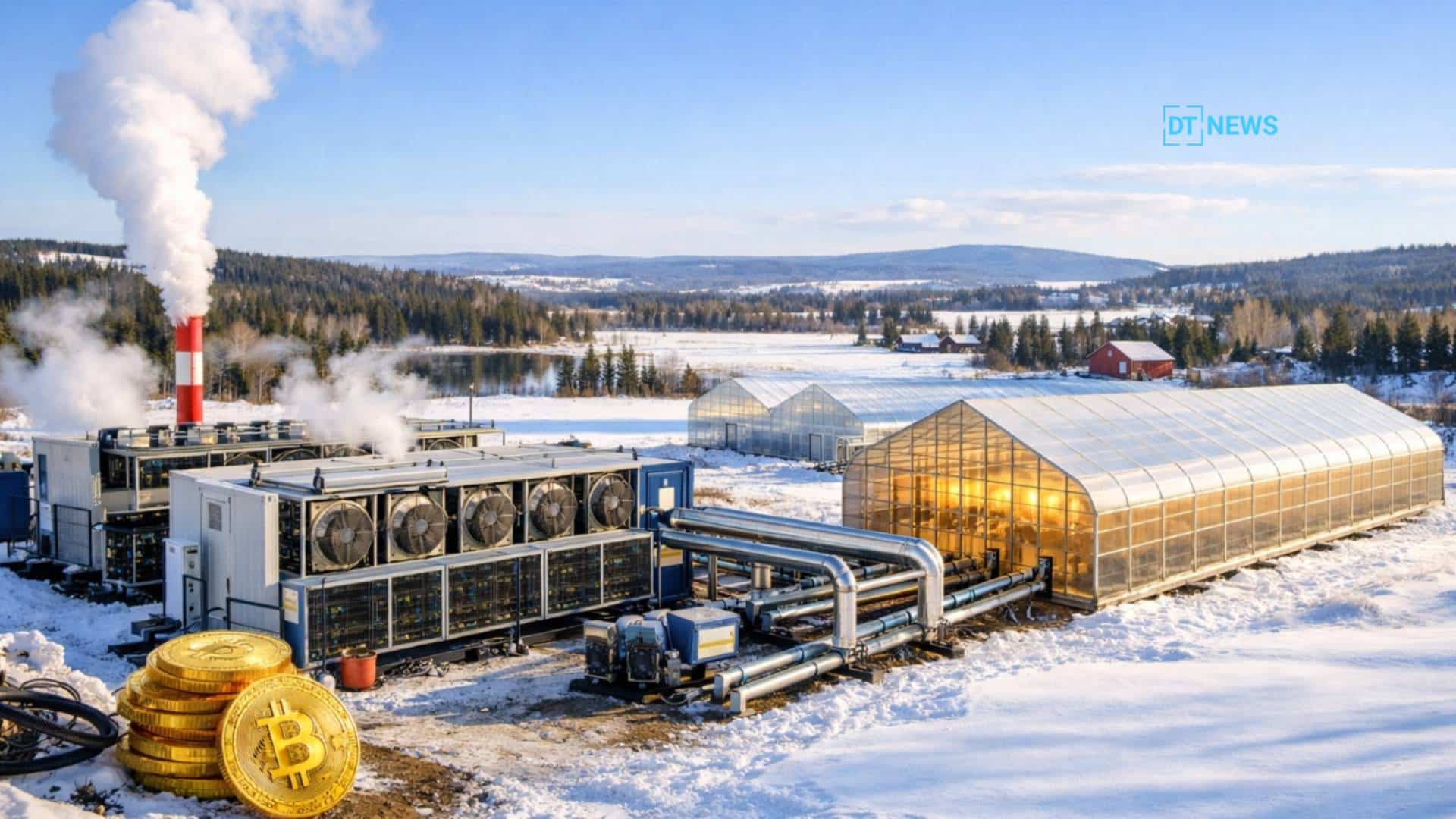

Bitcoin mining heat is being tested as a new way to provide sustainable heating for greenhouses in Manitoba, Canada. The pilot project studies how the large amount of heat generated by cryptocurrency servers can be captured and redirected to support plant growth and farming operations.
- What is the Manitoba pilot project?
- Why is Bitcoin mining heat important for greenhouses?
- How does mining heat integrate with greenhouse operations?
- Can reusing mining heat reduce operational costs?
- What are the limitations of mining-integrated heating?
- Can this model be replicated elsewhere?
- Why does this matter for Bitcoin’s long-term energy narrative?
- Conclusion
- Glossary
- Frequently Asked Questions About Bitcoin Mining Heat
In Manitoba’s cold winters, greenhouses need steady and reliable heat to maintain crops year-round. This approach could lower energy costs and reduce carbon emissions by using heat that would otherwise be wasted.
What is the Manitoba pilot project?
The Manitoba project brings together Canaan, a top mining hardware maker, and Bitforest Investment, a company focused on sustainable farming and infrastructure. The project runs with about 3 megawatts (MW) of mining power and uses roughly 360 liquid-cooled Avalon miners. It is designed as a 24-month proof of concept.
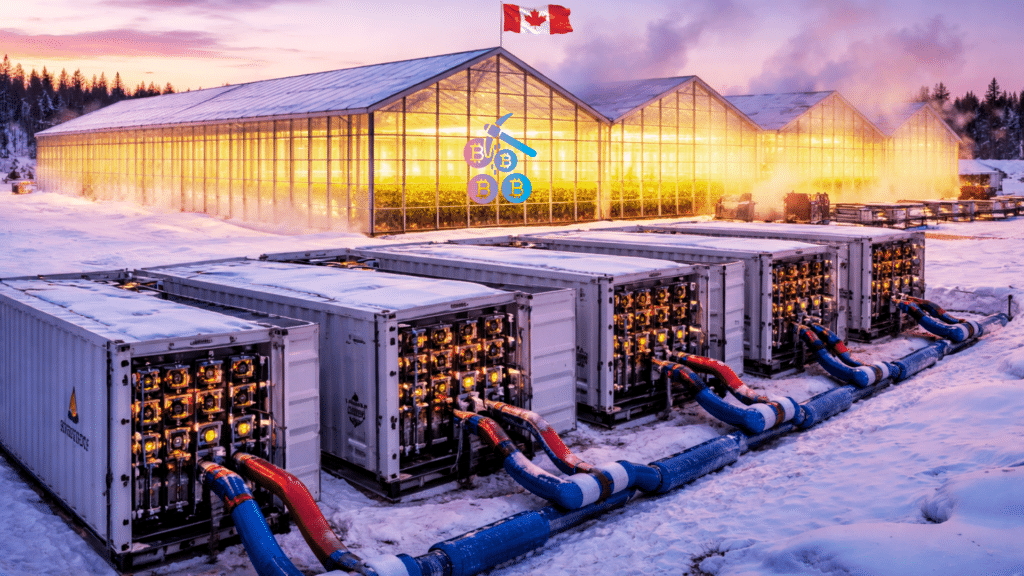
Instead of replacing regular heating systems, the setup captures heat from the mining machines and uses it to preheat water for the greenhouse’s heating system. This lowers the energy needed from conventional boilers in the cold winter months. The liquid-cooled miners are linked to a closed-loop heat exchange, which keeps the heat stable and usable for industrial-scale heating.
Why is Bitcoin mining heat important for greenhouses?
Bitcoin mining heat produces a large amount of warmth because mining machines run constantly. Normally, this heat is treated as waste and removed using cooling systems. In cold regions, throwing away this energy is inefficient because electricity is used both to create the heat and then to cool it down.
The Manitoba project changes this by turning the wasted heat into a useful resource. Liquid-cooled miners capture heat at higher and more stable temperatures than standard air-cooled machines, making it suitable for greenhouse heating. This method improves energy efficiency and also helps reduce environmental impact from electricity use.
How does mining heat integrate with greenhouse operations?
Greenhouses need steady and continuous heat to keep crops like tomatoes growing well, as they are sensitive to temperature changes. Bitcoin mining heat provides a reliable and constant source of warmth, making it a good fit for greenhouse heating. In the Manitoba pilot, the liquid-cooled miners send heat through a closed-loop system into the greenhouse’s water-based heating setup.
This system preheats incoming water, which lowers the need for boilers that run on fossil fuels. The approach keeps temperatures stable, improves energy efficiency, and allows mining operations to work as a partner in the local energy system.
Can reusing mining heat reduce operational costs?
Heating is one of the biggest expenses for greenhouse operators. Using Bitcoin mining heat can reduce fuel use and lower overall costs. For mining operators, capturing and reusing this heat makes energy use more efficient, helping sites with high heating needs become more cost-effective.
While it doesn’t stop electricity consumption, heat recovery turns a larger share of the electricity used by mining rigs into useful warmth. This approach also creates possibilities for using mining heat in industrial drying, district heating systems, and home heating, increasing both economic and environmental benefits.
What are the limitations of mining-integrated heating?
Despite its advantages, reusing Bitcoin mining heat has several important limitations that cannot be ignored. Liquid-cooled systems and heat-exchange equipment cost significantly more upfront than standard mining setups, which makes the initial investment substantial.
For this approach to be economically practical, there needs to be a steady and ongoing need for heat, and the greenhouse must be located close to the mining facility, because moving heat over long distances causes energy losses. Greenhouses rely on consistent and uninterrupted heating, so any pause in mining operations can affect temperature control and crop growth.
To maintain stability, backup systems are necessary in case of maintenance or downtime. Moreover, the environmental benefits of using this heat are greatest when the mining operation runs on low-carbon electricity, ensuring that reductions in fossil fuel use are real and meaningful.
Can this model be replicated elsewhere?
Canaan plans to use the Manitoba project as a replicable model for other cold-climate regions. By gathering detailed data on heat capture efficiency, system reliability, integration with greenhouse equipment, and overall cost savings, the pilot aims to show whether Bitcoin mining heat can be scaled up for wider agricultural or industrial applications.
If the project proves successful, similar systems could be set up in northern U.S. states, parts of Europe, and other areas that depend heavily on greenhouse heating. The Manitoba pilot demonstrates that Bitcoin mining can support regional energy needs, turning what has usually been a high-energy, standalone operation into a useful part of local infrastructure.
Why does this matter for Bitcoin’s long-term energy narrative?
Bitcoin mining heat has long faced criticism for its large energy use. The Manitoba greenhouse pilot, however, highlights a different perspective, emphasizing how that energy is put to work rather than the total amount consumed. By capturing and reusing the heat from mining rigs, operators can help reduce emissions and contribute to more sustainable regional energy systems.
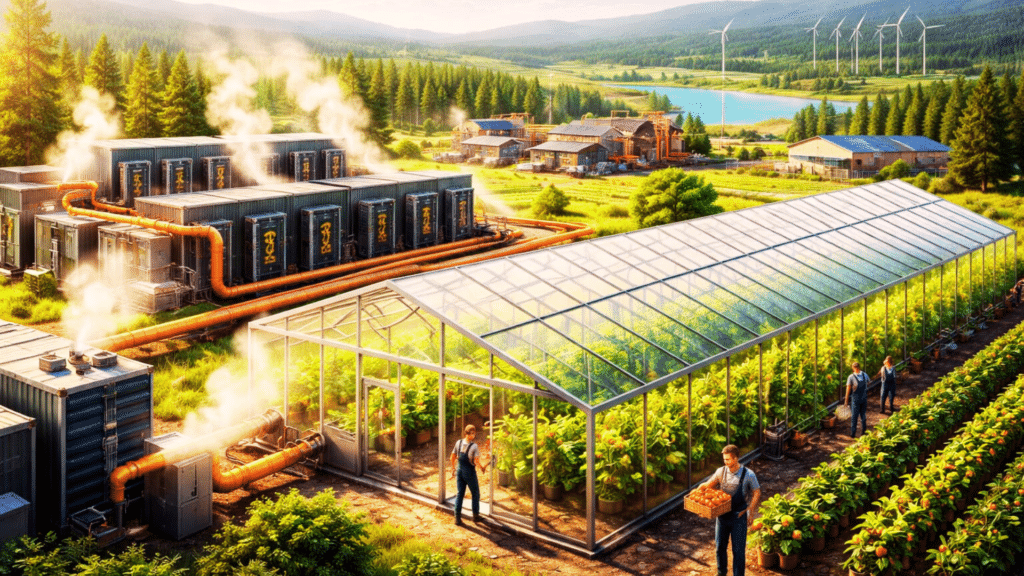
This approach frames Bitcoin mining as more than just a high-energy digital activity. Mining infrastructure could provide reliable heat for greenhouses, industrial processes, or even local community needs, shifting the view of the sector from an isolated, energy-intensive operation to a practical partner in supporting broader infrastructure.
Conclusion
Bitcoin mining heat turns into a real resource for sustainable greenhouses up north where winters bite hard. The Manitoba pilot proves thermal energy from crypto servers can preheat greenhouse water just right. That cuts back on old-school heating systems and trims down costs all around.
While challenges remain, such as upfront system costs, proximity requirements, and the need for low-carbon electricity, the initiative provides a model for integrating digital infrastructure with local energy needs. If scaled successfully, this approach could redefine the role of Bitcoin mining, turning heat that was once wasted into a productive asset for agriculture and regional energy systems.
Glossary
Bitcoin Mining: Using computers to process cryptocurrency transactions.
Greenhouse Heating: Keeping plants warm and stable inside greenhouses.
Canaan: A company that makes mining machines, including liquid-cooled miners.
Manitoba Pilot Project: A Canadian test using Bitcoin mining heat for greenhouses.
Liquid-Cooled Miner: A miner cooled with liquid to capture heat efficiently.
Frequently Asked Questions About Bitcoin Mining Heat
Why is Bitcoin mining heat usually wasted?
Most mining machines produce a lot of heat, which is normally removed with cooling systems and not used for anything.
Who is involved in the Manitoba project?
Canaan, a mining hardware company, and Bitforest Investment, a sustainable farming company, are running the project together.
How does the heat help greenhouses?
The heat preheats water in the greenhouse heating system, keeping plants warm and reducing the need for fuel-powered boilers.
What type of mining machines are used in this project?
The project uses 360 liquid-cooled Avalon miners, which capture heat more efficiently than normal air-cooled machines
What are the limitations of using mining heat?
It needs a constant heating demand, close proximity to greenhouses, backup systems for interruptions, and works best with low-carbon electricity.