
This article was first published on Deythere.
Bitcoin Iran war impact has been a key driver for global markets this week as the cryptocurrency reacted first because it trades around the clock, unlike U.S. stocks that are closed on weekends. Over the weekend and into Monday, Bitcoin movements reflected signals from both Iran and the United States, giving investors a real-time view of how these developments were affecting market sentiment outside regular trading hours.
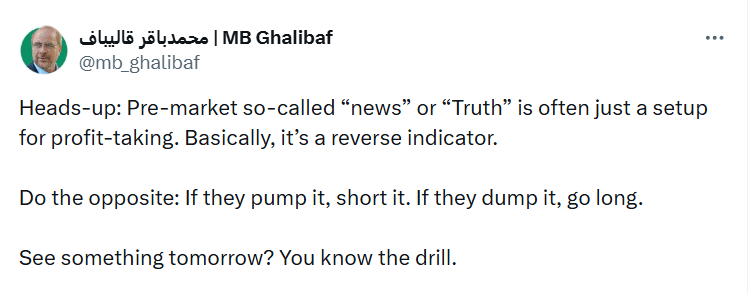
Mohammad Bagher Ghalibaf, the speaker of Iran’s parliament, shared a pre-market message on X calling conventional news a “reverse indicator.” His post sparked online propaganda disputes and raised questions about Polymarket war bets and insider trading. He wrote, “If they pump it, short it. If they dump it, go long,” advice that closely matched the actual market swings. The Kobeissi Letter tracked these changes in real time, MarketWatch verified Ghalibaf’s account, and Barron’s described Monday’s rebound as another early-morning market movement influenced by news related to Iran.
What Does Bitcoin Iran War Impact Mean for Investors?
Bitcoin Iran war impact highlights the cryptocurrency’s sensitivity to events between Iran and the U.S. Recent movements show that while Bitcoin followed the overall trend of broader markets, its timing was different. Bitcoin first reflected the Iran conflict with an 8.5% drop on Saturday, reaching a low of $67,300. It later climbed above $71,000 when signs of de-escalation appeared, then fell below $68,500 last week as mixed signals from Iran created uncertainty.
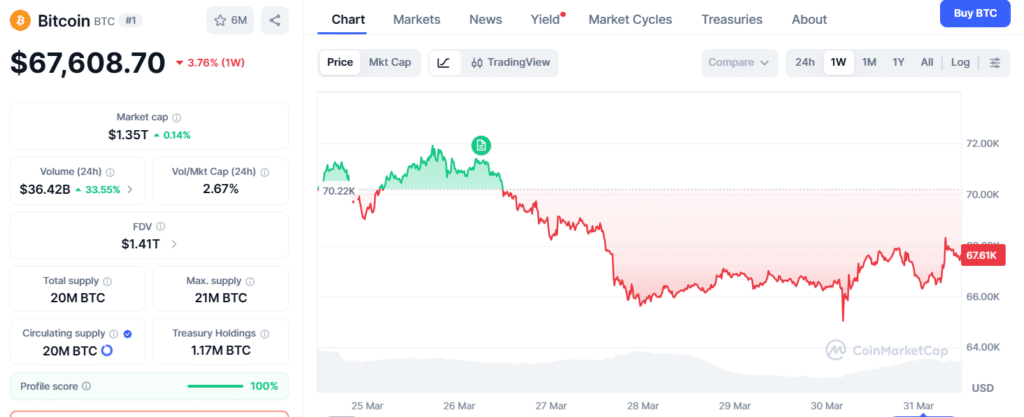
Bitcoin is currently trading around $67,630.52. This pattern shows that although Bitcoin tracked the S&P 500 at a general level, it moved more gradually during the day, forming a steady range while U.S. stocks were closed. Traders noted that Bitcoin’s around-the-clock trading gave a real-time view of market reactions, providing early insight into shifts in sentiment before the U.S. markets reopened.
How Did Geopolitical Messaging Influence Markets?
Donald Trump’s posts on Truth Social had a strong effect on both equities and oil markets. His comments about “great progress” in Iran peace talks initially pushed S&P 500 futures up by about 100 points from overnight lows, though part of these gains later reversed, causing swings worth roughly $2 trillion in market value. Bloomberg and The Wall Street Journal noted that billions of dollars in oil and stock-index futures were traded just before Trump’s posts, attracting close attention from trading desks.
Oil prices also surged, with WTI rising above $100 a barrel and Brent climbing past $116, adding to inflation concerns. Bitcoin’s movements responded to the same events but followed a slower, more gradual path compared with equities, showing its function as a live macro market while U.S. cash markets were closed. The U.S. Dollar Index also increased steadily, giving additional context for Bitcoin’s adjustments without being the main driver of its price changes.
What Lies Ahead for Markets This Week?
The coming week is being shaped by ongoing geopolitical tension, sharp moves in oil prices, and important U.S. economic data releases. The OECD expects U.S. inflation to reach 4.2% in 2026, which is 1.2 percentage points higher than its December estimate, while WTI crude has risen by about 50% since U.S. and Israeli strikes on Iran in late February. Investors are now watching several key reports, including the delayed February retail sales data on April 1, the March Manufacturing PMI on the same day, the U.S. trade report on April 2, and the March Employment Situation on April 3.

Bitcoin Iran war impact continues to offer a round-the-clock view of investor sentiment, allowing markets to adjust risk expectations even before traditional trading hours begin. Traders are using these signals to understand how geopolitical developments and oil price movements are influencing broader asset pricing, with Bitcoin serving as a useful, though not dominant, indicator during periods of uncertainty.
Conclusion
Bitcoin Iran war impact shows how geopolitical tensions, oil price swings, and political messaging come together to influence market behavior. While traditional equity markets tend to move in sharp and sudden steps, Bitcoin’s continuous trading provides a clearer real-time view of investor sentiment outside U.S. market hours.
This week, Bitcoin hovered between the mid-$66,000s and mid-$67,000s, reflecting mixed signals from Iran and U.S. developments. Investors and traders are closely tracking both geopolitical updates and upcoming economic data to assess risk, with Bitcoin acting as an indicator of uncertainty rather than a definite predictor of where markets will move next.
Disclaimer: This article is only for information. It is not financial advice. Please do your own research before making any investment decisions.
Glossary
Polymarket: Platform for betting on real-world outcomes
S&P 500 Futures: Contracts predicting US stock market direction
U.S. Dollar Index (DXY): Gauge of the dollar’s global strength
Safe-Haven Narrative: Assets seen as stable in crises
Cross-Asset Movement: Price shifts across multiple markets
Frequently Asked Questions About Bitcoin Iran War Impact
What is Bitcoin Iran war impact?
Bitcoin Iran war impact means how the Iran conflict affects Bitcoin price and market behavior.
Why does Bitcoin react before stock markets?
Bitcoin reacts first because it trades 24/7 while stock markets close on weekends.
How did Donald Trump’s posts affect markets?
Donald Trump’s posts caused quick price changes in stocks, oil, and crypto markets.
Why did oil prices rise during this period?
Oil prices rose because war risks can disrupt supply and increase global demand fears.
How does Bitcoin help investors during such events?
Bitcoin helps investors by showing real-time market sentiment when other markets are closed.