
























Fears of Bitcoin stagflation have returned as new U.S. PMI data shows a worrying combination of slowing growth and rising costs. The latest figures reveal an economy with waning momentum and inflation that isn’t backing off; a pairing that has for decades been a drag on risk assets, including Bitcoin.
- Retail PMI Data Indicate a Fragile Economy
- Behind the Data: Why Markets Were Uneasy
- Why This Matters for Bitcoin
- Market reaction: Bitcoin and Macro Assets Are on the Same Page
- Conclusion
- Frequently Asked Questions About Bitcoin Stagflation Fears
- Why are fears of Bitcoin stagflation fears surfacing now?
- How does stagflation affect Bitcoin?
- What does this mean for the Federal Reserve?
- How did Bitcoin price react to the PMI data?
- What should traders watch next?
- References
Markets absorbed the implications as Bitcoin stagflation fears intensified. Now, traders are re-evaluating their expectations about interest rates, liquidity and macro stability while Bitcoin is stuck around the $70K-$71K level.
Rising oil prices associated with the Iran conflict, higher treasury yields and stubborn inflation are all contributing to this Bitcoin stagflation fears.
Retail PMI Data Indicate a Fragile Economy
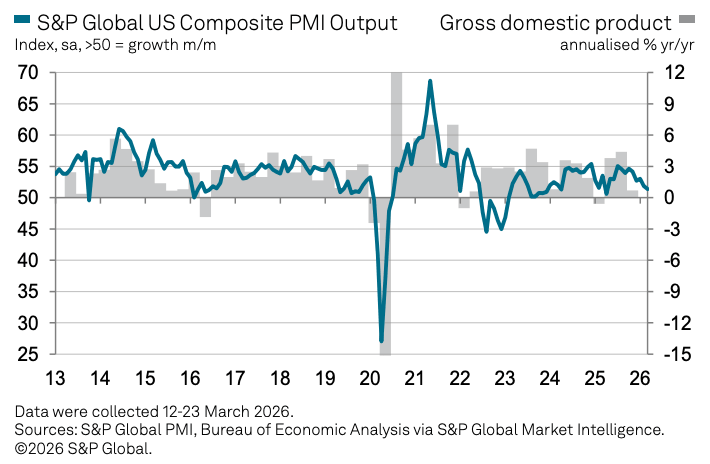
The latest data from S&P Global showed that U.S. business activity slowed in March. The composite PMI fell to 51.4 from 51.9; pointing to weaker growth across the economy.
Services; which account for the bulk of U.S. economic output, slowed more sharply to 51.1. Manufacturing ticked up a bit to 52.4; but the details of that increase caused worries rather than reassurance.
Firms recorded the quickest increase in input costs in 10 months and employment fell for the first time in more than a year. It is this combination that triggered Bitcoin stagflation fears.
Also; rising energy costs linked to geopolitical tensions have increased production costs, while growth momentum is reducing across major economies.
This mix of deceleration and inflation is precisely what stagflation means. And it makes things hard for policymakers and markets alike.
Behind the Data: Why Markets Were Uneasy
The strongest detail in the PMI report is the difference between manufacturing and services.
Manufacturing strength wasn’t because of strong demand. Instead; companies are buying more and building inventories, trying to insulate themselves from supply disruptions and higher costs. Supplier delivery times also stretched out; adding to the impression that companies are reacting defensively.
On the other side, services exhibited notable weakness. Business slowed, exports fell and confidence dropped. Companies cited rising living costs, pressure from borrowing and uncertainty related to war as major factors.
According to S&P Global, the data pointed to U.S. economic growth of about 1% annualized, and inflation trends that could return toward 4%.
This is precisely why Bitcoin stagflation fears are coming back. Markets are suddenly pricing a scenario in which growth comes down but inflation stays high and stubborn.
Why This Matters for Bitcoin
Stagflation fears matter because Bitcoin is still in risk asset trade mode for the time being.
Bitcoin has always performed best during periods of strong liquidity and loose monetary policy. But the current setup is going in the other direction.
So far, the Federal Reserve has indicated it is cautious. Officials held rates steady in March and cautioned that inflation is still “somewhat elevated,” allowing little room for imminent cuts.
At the same time, bond yields have moved higher and market expectations for aggressive rate cuts have fades. That makes it an even harsher climate for Bitcoin. Higher yields and tighter liquidity tend to pull capital from risk assets like crypto.
Other research from S&P Global also suggests Bitcoin’s price movement is increasingly correlated with financial markets, rather than serving as a pure hedge. Its volatility might be decreasing, but its susceptibility to macro conditions is strong.
Market reaction: Bitcoin and Macro Assets Are on the Same Page
Bitcoin’s initial response to the PMI was swift but controlled. The asset fell back below the $70,000 mark while traders adjusted to the data.
The overall market reaction played out in almost the same way. Oil remained high based on the Iran conflict, Treasury yields rose and the U.S. dollar held firm.
The crypto markets have already displayed a sensitivity to signals from the Federal Reserve this month. After the most recent policy decision, Bitcoin dropped nearly 4 percent.
Conclusion
Bitcoin stagflation fears are currently changing market expectations. The latest PMI data confirms; that growth is slowing even as inflation stays elevated. That puts the Federal Reserve in a tight spot and reduces the likelihood of any sharp rate cuts.
This sets Bitcoin up for a tougher environment in the short term. There has been no expanding liquidity, yields are increasing and macro uncertainty remains persistent.
The next big test will come with the forthcoming inflation and labor data. Bitcoin could continue to be under pressure from these factors that are increasingly difficult to ignore.
Glossary
PMI: Purchasing Managers’ Index; an important economic benchmark which gauges business activity.
Stagflation: a scenario in which economic growth slows; but inflation stays elevated.
Treasury yields: the returns on U.S. government bonds; and they help influence global financial conditions.
Liquidity: the degree to which money flows through markets and props up asset prices.
Risk assets: investments such as stocks and cryptocurrencies that respond to economic conditions.
Frequently Asked Questions About Bitcoin Stagflation Fears
Why are fears of Bitcoin stagflation fears surfacing now?
They are rising because PMI data shows a reducing growth coupled with rising prices; one of the classic signatures of stagflation.
How does stagflation affect Bitcoin?
Stagflation typically results in tighter monetary policy that shrinks liquidity and weighs on risk assets such as Bitcoin.
What does this mean for the Federal Reserve?
The Fed sets interest rates. Sustained high inflation could push back rate cuts; which negatively affects Bitcoin.
How did Bitcoin price react to the PMI data?
While Bitcoin fell below $70,000; it did not crash as the market adjusted.
What should traders watch next?
Inflation and employment data will clarify whether the risks of stagnation are growing or fading.