
The Binance Iran probe has pushed the world’s largest cryptocurrency exchange back into regulatory scrutiny as U.S. authorities review whether Iran-linked crypto flows moved through networks tied to the platform despite recent compliance reforms.
According to the source, the U.S. Department of Justice (DOJ) is investigating suspicious crypto transfers linked to Iranian entities, including more than $1 billion reportedly routed through Blessed Trust. The probe comes less than three years after Binance reached a $4.3 billion settlement with U.S. authorities over sanctions and anti-money-laundering violations.
The renewed Binance Iran probe raises broader concerns for the crypto industry, suggesting regulators could tighten oversight across major exchanges if compliance failures are confirmed.
Settlement History Returns to the Spotlight
Binance Iran probe carries unusual significance because the exchange already admitted compliance failures in 2023 and paid billions in penalties while accepting years of regulatory oversight to strengthen sanctions monitoring.
Now prosecutors are examining whether Iran-linked crypto flows continued through intermediary networks despite those reforms. Earlier reports suggested Binance’s own investigators flagged suspicious activity during internal compliance reviews.
Around $1.7 billion in transfers were reportedly tied to sanctioned networks, including one account labeled “internal,” raising questions about how intermediary accounts and alerts were handled. Binance denies wrongdoing, saying its review found no sanctions violations and that suspicious entities were removed. The company has also filed a defamation lawsuit related to reporting about the Iran investigation
Investigators are still determining whether the case ultimately targets Binance itself, specific users, intermediary networks, or a combination of all three.

Binance Iran Probe and the Complex Route of Iran-Linked Crypto Flows
The Binance Iran probe highlights how difficult it can be to trace Iran-linked crypto flows across modern blockchain networks. Digital assets often move through multiple wallets, exchanges, and intermediaries before reaching their final destination.
Blockchain analytics research from this industry study shows that stablecoin transactions exceeded $1 trillion in monthly volume several times in 2025, while illicit entities received about $141 billion through crypto wallets that year. Notably, 86% of those illicit funds were linked to sanctions-related activity, explaining why regulators closely monitor large exchanges when suspicious crypto flows appear.
Iran’s own crypto ecosystem adds another layer. Analysts report that the exchange Nobitex handled over 87% of Iran’s crypto trading volume in 2025, processing roughly $3 billion, with about $2 billion moving through the TRON network using TRC-20 USDT tokens.
Market Data Shows Scale and Stability
Despite headlines around the Binance Iran probe, the broader crypto market has remained stable. Bitcoin trades near $69,900, while BNB sits around $643, with Bitcoin dominance close to 58%, suggesting investors still separate Bitcoin from exchange-specific risks.
The scale of Binance highlights why the investigation matters. Kaiko research shows the exchange processes over $20 billion in daily spot trading across about 1,630 trading pairs and serves nearly 300 million users.
Industry data also indicates Binance controlled roughly 38.3% of centralized exchange spot trading in December 2025, with $361.8 billion in monthly volume and about $7.3 trillion traded during 2025. The platform reportedly holds around $151 billion in reserves and handles close to $10 billion in daily spot volume.
Possible Outcomes of the Binance Iran Probe
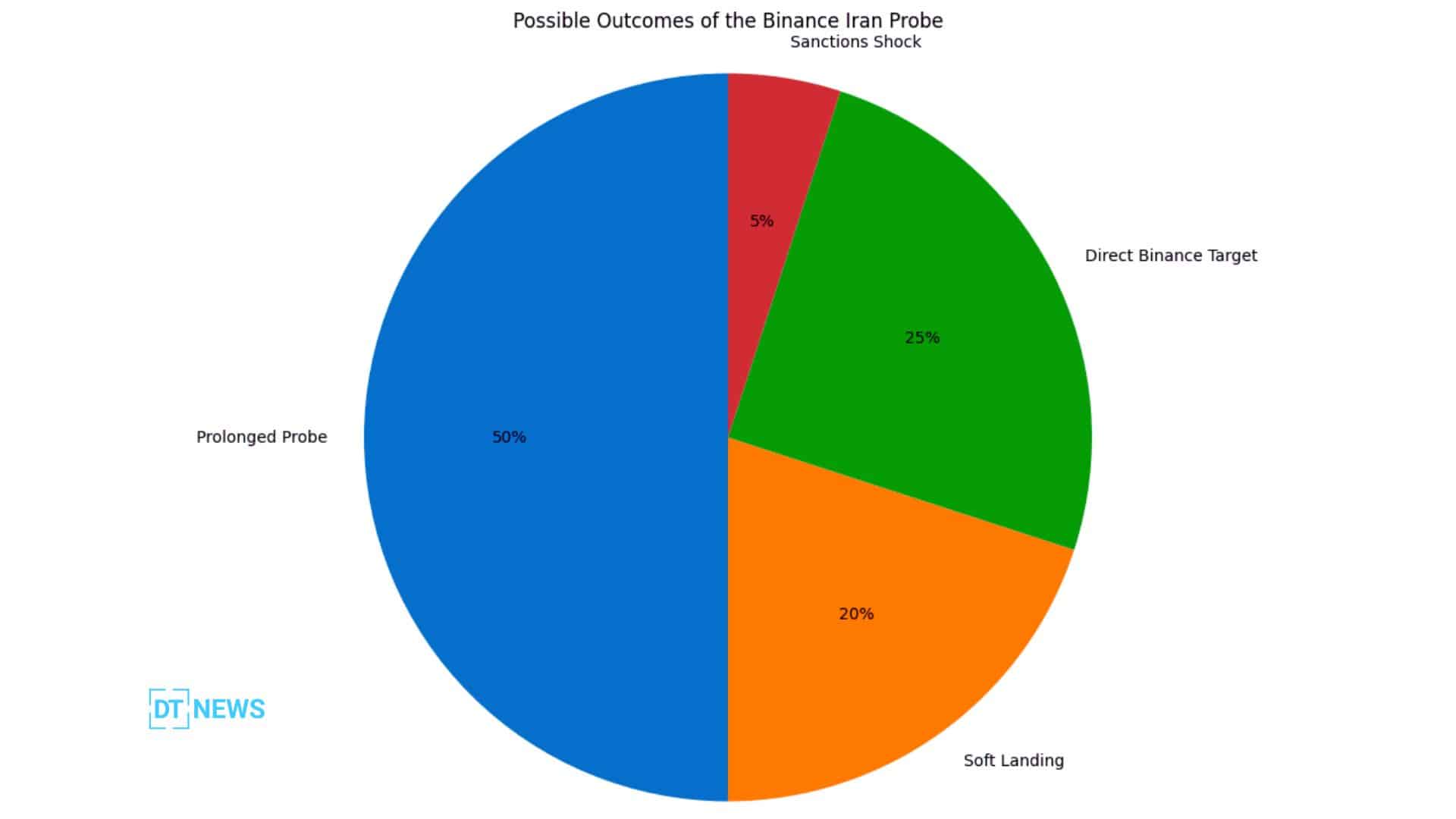
The Binance Iran probe could develop in several directions depending on what investigators uncover about Iran-linked crypto flows. Analysts estimate the most likely outcome, with a 50% probability, is a prolonged investigation with limited immediate market impact.
A softer scenario (20%) could occur if regulators focus mainly on individual users or intermediary networks rather than Binance itself. However, a 25% probability remains that regulators may place the exchange directly under scrutiny if they conclude Binance failed to prevent sanctions-related activity.
The least likely outcome, estimated at 5%, would involve broader enforcement actions targeting settlement routes tied to Iran-linked crypto flows. Investigators are still determining the scope of the case, which could ultimately focus on customer misuse, intermediary networks, or Binance itself if compliance failures are confirmed.
Conclusion
The Binance Iran probe is becoming a key test of how well global crypto exchanges enforce sanctions rules. Blockchain allows money to move quickly across borders, but that same speed makes tracking Iran-linked crypto flows difficult for regulators.
At the moment it maintains confidence that the DOJ investigation is looking into transaction data and compliance systems. Nonetheless, how this case turns out could also remake prospects concerning transparency and oversight throughout crypto industry.
Should the investigation on Binance Because of Iran result in more stringent rules of compliance, this entire sector will face increased scrutiny under regulation in years to come.
Glossary of Key Terms
Sanctions Compliance: Regulations that prevent financial institutions from processing transactions linked to restricted countries or sanctioned individuals.
Crypto Liquidity: The ability to buy or sell digital assets quickly without causing large price changes.
Intermediary Wallet: A wallet used to move funds between parties, sometimes obscuring the original transaction source.
Blockchain Analytics: Technology used to analyze blockchain data and identify suspicious financial activity.
FAQs About Binance Iran Probe
What is the Binance Iran probe?
The Binance Iran probe refers to a U.S. Department of Justice investigation into whether Iranian entities used networks connected to Binance to bypass sanctions.
What are Iran-linked crypto flows?
Iran-linked crypto flows are cryptocurrency transactions suspected of involving Iranian entities or networks tied to sanctions evasion.
Did Binance’s internal investigators flag suspicious activity?
Reports suggest Binance’s internal investigators flagged suspicious transfers during compliance reviews, though the company denies sanctions violations.
Why does the investigation matter for the crypto industry?
Because Binance processes billions in daily trading volume, regulatory action could influence market liquidity, investor confidence, and exchange compliance standards.