
























This article was first published on Deythere.
- Why People Rotate from Bitcoin into Altcoins
- The Volatility Reality: Drawdowns and Recovery Timelines
- What Bitcoin Dominance Can (Or Can’t) Tell You
- When Altcoins Usually Outperform Historically
- When Altcoins Usually Underperform (Risk-Off Environments)
- Portfolio Role: Core vs Satellite Positions
- Liquidity and Survivorship Bias: Why “Best” Changes Over Time
- How to Size Altcoin Exposure Responsibly
- Signals to Reduce Risk (Funding, Leverage, Macro, Stablecoins)
- A Simple Allocation Framework for Different Risk Profiles
- Conclusion
- Glossary
- Frequently Asked Questions About Best Altcoin Investments vs Bitcoin
- What is Bitcoin dominance and what does it mean?
- When does “altcoin season” usually take place?
- What percentage of one’s crypto portfolio should be in altcoins?
- Why do a lot of altcoins fall despite Bitcoin rallying?
- What are the signs one must be cautious of while investing in altcoins?
- References
It’s not uncommon for investors to seek the best altcoin investments, however there’s need to be aware of when the right time is to prioritize altcoins over Bitcoin and vice versa.
There are certain market cycles and data-driven signals to understand why funds rotate into altcoins, the volatility and drawdowns they experience, and how investors should think about combining Bitcoin exposure with alt exposure for their portfolio.
Why People Rotate from Bitcoin into Altcoins
As a rule, the big crypto bull runs begin with Bitcoin at the forefront. As the early investors capture profits, the gains available in Bitcoin outweigh the risks less and less, leading to a quest for something new that could bring more gains.
This ends up pushing capital into altcoins in pursuit of capturing additional “alpha.” For instance, when Bitcoin has its early rally, money tends to go into the larger altcoins like Ethereum or Solana that had more room to run. Based on historical cycles, there have been Bitcoin dominance drop from 70% to 45% during 2017 and 2021 as altcoins boomed.
This altcoin rotation is somehow mechanical because when Bitcoin is “fully priced” in the short-term, traders look for higher volatility coins with large returns. Actually, Investors who watch Bitcoin’s value stabilize or trade flat may move their profits into altcoins in an effort to capitalize on a stronger upside.
Evidence of this move includes the decreasing Bitcoin dominance, increasing altcoin market cap and volume explosion in a series of altcoin markets.
The Volatility Reality: Drawdowns and Recovery Timelines
Crypto markets are famously volatile. Even in bull markets, 20-40% pullbacks are both common and usually short-lived. For Bitcoin, there has been heavy drawdowns repeatedly; since 2014, it has suffered four corrections over 50%, with three averaging about 80% losses.
Data gives good evidence that these deep drawdowns often last years to recover. The 2014-2015 crash, for example, took almost three years for Bitcoin to return to where it was. Altcoins are even worse. In the post 2022 crash, total market cap excluding BTC fell 80% before surging roughly 400% over the subsequent two years.
However, crushing volatility can be followed by recovery. In fact, the largest intra-year drawdowns tend to occur in Q1, and are then followed by solid rallies during the rest of year.
Seasonality counts for something too. Many big corrective phases come early in the cycle to “shake out” weak hands and are followed by strong gains.
Investors who follow disciplined approaches (dollar-cost-averaging and holding through core positions) have been known to fare better than the panic-sellers.
For portfolios, this means preparing for volatility, establishing stop-loss or rebalance rules and concentrating on long-term returns.
Table: Historical Drawdowns and Recoveries (Bitcoin, Select Periods) (illustrative)
| Drawdown Period | Peak to Trough (%) | Months to Bottom | Months to Full Recovery |
| 2013–2015 (Capitulation) | -80% | 12 | 36 |
| 2017–2018 (Bear Market) | -83% | 12 | 42 |
| 2021 (NFT/Crypto Peak) | -75% | 9 | 28 |
| Average of above | -79% | 11 | 35 |
What Bitcoin Dominance Can (Or Can’t) Tell You
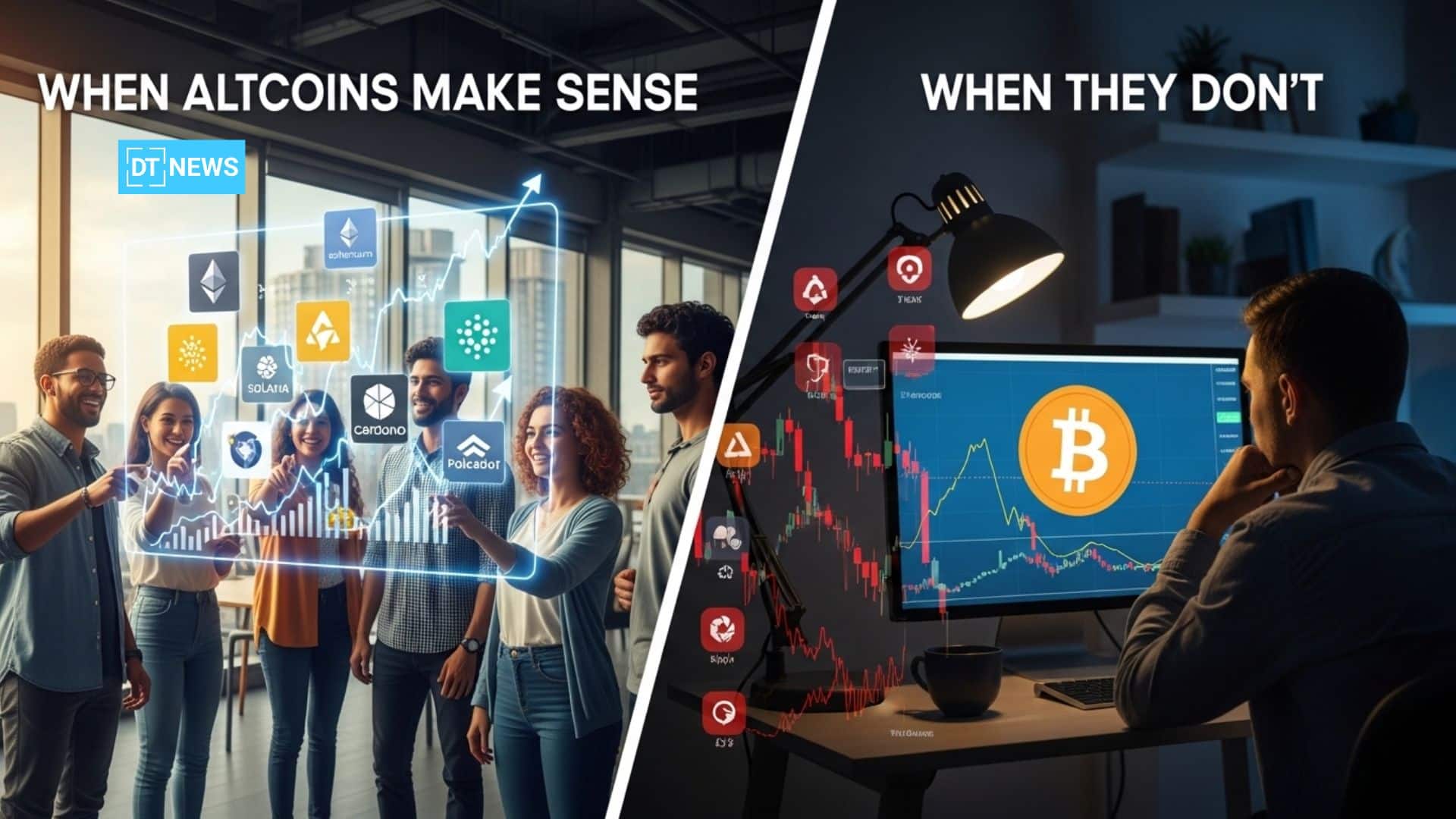
Bitcoin dominance is a popular measure derived from the Bitcoin market cap divided by the total crypto market cap. When dominance climbs, it usually means capital moving into Bitcoin (or out of alts), and is typically a sign of risk-off. On the contrary, a dropping dominance indicates capital is flowing into altcoins.
In many altcoin seasons, BTC dominance would drop below 50%, as money flowed into alts. Declining dominance has mostly coincided with altcoin rallies seen in 2017 and 2021, indicating a potential of an “altseason” where altcoins may begin to outperform Bitcoin.
However, Bitcoin dominance has limitations. It includes stablecoins and is influenced by the way market cap is calculated. For instance, growth in stablecoin (USDT, USDC) can reduce BTC’s share without any real alt rally.
In other words, dominance is a useful sentiment indicator but not a crystal ball. It is a tool to be used along with volume, price and other indicators for potential rotation. If dominance drops while Bitcoin’s price is stable or rising, it usually means a rise in risk appetite and that altcoins are catching speculative bids.
When Altcoins Usually Outperform Historically
In history, altcoins have popped after Bitcoin’s major rallies or when BTC loses momentum. During a bull market, as Bitcoin’s initial run maxes out, investors look for where they expect to make the next big gains.
As an example, following Bitcoin’s path to $20K at the end of 2017, altcoins such as Ethereum surged, leading to the 2018 altcoin season. Likewise in 2021, when Bitcoin’s growth cooled, DeFi, NFTs and meme coins brought in a fresh wave of alt rally.
These phases normally require risk-on conditions such as abundant liquidity, low interest rates and bullish investor sentiment.
Technical breakouts can also come before outperformance in alts. Crypto analysts add that when Ethereum breaks out from long consolidation ranges, it often leads to a general alt rally.
The premise is that good performance in a leading alt like Ethereum can trigger such an effect. Once the leading coin “clears” resistance, capital flows into other alts to enable outsized movements.
During these times, smaller cap projects could yield the best altcoin investment returns, as long as the overall crypto trend is up.
All in all, altcoins perform well during later stages of bull markets not randomly. This rally is mostly enabled when Bitcoin rally ends, by macro liquidity inflows as well as by certain catalysts like l blockchain upgrades.
It’s always worth noting that past cycles are not a guarantee of future results. Data-driven trends showed that when all three assets appreciate, that is, Bitcoin, Ethereum and stablecoin flows communicating availability of capital, alts outperform.
When Altcoins Usually Underperform (Risk-Off Environments)
Altcoins are liable to wither in risk-off scenarios. In times of economic worries like hawkish central banks, higher bond yields and market stress, investors pile into “safer” assets.
In crypto, that frequently includes Bitcoin and stablecoins while speculative altcoins underperform. This can be seen from data in late 2025; following a big selloff, funding rates across many alt markets became deeply negative while Bitcoin barely flinched.
Leveraged alt longs were left to bleed, traders had modified their capital placement, leaving alt assets under pressure.
Moreover, when world markets go down, crypto generally does so even faster. When the tech sector falls or when geopolitical crises hit, altcoins are often affected the most.
In other words, altcoins generally see a period of underperformance when there is high macro volatility and liquidity is desired by market participants. Worsening funding rates, futures market deleveraging, and reduced ETF inflows can be indicators of warnings to bet less on alts.
Portfolio Role: Core vs Satellite Positions
In a well-diversified crypto portfolio, Bitcoin (and usually Ethereum) are the “core” holdings and altcoins are more of a “satellite” or tactical allocation. Due to things like its size, liquidity and overall stronger track record, Bitcoin serves as an anchor that can protect core market exposure.
Institutional models, for instance, tend to put as much as 40-80% of crypto funds into Bitcoin as core positions. These blue-chip assets have longer market history and cycle over the entire market which can smooth out total portfolio volatility.
Satellite positions (altcoins, DeFi tokens, new protocols) are usually a lesser share, but with high risk and high potential reward. Experts recommend a core/satellite split of about 60% to Bitcoin+Ethereum, 30% to major altcoins (such as Solana, Cardano, Avalanche) and emerging themes and 10% in stablecoins or tokenized yield.
This design anchors performance to BTC/ETH but leaves enough to take advantage of alt-market rallies. It is similar to the traditional 60/40 investing logic. Bitcoin/Ethereum are the 60% foundation, altcoins are the 30% cornerstone growth engine, and stablecoins/yield (10%) function as dry powder.
The suitable precise balance will depend on the investor’s goals, but the core-satellite framework helps manage risk by not risking everything on one alt.
Liquidity and Survivorship Bias: Why “Best” Changes Over Time
The crypto space evolves rapidly. Altcoins can spike onto the scene one week and crash off of it the next. A coin that was the “best altcoin investment” in one cycle can have no value later.
This high rate of failure results in survivorship bias as most traders tend to remember the successes (the rare 100x winners) and forget about all the countless projects that simply went to zero.
As research points out, the average altcoin has fallen 90% against Bitcoin within 10-20 months after its peak. Even the big names eventually experience losses that are even deeper (Cardano and XRP each took 3 years to drop 90% from peak).
Liquidity is another issue. The market depth for smaller coins can dry up when there’s a crash, which is a very bearish sign, because it means traders find it hard to exit their positions.
The sheer quantity of tokens, millions made from ICOs, DeFi farms and Solana forks, means that capital is fragmented. As an example, 89% of early 2025 new listings had already seen prices dip below previous peaks. Many altcoins are fueled by hype, not long-term use case, so their best performance is typically short-lived.
All that is to say, the best altcoin identity isn’t a fixed place in the rankings. It moves as projects wither and new ones sprout. Smart investors hedge against this by buying broad, liquid baskets of altcoins (i.e. major altcap funds or indexes) as opposed to making a bet on any single new token.
How to Size Altcoin Exposure Responsibly
Because of these risks, altcoins should typically be a small portion of a crypto portfolio. Industry guides recommend scaling altcoin allocations to risk tolerance.
So, conservative portfolios may hold 0-5% in altcoins or avoid them entirely, while moderate investors might use 5-10%. Aggressive, crypto-native tactics might have you as high as 10-15% in altcoins most of the time, but rarely more. Even with that, holding multiple smaller alts positions is just spreading the risk.
Trading conditions should also be accounted for in sizing. For example, if perpetual futures funding rates suddenly surge positively, it means that many longs are leveraged and the market may be overbought. Under those overheated conditions, it makes sense to trim back alt exposure.
Similarly with Bitcoin ETFs and macro indicators getting bearish, reducing alt positions in favor of stablecoins or core BTC can preserve capital. Effective management involves rebalancing, that is, taking profits from alt rallies (risk assets) and putting them back towards solid holdings.
Always maintain an emergency buffer. Many investors hold some stablecoins as “dry powder” for risk-off periods or when they spot buying opportunities.
While the focus is on alt vs BTC, moving to cash (fiat) or stablecoins is a valid way to reduce the amount of crypto risk as well when things heat up.
Signals to Reduce Risk (Funding, Leverage, Macro, Stablecoins)
There are some market signals that would suggest altcoin risk is increasing. These are:
Derivatives metrics: these are important. If the funding rates which is the cost of holding perpetual futures soar to extremes, it means leverage is excessive and a correction might be sharp. For instance, in late 2025, many Altcoins saw heavily negative funding suggesting massive de-risking just as prices fell. It is important to look for open interest and liquidation cascades, as big one day volume spikes often come alt crashes.
Macro indicators: In the past, whenever monetary policy tightens, bond yields have spiked or equities have fallen out of favor, crypto investors flock back to Bitcoin or cash. For that reason, alt positions should be eyed with caution if fed rate hike were to materialize or any negative economic news.
Stablecoin dynamics: this is one underappreciated indicator. When stablecoin supply is expanding rapidly, it often signals fresh liquidity ready to deploy in crypto markets. Inversely, if stablecoin growth stalls or the market sees outflows, this means the altcoin fuel tank is empty. Glassnode’s altseason model shows that increasing Ethereum capital flow and growing supply of stablecoins are the features of real alt rallies. This should be taken as a signal to trim back those aggressive bets if net issuance of stablecoins slows or reverses.
Finally, using traditional sentiment indicators like Crypto’s Fear and Greed Index or extreme call/put skew can also be suggesting that overconfidence or panic is nearing its peak. In other words, if leverage and sentiment indicators flash “overheated,” dial back alt exposure. If risk factors fall (funding flips negative, equities tumble, stablecoins stagnate), treat it as a red light for aggressive alt bets.
A Simple Allocation Framework for Different Risk Profiles
The following is an example of allocation model for Bitcoin, Ethereum and other altcoins according to the investor’s risk tolerance. This encompasses the principle that Bitcoin and Ethereum are included in the core, while other altcoins stay at a reasonable percentage.
| Risk Profile | Bitcoin (BTC) | Ethereum (ETH) | Other Altcoins | Stablecoins/Yield* |
| Conservative | 80% | 15% | 5% | 0–5% |
| Moderate | 70% | 20% | 10% | 0–5% |
| Aggressive | 60% | 25% | 15% | 0–5% |
Stablecoins are for emergency use, and can be adjusted based on personal strategy.
Naturally these percentages are just basic starting points and would need rebalancing should markets change. No more than a small percentage, often less than 15% should go to altcoins in all. That way, a portfolio doesn’t get wiped out in the event of an across-the-board altcoin crash.
Conclusion
The best altcoin investment strategy is one that aligns with market cycles and risk appetite level, not one which blindly chases after the hottest token. In bull phases, the altcoin market might also outperform BTC, particularly after the rally on Bitcoin cools off and risk-on environments are established.
Noteworthy signals such as a decrease in Bitcoin dominance, an increasing stablecoin supply, and improving derivatives flows tend to occur with these rallies. But in risk-off periods when sharp macro selloffs, Fed tightening, extreme leverage take over, altcoins underperform drastically.
By regarding altcoins as high-beta, satellite positions and by having concrete guidelines based on cycle indicators, liquidity, fundamentals, traders can be much more confident about when altcoins do make sense or not.
Glossary
Altcoin: A term for any cryptocurrency other than Bitcoin (e.g. Solana, Cardano).
Bitcoin Dominance: The proportion of crypto market cap that belongs to Bitcoin. It’s a rough measuring stick for how the market feels about Bitcoin vs other coins.
Core-Satellite: A portfolio strategy where the “core” is made up of conservative bluechips (BTC, ETH) providing stability and the satellites are positions in aggressive altcoins targeting extra profits.
Drawdown: The decline in an asset’s price, from its peak to its trough.
Risk-Off: A market environment where traders are seeking safety (e.g. in Bitcoin and stablecoins) instead of taking risks by buying the more speculative assets like altcoins.
Funding Rate: A recurring charge that is swapped between longs and shorts in perpetual futures. Extreme rates can be a sign of overheated markets or deleveraging phases.
Frequently Asked Questions About Best Altcoin Investments vs Bitcoin
What is Bitcoin dominance and what does it mean?
Bitcoin dominance refers to the percentage of Bitcoin’s market cap against all crypto at once. Generally when dominance rises that indicates risk-off sentiment (capital flowing to BTC). Declining dominance frequently comes alongside altcoin rallies, although it’s not 100 percent guaranteed; growth in stablecoins or a rising tide for Ethereum can also distort the metric.
When does “altcoin season” usually take place?
Altcoin season usually comes after Bitcoin’s initial bull run has stalled. In prior cycles (2017, 2021): Bitcoin broke out first, thereafter dominance fell under 50%, and altcoins took off.
What percentage of one’s crypto portfolio should be in altcoins?
This depends on risk tolerance. Typical financial planners advise to allocate a small satellite portion of trader’s investment to altcoins, maybe 0-5% if conservative and 10-15% for aggressive investors.
Why do a lot of altcoins fall despite Bitcoin rallying?
Many altcoins lack long-term fundamentals. Research indicates that the average altcoin declines 90% compared to BTC in the months after its ATH.
What are the signs one must be cautious of while investing in altcoins?
Watch derivatives and macro factors. When perpetual futures funding rates are very positive or negative, leverage is too high and correction risk rises. If things go bad economically or Bitcoin ETF flows reverse course, altcoins can sink. Also keep an eye on stablecoin supply as stagnation would indicate that ‘alt liquidity’ is waning.
References