


























ASTER vs Hyperliquid is becoming a key battle as decentralized finance expands and Layer 1 networks rethink their strategies to stay competitive. With stablecoins acting as a bridge between traditional finance and on-chain markets, platforms are now focusing on areas like real-world assets, AI, and NFTs to drive growth.
- Why is Hyperliquid leading the perpetual trading market?
- Why is ASTER facing pressure despite new strategies?
- How is USD1 being used as a counter strategy?
- What do key metrics reveal about the competition?
- How does USD1 compare with USDT in growth?
- What does this mean for the broader DeFi landscape?
- Conclusion
- Glossary
- Frequently Asked Questions About ASTER WLFI Partnership
Hyperliquid recorded $620 billion in Q1 perpetual volume, while ASTER reported $318 billion, showing a clear gap in scale. At the same time, Hyperliquid [HYPE] rose 43% as ASTER declined 3.32%, highlighting the difference in momentum between the two.
Why is Hyperliquid leading the perpetual trading market?
Hyperliquid leads with $620 billion in Q1 perpetual volume, nearly double ASTER’s $318 billion. Oil trading has been a major driver behind this strong performance, helping maintain steady liquidity even as overall market activity slowed.

This strength is also reflected in price trends. HYPE gained 43% in Q1, while ASTER dropped by 3.32%. The ASTER vs Hyperliquid comparison shows how traders have continued to favor platforms with deeper liquidity and active commodity markets.
Why is ASTER facing pressure despite new strategies?
ASTER has been under pressure due to broader market uncertainty, with both ASTER and WLFI testing key support levels after declines from earlier highs. These conditions reflect ongoing macro concerns that continue to impact Layer 1 ecosystems.
Even with new developments, the ASTER vs Hyperliquid gap remains significant. The network still has a long way to go before recovering earlier price levels, making execution and adoption key factors going forward.
How is USD1 being used as a counter strategy?
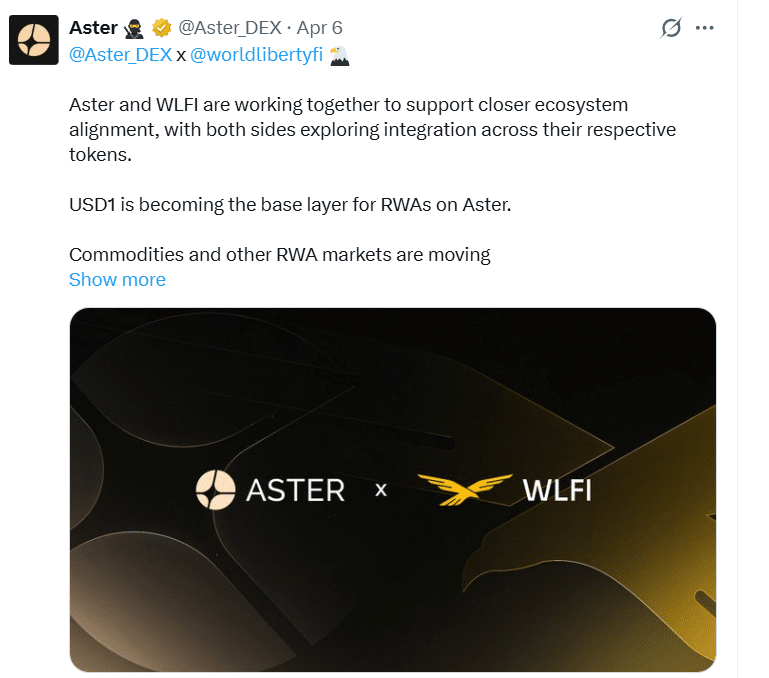
To respond, ASTER is introducing USD1 as the core settlement layer for its perpetual and real-world asset markets. This includes trading pairs such as $CLUSD1, $XAUUSD1, $XAGUSD1, and $BZUSD1, along with fees of 1bps for takers and minus 0.5bps for makers.
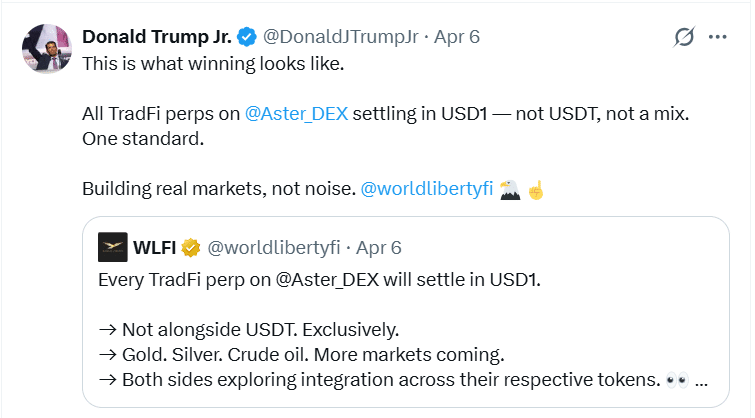
The announcement quickly drew attention across the market. Donald Trump Jr. called it a “major win,” and his reaction became one of the most discussed responses, reflecting how the ASTER vs Hyperliquid shift is being closely watched. This move signals an effort to build more structured markets rather than relying on mixed stablecoin systems.
What do key metrics reveal about the competition?
The gap between both platforms remains clear when comparing volume and price performance. Hyperliquid continues to lead with strong activity, while ASTER is working to improve its position through USD1 integration.
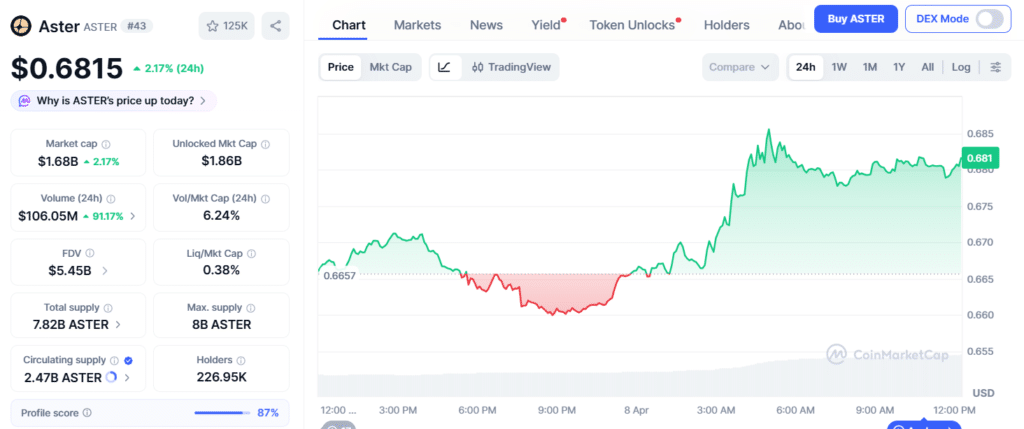
Currently, ASTER is trading around $0.6808, up 2.12% in the last 24 hours. WLFI is near $0.09824, up 0.11%, while USD1 is holding close to $0.9993, down 0.02%. These figures give real time context to the ongoing ASTER vs Hyperliquid competition.
How does USD1 compare with USDT in growth?
USD1 has grown 34.3% in market cap, compared to USDT’s 1.6% growth during a 20% broader market correction. This shows stronger expansion, especially as capital shifts toward more structured assets.
At the same time, the real-world asset sector has grown 35% this year. Within this trend, the ASTER vs Hyperliquid discussion is not only about trading volume but also about capturing growth across RWAs, AI, and NFT-related markets.
What does this mean for the broader DeFi landscape?
Layer 1 networks are adapting their strategies as decentralized finance (DeFi) continues to mature. Stablecoins are increasingly central to how capital flows across ecosystems while emerging sectors such as real‑world assets (RWAs), AI, and NFTs are helping to shape future demand for on‑chain infrastructure.

In this context the ASTER vs Hyperliquid dynamic highlights two distinct approaches. Hyperliquid is leveraging its strong existing liquidity and established user base whereas ASTER is building around USD1 to create a more unified and capital‑efficient architecture across its ecosystem.
Conclusion
The ASTER vs Hyperliquid comparison underscores a noticeable gap, with Hyperliquid continuing to lead in both trading volume and price performance. ASTER’s integration of USD1 signals a more structured strategy aimed at deepening liquidity and expanding into real‑world assets (RWAs).
Nonetheless the core uncertainty lies in whether this approach can generate sustained price gains. While USD1’s growth and widening use cases provide a supportive foundation the ASTER vs Hyperliquid trend suggests that narrowing the gap will depend heavily on adoption, execution and the prevailing market environment.
Disclaimer: This article is meant to present information, not to influence any financial decisions. Please evaluate the details carefully before acting on them.
Glossary
USD1 stablecoin: A digital dollar by WLFI used to trade and settle transactions
DeFi: Financial services built on blockchain without banks
RWA: Real assets like gold or oil brought onto blockchain
Perpetual markets: Trading contracts that don’t have an expiry date
Liquidity: How easily you can buy or sell an asset
Settlement asset: The currency used to complete a trade
Frequently Asked Questions About ASTER WLFI Partnership
What is ASTER vs Hyperliquid?
ASTER vs Hyperliquid is a competition between two platforms in the decentralized trading market.
Can ASTER compete with Hyperliquid?
ASTER can compete with Hyperliquid if USD1 adoption increases and trading volume grows.
Why is Hyperliquid leading right now?
Hyperliquid is leading because it has higher trading volume and stronger price growth.
How much trading volume does Hyperliquid have?
Hyperliquid recorded about $620 billion in perpetual trading volume in Q1.
How does USD1 help ASTER?
USD1 helps ASTER by improving liquidity and making trading more simple and efficient.