

This article was first published on Deythere.
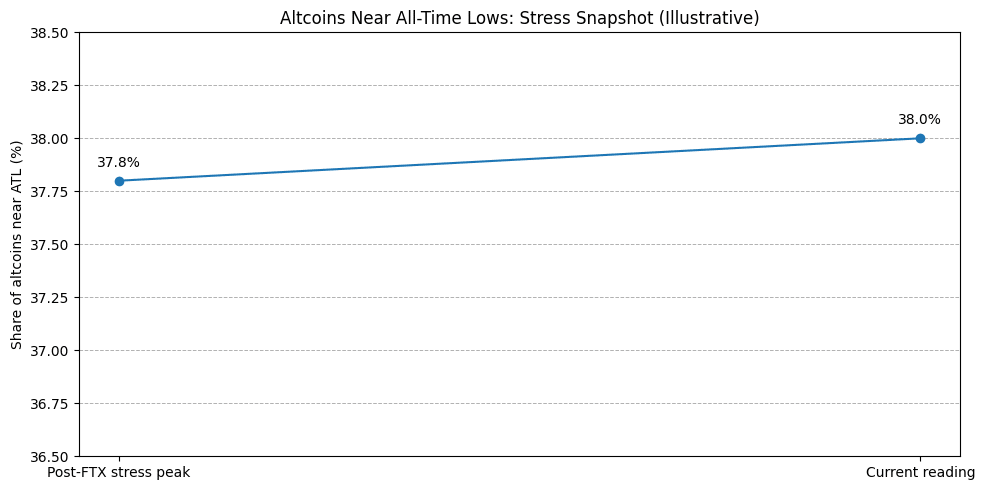
In the parts of crypto that usually run hot, the temperature is dropping fast. A fresh on-chain snapshot suggests that 38% of listed alternative tokens are now hovering close to their historical bottoms, a level that edges past the stress seen after the FTX collapse. For traders watching the market’s “risk barometer,” this is the kind of signal that does not shout, but it lingers, and it matters.
Market stress pushes altcoin all-time lows closer
The headline number is simple, but the message behind it is not. When a large share of the market sits near extreme lows, it tells a story about breadth, not just price. In this case, the breadth is thin, and it is getting thinner. The same dataset shows the current reading slightly above the post-FTX peak stress level, which was around 37.8%, making this one of the harshest stretches for smaller tokens in the current cycle. That is why the phrase “altcoin all-time lows” keeps showing up in trader conversations right now, because it captures both the scale and the mood.
Behind the scenes, this kind of market usually punishes indecision. Buyers hesitate because they expect more downside. Sellers press because liquidity feels unreliable. That push and pull can grind prices lower without a dramatic catalyst, the same way a slow leak can flatten a tire before anyone notices.
Liquidity is not gone, it is just choosing favorites
The pressure is not evenly distributed. Bitcoin tends to hold up better during risk-off phases because it is the most liquid asset in the category, and it is the easiest place for larger players to park capital without moving the price too much. Meanwhile, many alts trade like small-town real estate: when there are fewer buyers, price discovery can get ugly quickly.
On-chain commentary tied to the 38% figure points to fragile liquidity and a cautious environment for risk-taking, with capital often preferring other high-volatility arenas instead of spreading across smaller crypto assets. In plain English, money is still moving, but it is being picky, and that selectivity often shows up as more alt underperformance. This is how altcoin all-time lows can creep closer even when the broader crypto headline feels calm.
What capitulation looks like when it is quiet
Capitulation is often imagined as a single dramatic candle. In reality, it can look like weeks of stalled rallies, quick selloffs, and rebounds that feel tired before they even start. One useful way to read the current signal is that it measures stress across a wide set of tokens, not just a handful of large names that still attract attention.
When a meaningful slice of the market approaches its historical floor, it usually means newer narratives have failed to attract fresh demand, and older bags are being trimmed for cash. In that context, altcoin all-time lows are less about one project failing and more about the market refusing to pay up for long-tail risk.
This is also why the FTX comparison lands emotionally. After that event, many investors assumed the worst had been priced in across the board. Seeing a broader “near-low” reading now suggests the healing has not been uniform, and some corners may never fully recover without new demand cycles.

What could flip the script, and what probably will not
A meaningful reversal usually starts with liquidity, not with a viral post. If spreads tighten, volume improves, and dips stop being sold automatically, the market begins to behave differently. In practice, traders often watch for leaders within sectors to stabilize first, then for laggards to stop making fresh lows, then for breadth to improve.
There is also a psychological trigger: once enough sellers are exhausted, even small inflows can lift prices. That is the part that tempts bargain hunters, and it is why some will argue that altcoin all-time lows can be a setup for sharp rebounds. Still, the same on-chain framing emphasizes that the environment remains unfavorable for broad risk-taking, so the path of least resistance can remain downward until conditions change.
Conclusion
This market is sending a blunt message without using loud words. With roughly 38% of alt tokens sitting near historical bottoms, the gap between majors and the long tail is widening, and it reflects a cautious, liquidity-driven cycle rather than a quick sentiment wobble. For now, altcoin all-time lows are functioning like a stress test. The next phase depends on whether liquidity returns and breadth improves, or whether the market continues to reward only the safest, most liquid corners.
Frequently Asked Questions (FAQs)
What does the 38% reading actually measure?
It reflects the share of tracked altcoins trading near their historical low zone, offering a market-breadth view of stress rather than focusing on a single token.
Why does the post-FTX comparison matter?
Because the post-FTX period is widely remembered as peak fear, and the current reading slightly exceeds that prior stress level, suggesting broad weakness across smaller assets.
Does this guarantee a rebound?
No. Extreme readings can precede rallies, but they can also persist if liquidity stays weak and risk appetite remains selective. That is why altcoin all-time lows are better treated as a warning light than a buy signal.
Glossary of key terms
All-time low (ATL): The lowest price level an asset has recorded in its trading history.
Breadth: A measure of how widely strength or weakness is spread across a market, not just concentrated in a few large assets.
Liquidity: How easily an asset can be bought or sold without causing large price swings.
Capitulation: A period where sellers dominate and many participants exit positions, often after sustained losses.
Risk-on / risk-off: A market posture where investors either seek higher-risk assets (risk-on) or prefer safer, more liquid holdings (risk-off).
Sources
Disclaimer: This article is for informational purposes only and does not constitute financial, investment, or trading advice. Crypto assets are volatile, and readers should conduct independent research and consider professional guidance before making any financial decisions.