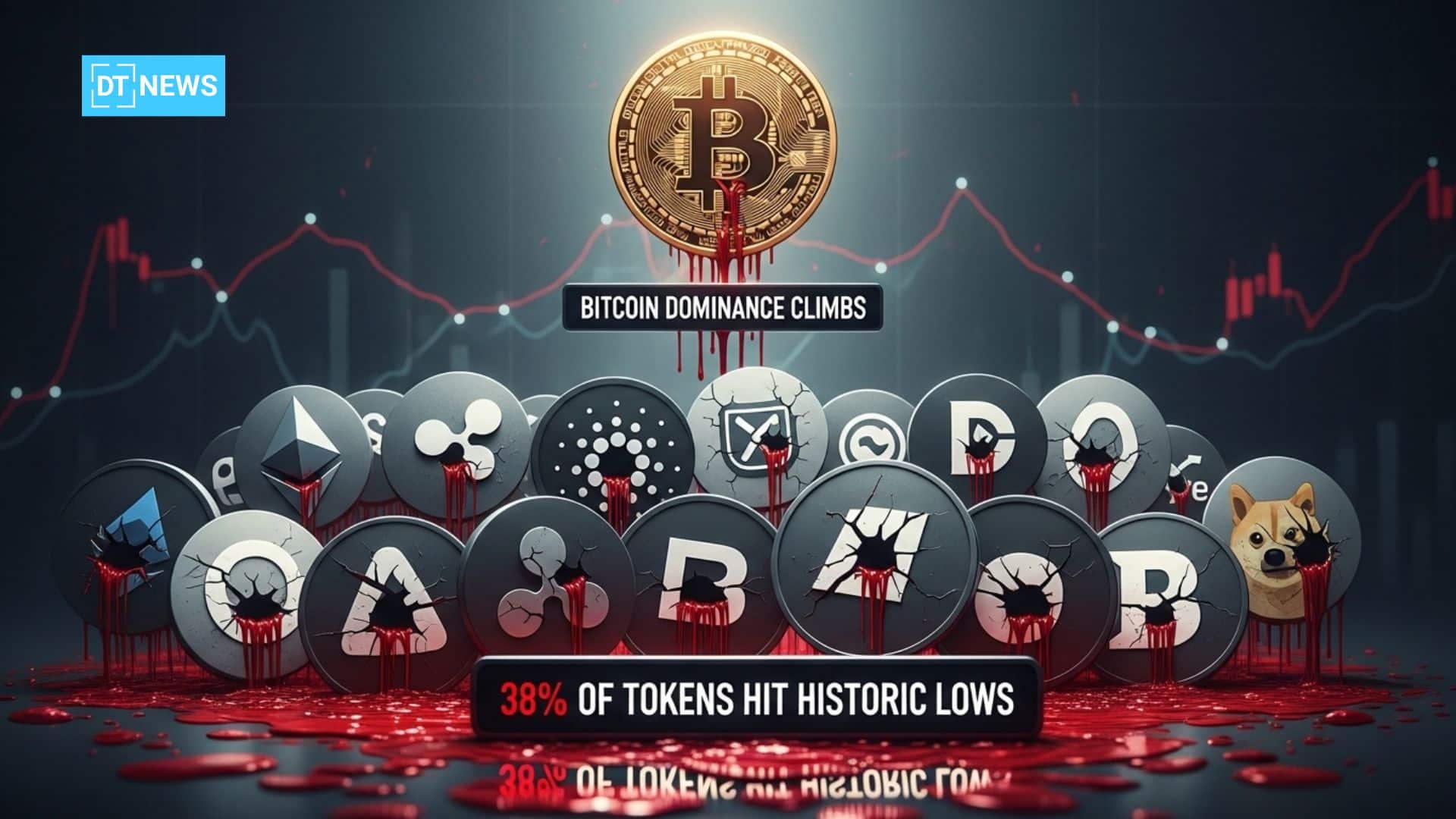

Altcoins currently sit near all-time lows across a sizable segment of the market. According to data from CryptoQuant, roughly 38% of all altcoins are now trading at levels close to their historical bottoms, even deeper in the red than the post-FTX collapse era of 2022.
- Altcoins at All-Time Lows, Market Weakness Worsening
- Bitcoin Dominance Increases as Capital Swings to Safety
- Liquidity Conditions and Weak Investor Appetite Weigh on Altcoin Market
- Social Sentiment Hits Rock Bottom Across Altcoin Communities
- Conclusion
- Glossary
- Frequently Asked Questions About Altcoin Market Decline
The situation has created a gap between Bitcoin and the rest of the market. While altcoins are approaching their all-time low; Bitcoin has continued to receive relatively stronger demand from investors.
Capital has rotated toward the biggest cryptocurrency in growing numbers; boosting its market dominance and leaving the Altcoin market gasping for liquidity.
Altcoins at All-Time Lows, Market Weakness Worsening
The latest numbers from CryptoQuant show just how deep the downtrend has become. According to the firm’s data set, 38% of altcoins are now within striking distance of their all-time lows, representing the deepest retracement seen in this cycle.
CryptoQuant writer Darkfost stressed how significant the fall was, saying that its position is already worse than during the 37.8% level seen post-FTX collapse, one of crypto’s most damaging moments in history.
According to the analytics firm, it’s a metric that shows how much pressure altcoins are still under. In fact, this is the largest regression of altcoins seen in this cycle.
The total market capitalization of altcoins has fallen sharply from the lofty heights seen in the last bull run. The altcoin market has since fallen to about $700 billion, according to market data. At its peak, the altcoin market came close to $1.2 trillion.
Such a drop is a sign of how massive the sell-off has become. Most tokens that rallied during previous bull runs are now traded near old support levels.
Bitcoin Dominance Increases as Capital Swings to Safety
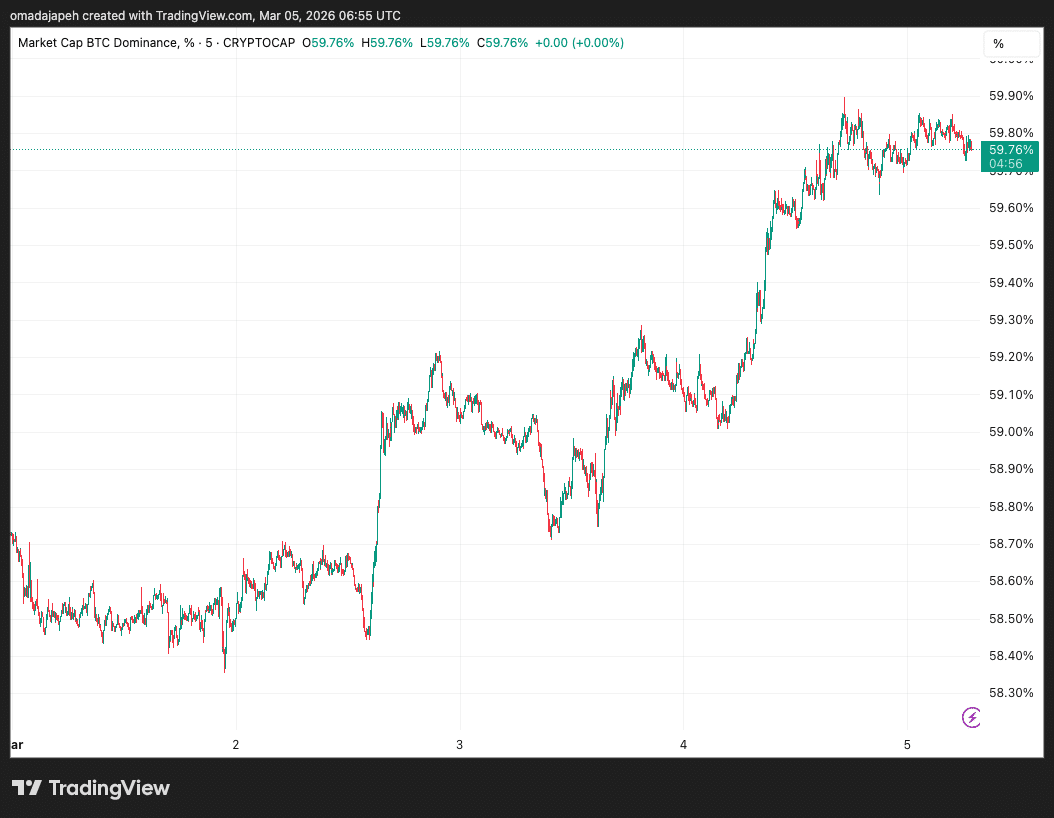
As most altcoins sit near their all-time lows, capital has become increasingly concentrated around Bitcoin. This has propelled Bitcoin dominance (BTC.D) in the past few days.
In the last 72 hours alone; Bitcoin dominance has gained about 1.75%, increasing the gap between Bitcoin and altcoins. This means; market players are reallocating liquidity toward assets that traders believe are better able to weather volatile conditions.
Recent reports also cover that the Fed is set to inject $16 billion in liquidity this week.
There are multiple reasons for this change. Changing global macro policy dynamics and geopolitical tensions have injected new uncertainty into financial markets which has prompted investors to reassess their risk exposure. In those environments, capital tends to flow toward assets that have better liquidity and stronger market history.
That perception continues to favor Bitcoin. Institutional participation, exchange-traded products, and long-standing market recognition have kept its role as the primary entry point for crypto capital.
Consequently, as altcoins hover around all-time low levels, Bitcoin has remained stable by comparison compared to smaller digital assets.
Liquidity Conditions and Weak Investor Appetite Weigh on Altcoin Market
A second reason for the current Altcoin market decline is fragile liquidity in wider crypto markets.
Analysts say liquidity is still weak and risk appetite low, which often impact smaller tokens first.
Some capital has also rotated completely out of digital assets. Market analysts say money has flown into traditional markets such as equities and commodities where volatility rates and trading opportunities have drawn short-term investors.
The altcoin market is less liquid leading to amplified price moves. In thin trading volumes, even small selling pressure can send tokens tumbling. This has played out repeatedly in recent months as retail participation dried up and institutional flows clustered around larger assets.
Many smaller tokens are highly dependent on speculative capital, as well as active trading volume that has been reducing during this market cycle.
Social Sentiment Hits Rock Bottom Across Altcoin Communities
According to blockchain analytics platform, Santiment, the social volume of altcoins has fallen to very low levels in terms of discussion and engagement within the sector.
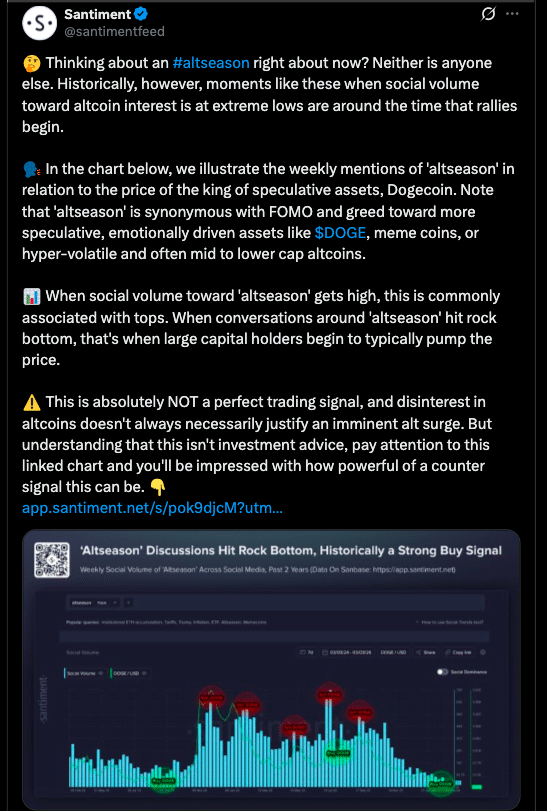
Falling social interest has always been present near market bottoms. When the public’s interest has clearly faded and levels of discussion have dropped, that can be a sign to traders that most participants have stepped away from the market.
Meanwhile Bitcoin has continued to dominate market discussions. Institutional flows, macro news and regulation developments.
Conclusion
There is a massive gap between BTC and the rest of the market in this cycle compared to previous ones. According to data from the CryptoQuant platform, 38% of all altcoins are now trading at near all-time lows, more than the severe retracement that was recorded after FTX’s collapse.
Meanwhile, Bitcoin dominance has risen as the flow of capital becomes even more concentrated around it. Liquidity conditions remain fragile, trading volumes across altcoin markets have dried up and social sentiment around smaller tokens has dropped significantly.
For the time being, data shows a market in a state of still adjusting to changing liquidity and investor positioning.
Glossary
Altcoins: Cryptocurrencies other than Bitcoin and Ethereum.
All-Time Low (ATL): The lowest price at which a cryptocurrency is sold for since it began trading.
Bitcoin Dominance (BTC.D): A measurement of Bitcoin’s portion of the entire cryptocurrency market capitalization.
Market Liquidity: The ability to buy or sell an asset without causing an impact on its price.
Social Volume: A metric that measures the frequency with which a cryptocurrency is mentioned in social media.
Frequently Asked Questions About Altcoin Market Decline
Why are altcoins near all-time lows in 2026?
There are several reasons for this; including reduced liquidity, caution among investors and capital rotating to Bitcoin rather than smaller tokens.
What does Bitcoin dominance mean for the market?
A rising Bitcoin dominance typically signals that investors are consolidating capital in Bitcoin; and not allocating to altcoins.
Is the current altcoin crash more brutal than post-FTX downfall?
Yes. According to data from CryptoQuant; 38% of altcoins are close to all-time-bearing lows which is slightly higher than the figure of 37.8% observed in the wake of the FTX collapse
How big is the altcoin market today?
Analysts say the altcoin market cap has fallen from a previous high of around $1.2 trillion to about $700 billion now.