
This article was first published on Deythere.
- Algorand Recognized by Google as a Live Post-Quantum Deployment
- Advantage through Falcon Signatures, State Proofs and Key Rotation
- The Growing Risk of Quantum Threats to Bitcoin and Ethereum
- Exposure of Ethereum Across Wallets, Staking & Layer 2 Systems
- Conclusion
- Glossary
- Frequently Asked Questions About Algorand Price Surge
- What caused Algorand price surge to 50%?
- Are quantum attacks fully protected against in Algorand?
- What makes Bitcoin and Ethereum the ones at risk?
- What scope of Bitcoin is potentially at risk?
- Why is Ethereum more exposed than Bitcoin?
- References
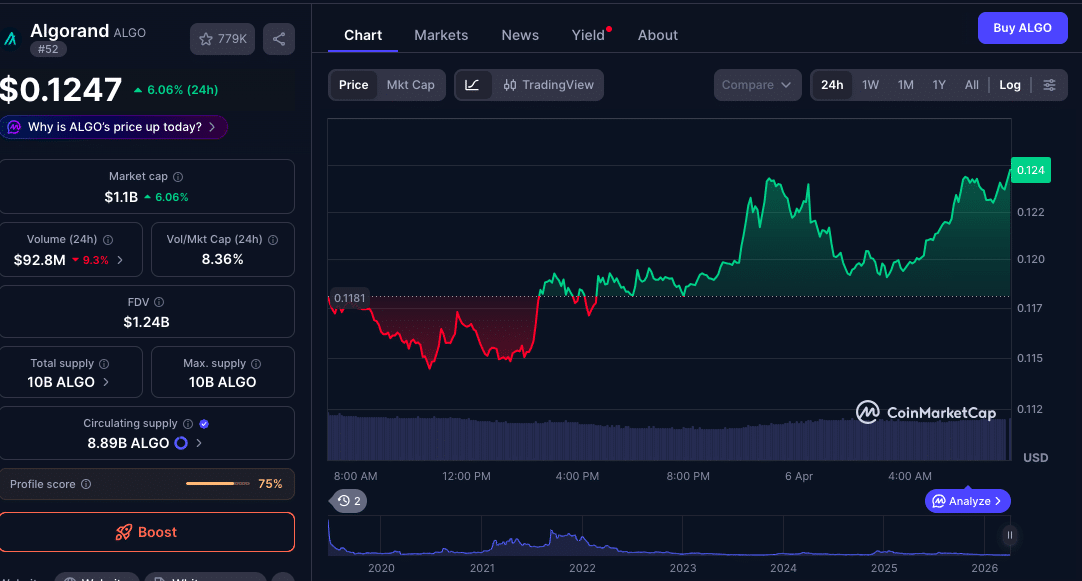
The recent Algorand price surge has placed the network in the midst of crypto’s growing quantum security discussion. From $0.08 to $0.12, ALGO rose by nearly 50% just in one week, being one of the best performers this early April.
This Algorand price surge happened shortly after a Google Quantum AI paper showcased Algorand as a real life example of post quantum cryptography going live on the blockchain. The response was swift as the surge came just days after ALGO hit an all-time low of $0.08, indicating a sudden change in sentiment.
The Google paper was taken by traders as an act that legitimizes technology already present on Algorand and thus triggered a repricing far beyond anything speculation can create.
Algorand Recognized by Google as a Live Post-Quantum Deployment
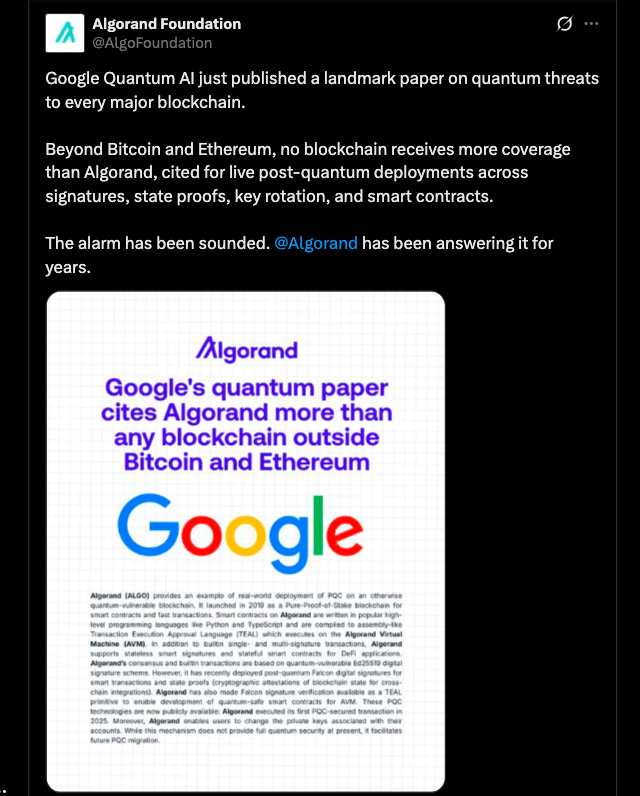
The rise in Algorand prices was directly related to the level at which Google’s research had placed its networks. That paper, which was released on March 31, explicitly pointed to Algorand as a real-world deployment of post-quantum cryptography in an otherwise quantum-vulnerable blockchain.
Google did not claim that Algorand had completely solved the problem of quantum risk, but it emphasized that compared to other efforts around quantum-resistant networks, this network had already moved into implementation. Algorand was mentioned 32 times throughout the study, more than most other blockchains, stressing its visibility.
The paper also insisted that Algorand’s base layer still depends on Ed25519 signatures so it is not yet completely immune to quantum threats. But deployed post-quantum components set it apart from some bigger networks that are still pondering migration paths.
Advantage through Falcon Signatures, State Proofs and Key Rotation
The Algorand price surge is supported by an infrastructure already in use on the network. Algorand features Falcon post-quantum digital signatures for smart transactions and state proofs, which are cryptographic mechanisms that validate blockchain state across systems.
In 2025, the network successfully completed its first post-quantum-secured transaction, a milestone that other bigger chains have yet to achieve.
Moreover, Algorand introduces native key rotation, which allows users to change the private keys tied to their accounts. This does not remove quantum risk but presents an actionable migration path to keep up with the advancement of threats.
Falcon verification is also offered natively in the Algorand Virtual Machine, making quantum-resistant tools available to developers at the application level. It was this integration of live deployment, developer tooling, and infrastructure readiness that pushed Algorand to the center of the larger market conversation, as evident in the price surge.
The Growing Risk of Quantum Threats to Bitcoin and Ethereum
While the Algorand price surge showed growing confidence behind its position, that same research has put Bitcoin and Ethereum under a scrutiny. Google’s findings indicate that it would take fewer than 500,000 physical qubits to break the elliptic-curve cryptography that secures those networks; a sharp drop from previous estimates in the millions.
As for Bitcoin itself, its struggle goes beyond cryptography but leans more towards the design. In total, around 6.7 million BTC exist in older Pay-to-Public-Key addresses where the public key is always visible on-chain, allowing increased exposure in a quantum scenario.
Ethereum’s exposure is more widespread because of its account model. The public key is visible even before signing a transaction, making accounts susceptible to being attacked once the first transaction has happened. The risk goes beyond the top wallets and critical smart contracts with exposed administrator keys to include infrastructure; proof-of-stake validators, Layer 2 networks and data availability systems.
The complexity of these ecosystems makes migration to post-quantum cryptography a very big technical challenge especially in networks that put strong emphasis on backward compatibility.
Exposure of Ethereum Across Wallets, Staking & Layer 2 Systems
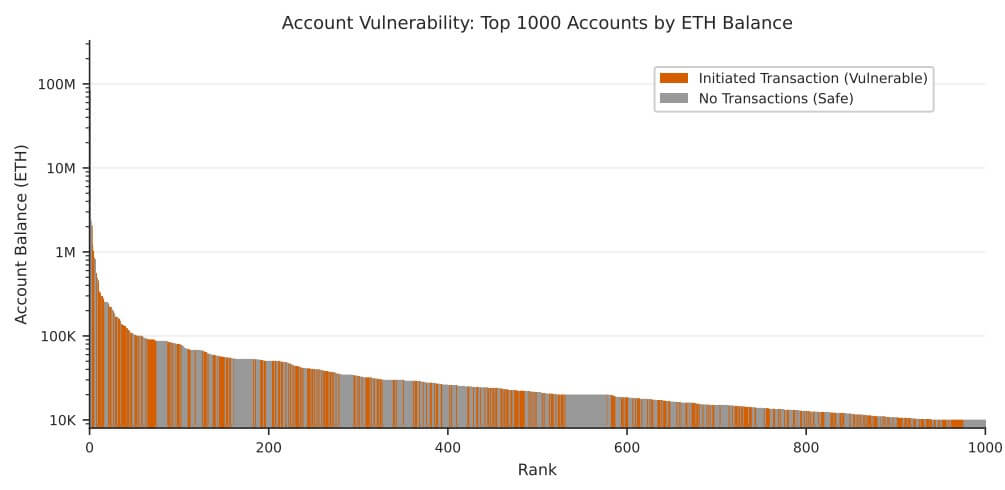
When an Ethereum user performs a transaction, their public key is on-chain permanently and visible and can be attacked with quantum computing.
According to the Google paper, the top 1,000 Ethereum wallets now control approximately 20.5 million ETH; all of those funds would be at risk in advanced quantum scenario. It also flags at least 70 large smart contracts with admin keys exposed on-chain that control functions such as stablecoin issuance and protocol governance.
The risk goes further into Ethereum’s infrastructure. Around 37 million ETH is currently staked and much of the transaction activity on the network runs through Layer 2 rollups and bridges. These systems inherit the cryptographic assumptions made at the base layer meaning that they would need to make any transition to post-quantum security work throughout a layered and interconnected system.
Conclusion
The current Algorand price surge shows a market reacting to early implementation and not from complete problem solving. Already, progress with Falcon signatures, state proofs and key rotation have been demonstrated on the network. These advances have put it ahead of many rivals in a conversation that is moving quickly toward urgency.
However, the network still continues to depend on cryptographic building blocks that remain susceptible to attacks, so its superiority is only partial and not absolute.
The reaction to Google’s research suggests that investors are starting to price in long-term security considerations along with the usual metrics. If quantum computing comes faster than anticipated, networks with existing infrastructure would have a stronger advantage.
Glossary
Quantum Resistance Cryptography: Cryptographic techniques developed to be secure against quantum computers attacks.
Falcon Signatures: A post-quantum digital signature scheme giving Algorand security boosts.
State Proofs: Crypto proof that crosschecks the data on blockchain.
Elliptic-Curve Cryptography: A popular kind of cryptographic system that is at risk to quantum attacks.
Layer 2: Secondary frameworks on blockchains that provide higher levels of scalability and efficiency.
Frequently Asked Questions About Algorand Price Surge
What caused Algorand price surge to 50%?
The surge came after a Google Quantum AI paper, which described Algorand as one of the few examples of post-quantum cryptography being utilized in the real world, causing heavy market reaction.
Are quantum attacks fully protected against in Algorand?
No. Although it has implemented post-quantum tools like Falcon signatures, its base layer is still not protected with quantum-safe cryptography which may be a risk in the future advanced quantum scenarios.
What makes Bitcoin and Ethereum the ones at risk?
Both are susceptible to elliptic-curve cryptography, which could be disrupted by powerful quantum computers, and could expose wallets and network infrastructure.
What scope of Bitcoin is potentially at risk?
Roughly 6.7 million BTC resides in older addresses with public keys that are not hidden, and thus more susceptible to being entered into riskier payment processes.
Why is Ethereum more exposed than Bitcoin?
Ethereum reveals public keys after transactions, and has more risks associated with staking, smart contracts and Layer 2 systems.