

























This article was first published on Deythere.
- What 3 Million Bitcoin Really Means
- How it Compares With the World’s Largest Bitcoin Holdings
- Even Bitcoin’s Remaining Supply Falls Short
- Why This Comparison Matters Now
- Fiat Flexibility vs Bitcoin Scarcity
- Conclusion
- Glossary
- Frequently Asked Questions About Iran War Bill Request
- Is the US funding the Iran war with Bitcoin?
- How big is $200 billion worth of Bitcoin?
- What does this compare to US Bitcoin possession?
- Why use war spending as a comparison to Bitcoin?
- What is the difference between Bitcoin and fiat?
- References
The Pentagon has reportedly made a request to the White House for more than $200 billion in additional funding for the war, which is already facing pushback from Congress. At current market rates of approximately $68,600 per Bitcoin, that figure is roughly 2,915,451 BTC.
As a result, by that standard, the number on this latest Iran war bill request is huge.
What 3 Million Bitcoin Really Means
Backing up the request, President Donald Trump said earlier that:
“This is a very volatile world. We want to have vast amounts of ammunition, which we have right now – we have a lot of ammunition, but it was taken down by giving so much to Ukraine.”
Supporting the claim, Republican House Speaker Mike Johnson said on Thursday that he was sure the $200 billion request for the Iran war was “not a random number”.
“Obviously it’s a dangerous time in the world, and we have to adequately fund defence, and we have a commitment to do that,” he said.
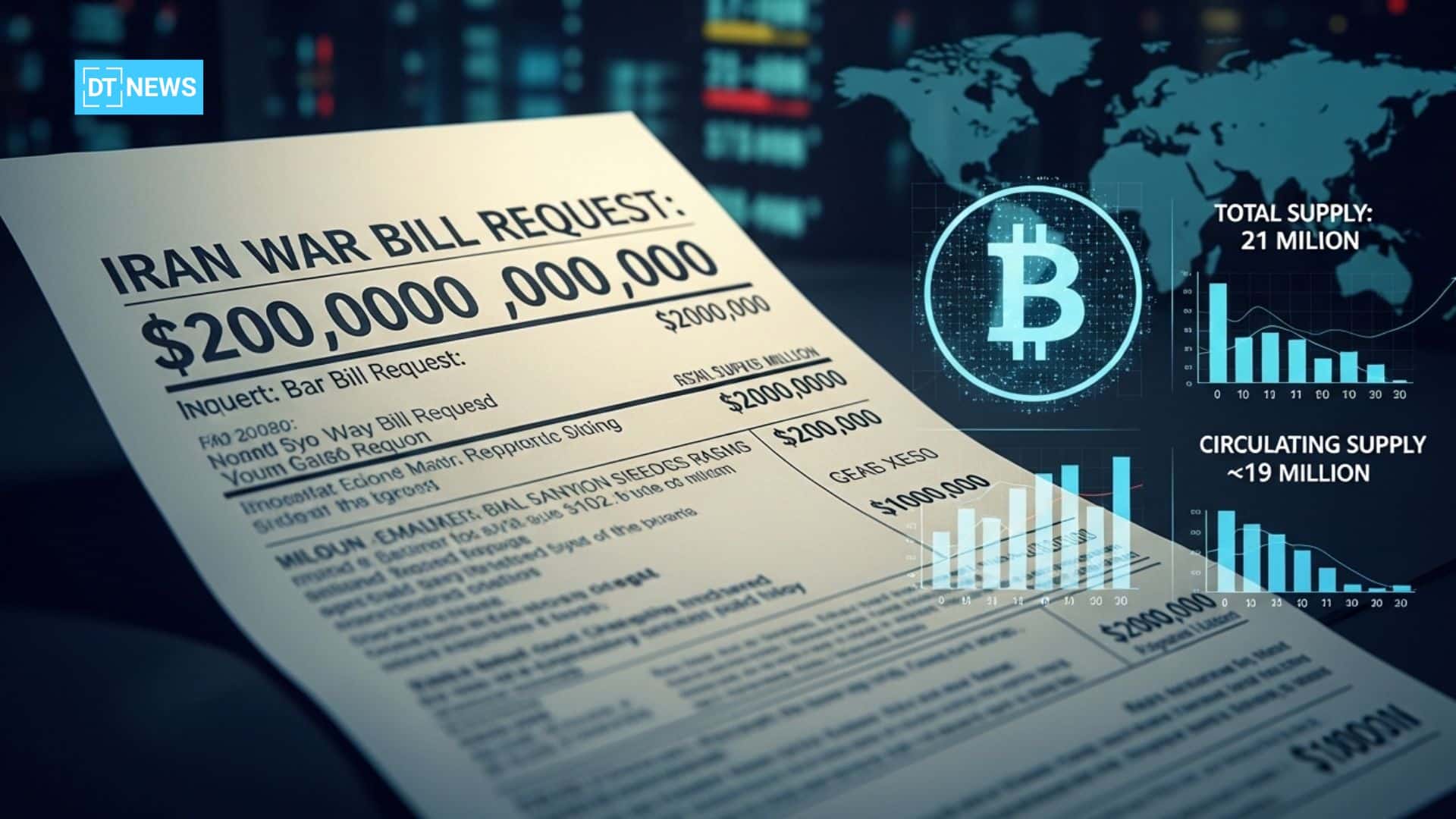
At $200 billion, the Pentagon’s request is roughly equivalent to 2.92 million BTC at current prices. That number is even more notable in context. Bitcoin operates on a capped supply of 21 million coins in total, making the war request a non-trivial portion of the eventual supply.
This supply cannot be expanded, unlike fiat currency. There’s no central authority able to mint millions more BTC if demand increases, and that is why such comparisons land so well among market participants.
How it Compares With the World’s Largest Bitcoin Holdings
A simple way to visualize the scale is by comparing it with current Bitcoin possessed by governments, institutions and large players.
This Iran war bill request in BTC terms is around 8.6 times what the US government itself currently holds in Bitcoin which is about 328,372 BTC. When looking at holders by corporations and institutions, the gap is just as wide.
MicroStrategy, which has 761,068 BTC on its balance sheet, when compared, this request would be approximately 3.7x bigger than that. BlackRock’s iShares Bitcoin Trust has roughly 785,629 BTC in it, so the Iran war bill request is about 3.6 times that size.
Satoshi Nakamoto is estimated to control approximately 1.096 million BTC, still well below the implied Bitcoin equivalent of the Iran war bill request for funding, which is roughly 2.6 times higher.
Even when considering aggregated holdings, the difference is stark. The 10 US spot Bitcoin ETFs cumulatively own around 1.525 million BTC, so the application would be 1.86 times that total.
Total Public Bitcoin treasury companies now hold approximately 1,176,615 BTC making the request approximately equal to 2.4 times larger than entire group.
Binance, for its part, continues to hold more than 639,000 BTC in reserves supporting user balances, meaning the war request was around 4.4-times larger by comparison.
Even Bitcoin’s Remaining Supply Falls Short
The contrast becomes even more glaring when drawn drawn against what is left of Bitcoin’s issuance.
According to blockchain data, 20,003,043 BTC have already been mined, which only leaves only 996,957 Bitcoins left before the network caps off its hard cap of 21 million.
The $200 billion Iran war bill request is worth about 2.83 times all the Bitcoin left to be mined at present prices.
This is an important differentiation because although fiat systems can expand supply via debt and issuance, Bitcoin cannot.
Why This Comparison Matters Now
The conflict with Iran has already proven expensive. Initial estimates indicate that the US spent at least $11.3 billion in just six days of war, and it is likely to accelerate in terms of the amount of capital high-intensity war consumes.
Overall projections indicate daily costs approaching $1 billion a day, pushing expectations that the total bill may continue to rise sharply.
At the same time, geopolitical escalation has driven up oil prices and added volatility in markets, injecting itself into a macro environment in which capital flows are increasingly risk-sensitive.
Mapping some of the costs of war into terms more familiar to investors gives a more grounded way to understand the scale, especially as Bitcoin has made its case as a reference asset in global finance.

Fiat Flexibility vs Bitcoin Scarcity
The US government is able to demand $200 billion because it exists inside a debt issuance-based fiat system. Total federal debt is already above $39 trillion, so large spending programs are paid for with borrowing and bond markets.
Bitcoin operates differently. Its supply is capped, issuance is time-predictable, and coins may only be created over time through mining. There is no ability to increase supply in response to demand.
It is this contrast that has made so many who trade in markets use Bitcoin as their yard-stick for gauging the magnitude of government spending.
Brian Armstrong summed up this perspective by explaining that Bitcoin is a check and balance on inflation. When spending goes too far out of control, capital flees to Bitcoin. That view has begun to inform policy thinking.
Conclusion
This Bitcoin war comparison is not about replacing dollar with crypto but about clarity. A $200 billion Iran war bill request is just another number in Washington. But expressed in terms of nearly 3 million Bitcoin, it is easier to grasp conceptually in terms of scarcity, ownership and global value.
It illustrates that the demand is greater than what governments, ETFs, exchanges, corporate treasuries and even the forecasted future supply still to be mined, holds.
In a financial system in which fiat supply can be expanded but Bitcoin cannot, this would be too hard to ignore.
Glossary
Bitcoin (BTC): The first and most well-known cryptocurrency, with a total supply limited to 21 million coins.
Spot Bitcoin ETF: A fund that owns actual Bitcoin and matches its price.
Fiat Currency: Paper currency that a government issues, not backed by a physical commodity.
Proof of Reserves: A method to verify that exchanges have enough assets to cover user balances.
Mining: The process of validating transactions and generating new Bitcoin.
Frequently Asked Questions About Iran War Bill Request
Is the US funding the Iran war with Bitcoin?
No. The comparison is for purposes of scale, not actual payment.
How big is $200 billion worth of Bitcoin?
At approximately $68,600 per BTC; that is about 2.9 million BTC.
What does this compare to US Bitcoin possession?
At 328,372 BTC reserves, the request is around 8.6 times more.
Why use war spending as a comparison to Bitcoin?
The fixed supply of Bitcoin can make it helpful for framing the scale behind large financial figures.
What is the difference between Bitcoin and fiat?
Fiat currency can be increased by debt and monetary policy, whereas Bitcoin has a limited supply.